
Amazon and QuEra set 2028 target for error-corrected quantum computing
The companies say a neutral-atom system called Libra could reach customers in two years, while other teams report gains in trapped ions and classical simulation.
By Hana Yoshida · Markets Reporter
3 min read
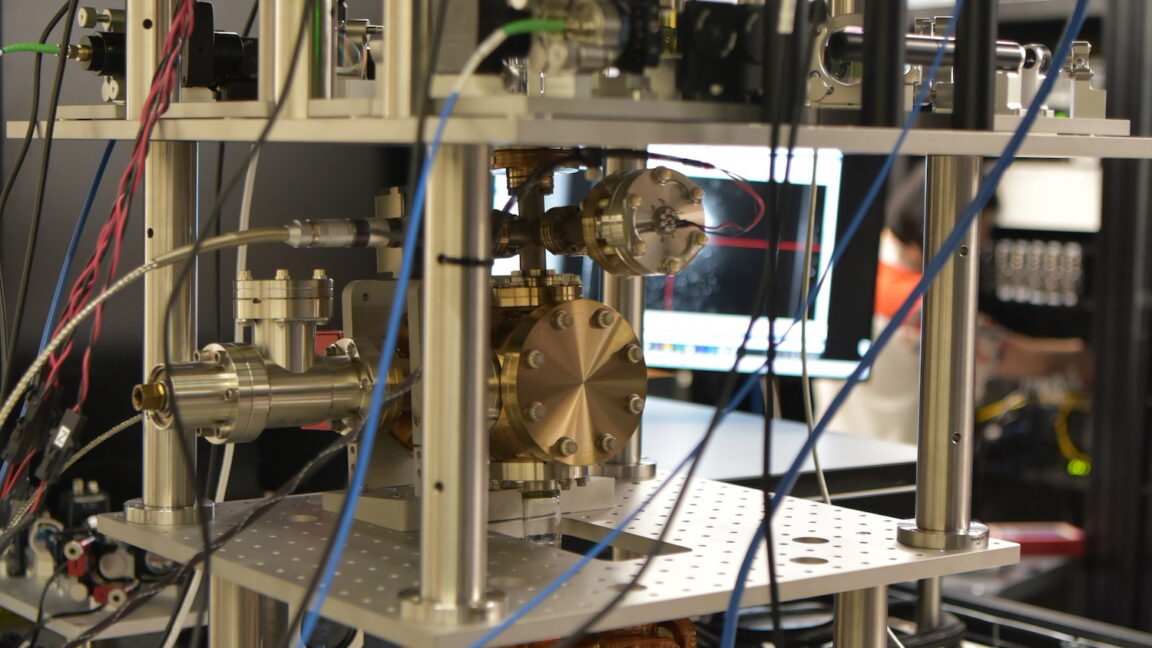
Amazon and QuEra say they plan to give customers access to useful error-corrected quantum computing by 2028, a timeline that would beat many expectations in the field. The claim matters because most valuable quantum algorithms are expected to need error correction, which current noisy machines generally lack.
According to Amazon, the planned system, called Libra, is intended to run one million quantum operations across hundreds of logical qubits. Amazon said the machine would support early scientific work in quantum chemistry, high-energy physics and materials simulation beyond what classical computers and today’s noisy intermediate-scale quantum computers can handle.
Ars Technica reported that many researchers still put broadly useful quantum machines roughly five to 10 years away. The main barrier is that logical qubits, which use groups of physical qubits to store information redundantly and detect errors, require large numbers of reliable underlying qubits.
For some chemistry models, Ars Technica reported, roughly 100 logical qubits may be enough. More demanding algorithms, including those relevant to breaking encryption, may require tens of thousands. That implies at least thousands of high-quality physical qubits for a useful error-corrected system.
QuEra, a Boston-area startup, is building the hardware behind Libra. Ars Technica reported that the company works on neutral-atom quantum computing and has ties to Harvard University and the Massachusetts Institute of Technology through shared staff and a long-term intellectual property arrangement.
Neutral-atom systems use lasers to cool and hold individual atoms in arrays, with quantum information stored in nuclear spin. Ars Technica reported that the approach can scale to large numbers of qubits, and QuEra’s academic partners have demonstrated a 3,000-qubit grid.
The same report noted that neutral-atom systems still face technical limits. Operations can heat the atoms, and moving atoms around can be slow, leading to losses. QuEra has shown error-correction work, but the company is expected to give more detail on its Libra roadmap next week.
Quantinuum details Helios system
A separate development came from Quantinuum, which published a technical description of its Helios trapped-ion processor in Nature. Ars Technica reported that Helios uses a storage ring connected to two operating sections, with ions moving in and out as computations proceed.
According to the Nature paper, Helios can cool ions while sorting and running other operations. The paper said that parallel process allows cooling and gate cycles to continue with little interruption as new batches of qubits are prepared.
Quantinuum also described a software layer that lets users work with “virtual qubits,” while a real-time control system assigns physical qubits. Ars Technica reported that this design could help the machine handle the mechanics of logical qubits and error correction.
The Helios paper reported a single-qubit gate error rate of 0.00003 and a two-qubit gate error rate of 0.0008. With 98 qubits, Ars Technica reported, simulating eight rounds of the machine’s operations would take the largest supercomputer about 10,000,000 years.
Classical algorithms narrow one quantum claim
The debate over quantum advantage also shifted. In May, researchers at Q-CTRL posted a manuscript saying an IBM quantum processor simulated a Fermi-Hubbard model 3,000 times faster than an optimized algorithm running on a 32-CPU cluster.
Researchers at Multiverse Computing and academic collaborators then improved the classical approach, according to Ars Technica. By accounting for more symmetries, using simulation output to choose a simplified calculation when appropriate, and optimizing the work for BPUs, they reduced the claimed speedup to a factor of 36.
The Multiverse team also ran the simulation one time step beyond the quantum system’s result, Ars Technica reported. IBM’s quantum advantage tracker was created for that kind of back-and-forth, as claims of advantage are tested against improved classical methods.
Together, the announcements show the field moving on two fronts: companies are pushing hardware toward error correction, while classical computing specialists continue to narrow some claimed quantum leads.
This story draws on original reporting from Ars Technica.