
AI agents run robot training cycles in Nvidia-led lab tests
Nvidia, CMU and UC Berkeley researchers say ENPIRE let coding agents improve robot manipulation policies with limited human direction.
By James Whitfield · Staff Writer
3 min read
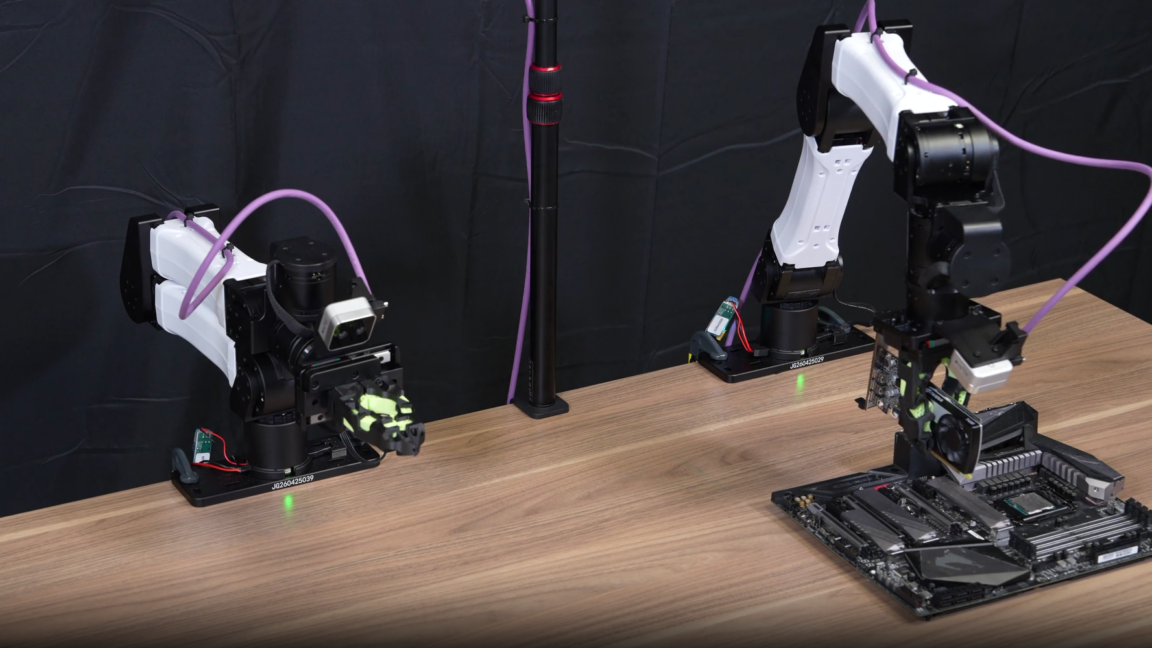
AI coding agents directed physical robot training in lab tests, choosing experiments and revising code until robots performed manipulation tasks with high success rates. The work matters because it points to a way robotics labs could automate part of the slow trial-and-error process behind teaching machines to handle objects.
Researchers at Nvidia’s GEAR lab, Carnegie Mellon University and the University of California, Berkeley described the system in a research paper uploaded June 16, 2026. They call the framework ENPIRE, a software harness that gives AI coding agents access to tools, memory, constraints, feedback and task context.
Jim Fan, Nvidia’s director of AI, said in a LinkedIn post that part of the company’s GEAR lab now improves itself overnight, with researchers reading reports in the morning. Fan also said the team plans to release the work openly so others can run similar robot-training setups.
How ENPIRE ran the lab
According to the researchers, ENPIRE is built around four modules. The system can reset and check tasks, improve policies that control robot behavior, test those policies on several robots at once, and respond to failures by reviewing logs, reading research papers and changing training code or infrastructure.
The team tested ENPIRE with three coding-agent setups: OpenAI’s Codex using GPT-5.5, Anthropic’s Claude Code using Opus 4.7, and Moonshot AI’s Kimi Code using Kimi K2.6. The researchers said groups of agents tried different training methods, ran physical experiments and kept code changes that improved task success across repeated cycles.
The tasks included a standard Push-T benchmark, in which a robot moves a T-shaped block into a target pose on a table. The researchers also tested pin sorting, zip-tie tying and cutting, and inserting a GPU into a motherboard socket before removing it to prepare for another attempt.
With ENPIRE, the coding agents reached a 99% success rate across several manipulation tasks, according to the research paper. In the pin insertion and organization task, the paper said the agent-directed system reached nearly perfect performance faster than a human-in-the-loop method developed by many of the same researchers.
More agents helped, with trade-offs
The paper said larger teams of coding agents improved more quickly than smaller groups in some tests. On the Push-T task, an eight-agent team reached 99% success after two hours of research time, while a four-agent team took three hours and a single agent took nearly five hours.
The researchers also reported clear limits. Robots often remained unused while agents read logs, wrote code, debugged or waited for the underlying language model. Bigger agent teams spent more time summarizing one another’s proposals, and the agents did not always use available computing resources well when starting parallel training jobs.
The gains also required more token use, according to the paper. That cost issue comes as AI service providers, including Anthropic, have been considering pricing models tied more closely to token consumption.
The ENPIRE work fits into Nvidia’s broader push into robotics. Nvidia announced a partnership with China’s Unitree on May 31 to provide a reference humanoid robot for research labs, and Nvidia CEO Jensen Huang met Hyundai Motor Executive Chair Chung Euisun in South Korea in early June to discuss scaling manufacturing of AI-powered robots, according to Nvidia and Bloomberg. Hyundai Motor Group owns Boston Dynamics, whose robots include Spot and the Atlas humanoid platform.
This story draws on original reporting from Ars Technica.