
Webb observations point to active atmosphere on lava planet 55 Cancri e
Astronomers say JWST data suggest 55 Cancri e has a hydrogen-rich atmosphere fed by gases from its molten interior.
By Priya Raghavan · Science Reporter
3 min read
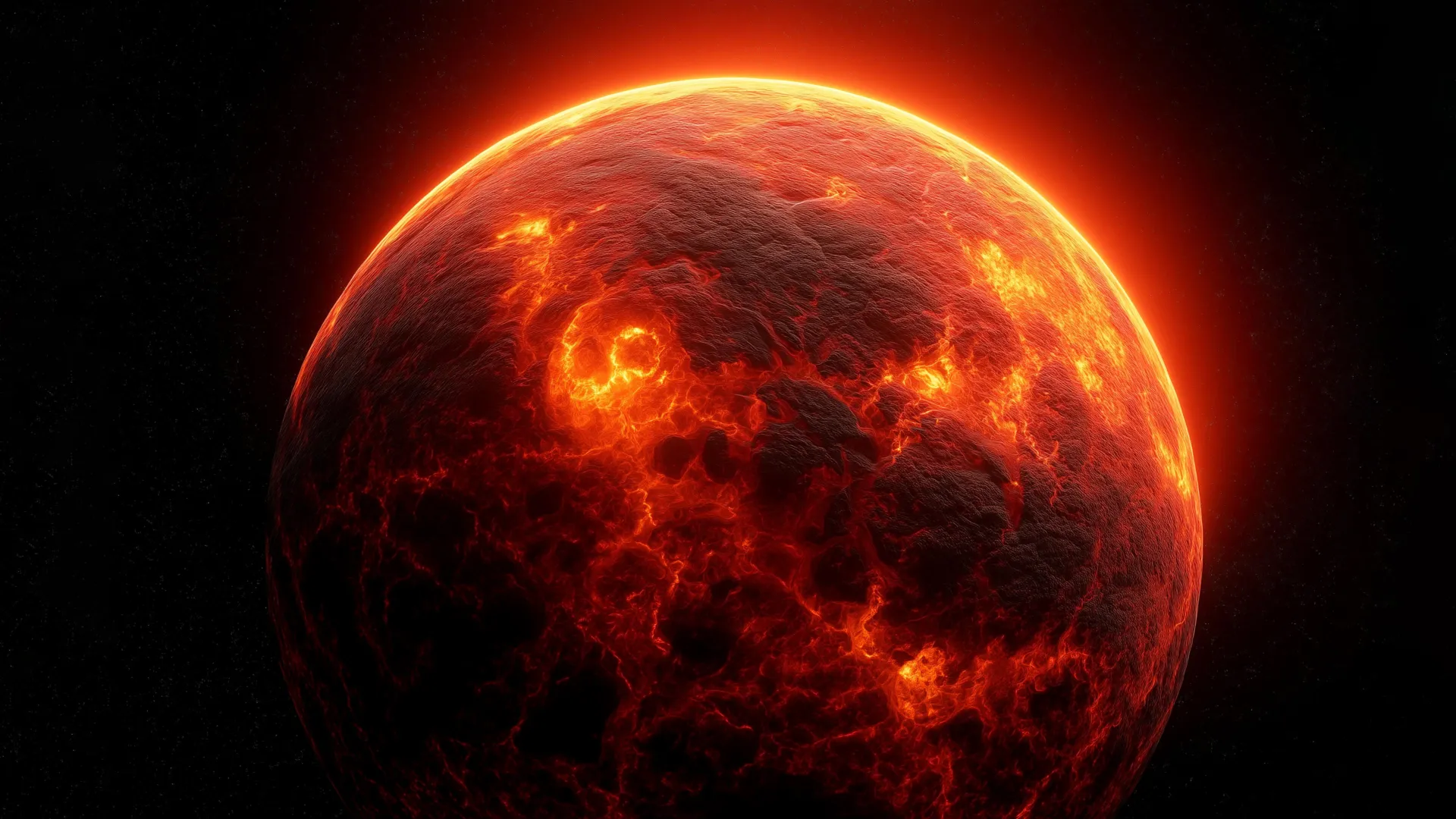
NASA’s James Webb Space Telescope has found evidence that the rocky exoplanet 55 Cancri e may have a changeable, hydrogen-rich atmosphere. The finding gives astronomers a rare way to study the chemistry inside a molten world beyond the solar system, according to Universe Today.
The planet, also known as 55 Cnc e, is about 41 light-years from Earth and orbits a Sun-like star. Universe Today reported that it is about 1.88 times Earth’s radius and roughly eight times Earth’s mass, placing it in the category often called a super-Earth.
Its orbit is extreme. According to Universe Today, 55 Cancri e circles its star in about 0.7 Earth days, while Mercury takes 88 days to orbit the Sun. Scientists think the planet is so close to its star that parts of its rocky surface remain molten.
The new results come from observations of five eclipses of the planet with Webb, according to the research team’s paper, posted to arXiv on June 10, 2026. The study, led by Ignas Snellen with co-authors Yamila Miguel, Leoni Janssen, Dario Gonzalez Picos, Sam de Regt, Natalie Grasser and Lars Klijn, has been submitted for publication in Nature Astronomy, Universe Today reported.
Models of rocky exoplanets have often pointed to atmospheres dominated by carbon monoxide and carbon dioxide, according to Universe Today. The Webb data instead favor an atmosphere with abundant carbon monoxide, less carbon dioxide and a substantial amount of hydrogen.
The researchers also reported that the eclipse measurements were not identical from one observation to the next. Universe Today said the team suggested those changes could come from volcanic outgassing, or from clouds formed by material released from the planet’s interior.
Those clouds, if present, may briefly lower surface temperatures before more outgassing removes them, according to Universe Today. The study links the atmosphere’s composition to the chemistry of the planet’s molten interior, especially its redox state, a measure of the balance among oxygen, hydrogen and iron.
In the paper, the researchers wrote that the preference for hydrogen-rich atmospheric models suggests “an interior with relatively low oxygen fugacity,” consistent with gases escaping from a reduced magma ocean. In practical terms, Universe Today reported, the result points to an interior where hydrogen is favored over oxygen.
55 Cancri e has been known since 2004, according to Universe Today, and interest in similar lava worlds has grown as more have been found. Other examples listed by Universe Today include K2-141 b, L 98-59 d, TOI-561 b, HD 63433 d and CoRoT-7 b, with orbital periods ranging from hours to several days.
Universe Today reported that these planets are thought to be tidally locked, meaning one side continually faces the host star. On 55 Cancri e, molten rock is believed to be concentrated on the permanent dayside, while some other lava planets may have broader magma oceans.
The same report contrasted such worlds with Jupiter’s moon Io, another volcanic body. Io’s activity is powered by tidal heating from Jupiter’s gravity, while lava exoplanets such as 55 Cancri e are heated mainly by their tight orbits around their stars.
Webb’s observations add to a growing effort to use exoplanet atmospheres as probes of what lies beneath their surfaces. For 55 Cancri e, the research team says the gases above the planet may carry information from a magma ocean that cannot be observed directly.
This story draws on original reporting from ScienceDaily.