
Stellar storms could blur radio signs of alien technology
A SETI Institute study says stellar plasma may spread narrow radio signals, making some technosignature searches less likely to detect them.
By Priya Raghavan · Science Reporter
3 min read
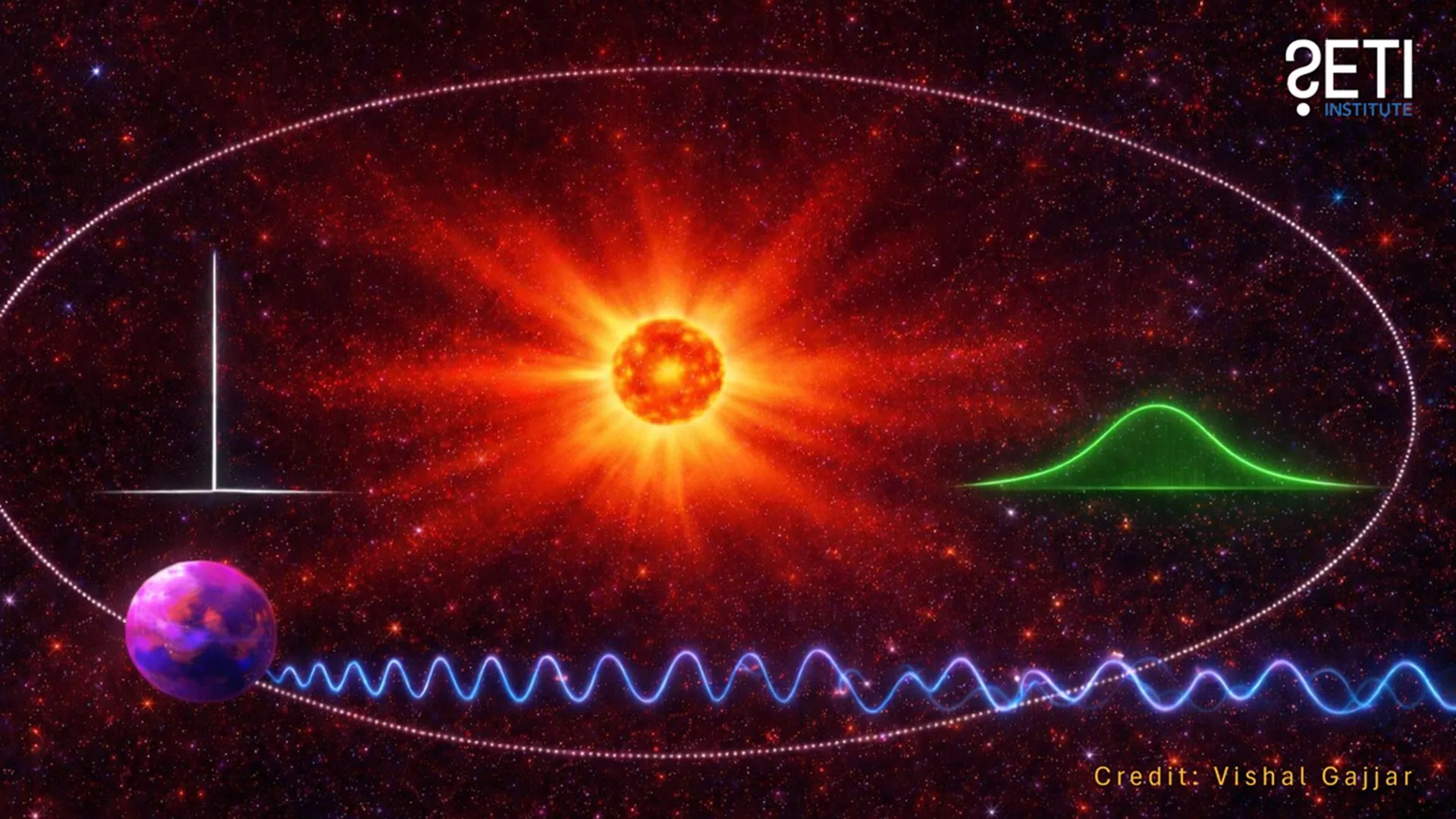
A SETI Institute study says radio signals from extraterrestrial technology, if they exist, could be made harder to detect by the stars they orbit. The work matters because many searches for intelligent life are built to spot very narrow radio tones, while stellar activity may turn those tones into broader, weaker signals before they cross interstellar space.
The study, by Vishal Gajjar and Grayce C. Brown of the SETI Institute, was published in The Astrophysical Journal. It examines how plasma around a signal’s home star could alter a narrowband transmission near its point of origin.
SETI researchers often look for sharp spikes at specific radio frequencies. According to the SETI Institute, those signals are attractive targets because natural cosmic processes are not expected to make such tightly concentrated radio features.
Gajjar and Brown argue that this strategy could miss some signals after they pass through turbulent stellar environments. Changes in plasma density in stellar winds, along with events such as coronal mass ejections, can scatter a signal’s energy across a wider set of frequencies, the institute said.
That spreading would reduce the narrow peak that many search systems are tuned to find. Gajjar, an astronomer at the SETI Institute and lead author of the paper, said narrow-signal searches can lose sensitivity if a signal has been broadened by conditions around its own star.
Spacecraft data helped test the idea
The researchers used radio transmissions from spacecraft in the solar system to estimate how much turbulent plasma can affect narrowband signals, according to the SETI Institute. They used those observations to calibrate the effect, then applied the results to other stellar environments.
The result is a framework for estimating how much broadening could occur around different star types and at different observing frequencies. The institute said the model is aimed at helping researchers account for active space-weather conditions near distant stars.
The study focuses on effects close to where a signal would be transmitted. SETI scientists already account for several changes radio waves can undergo as they travel through interstellar space, but Gajjar and Brown looked at scattering before the signal leaves its own star system.
M-dwarf systems may pose a bigger challenge
The SETI Institute said the effect could be especially relevant for M-dwarf stars, which account for about 75% of the stars in the Milky Way. These stars are common targets in studies of planets beyond the solar system, and the study suggests their environments may broaden narrow radio transmissions before those signals escape.
Brown, a SETI Institute research assistant and co-author, said quantifying the effect can help scientists design searches for what arrives at Earth, rather than only for what may have been transmitted.
The findings do not report a detected alien signal. They suggest that future technosignature searches may need to keep looking for ultra-narrow radio tones while also checking for wider signals that could have started narrow and been distorted near their source.
The SETI Institute said the project was supported through its STRIDE program, which backs research and tool development at the institute. STRIDE is funded by the Franklin Antonio Bequest, established to support science and education efforts there.
This story draws on original reporting from ScienceDaily.