
Staple-shaped particles point to materials that lock and release
CU Boulder researchers say entangled, staple-like particles can form strong structures and then separate quickly when vibrations change.
By Lucas Ferreira · Science & Environment Writer
3 min read
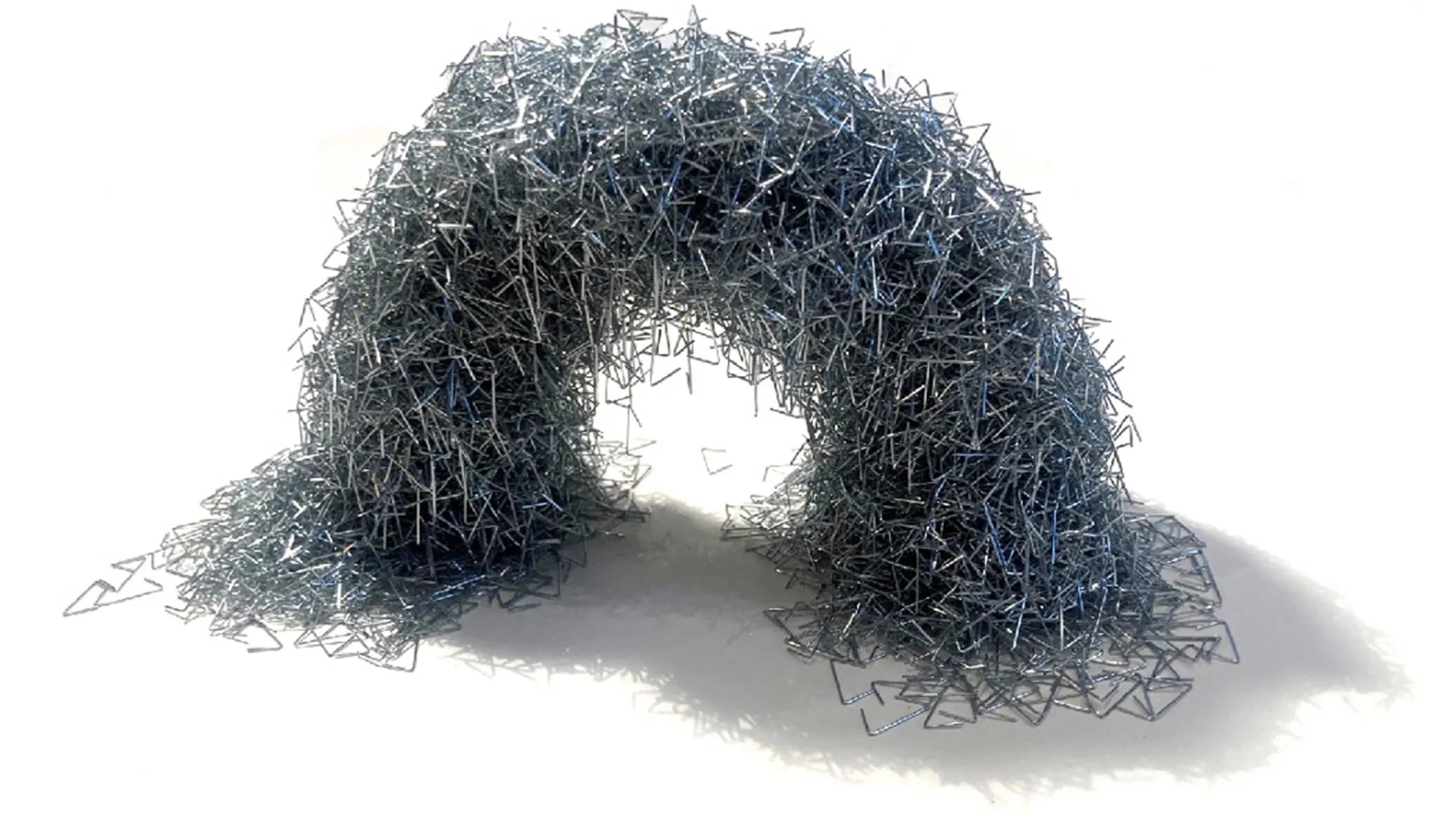
Researchers at the University of Colorado Boulder say particles shaped like office staples can tangle into a material that behaves like a strong structure, then come apart within seconds under different vibrations. The work could inform future materials designed for reuse, reconfiguration and robotic systems, according to the university.
The study, by Saeed Pezeshki and Francois Barthelat of CU Boulder, was published in the Journal of Applied Physics. The research focuses on entanglement, a mechanical effect in which separate pieces become intertwined and resist being pulled apart.
According to CU Boulder, a compressed mass of staples offers a familiar example: many separate metal pieces can catch on one another tightly enough to act almost like a single object. With the right shaking or motion, the same bundle can loosen and return to individual pieces.
Shape drives the effect
The CU Boulder team studied how particle geometry changes the strength and behavior of granular materials. Youhan Sohn, a doctoral student involved in the work, said smooth, convex grains such as sand do not interlock well, while changing a grain’s shape can sharply alter its mechanical properties and its ability to link with neighboring particles.
To test possible shapes, the researchers used Monte Carlo simulations, a computational method for studying many possible arrangements. CU Boulder said the team then ran pickup tests to see how selected particles behaved under physical conditions.
The researchers found that a two-legged particle resembling a staple produced the strongest entanglement among the tested designs, according to the university. Pezeshki said the entangled material made from staple-like particles showed both high strength and toughness, a pairing that conventional materials often struggle to combine.
Vibrations can strengthen or loosen it
The same experiments showed that vibration patterns could change how tightly the particles locked together, CU Boulder said. Softer vibrations encouraged the pieces to become more entangled, while stronger vibrations caused the network to come undone.
Barthelat, who leads CU Boulder’s Laboratory for Advanced Materials & Bioinspiration, described the material as neither a normal liquid nor a normal solid. He said the behavior gives engineers a different way to think about materials made from many separate building blocks.
The university said related examples of entanglement appear in nature. Bird nests hold together through interwoven twigs and fibers, while bone gains mechanical performance from interactions between hard mineral parts and softer proteins.
Possible uses remain early-stage
CU Boulder said the findings suggest possible long-term uses in construction, including structures that could be assembled, taken apart and reused rather than demolished. The university also said the same principle could support reconfigurable systems.
Pezeshki said other students have discussed possible use in swarm robotics, where small robots could entangle to complete a task and then separate afterward. Barthelat compared the broad idea to shape-changing science-fiction systems, while noting that cost and scale-up remain challenges.
The research team is now testing particle designs with more protruding legs, according to CU Boulder. The university said the new shapes resemble burrs that cling to clothing or shoes and may produce stronger entanglement effects.
This story draws on original reporting from ScienceDaily.