
Planet may be magnetically stirring its nearby star, study finds
A Science study reports evidence that GJ 436 b leaves a detectable magnetic signal on its red dwarf host star.
By Priya Raghavan · Science Reporter
3 min read
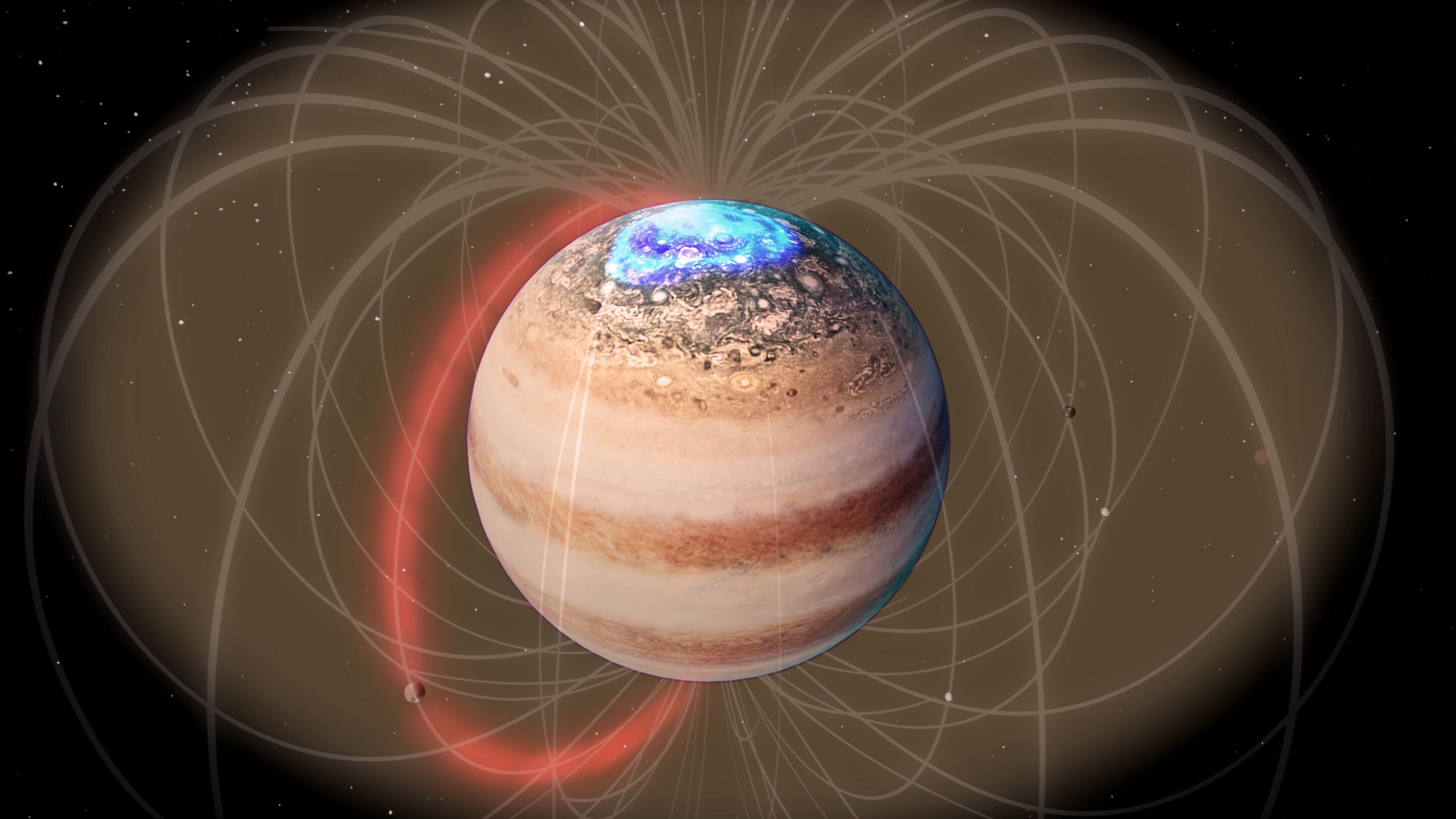
A close-orbiting giant exoplanet appears to be producing a measurable magnetic effect on its host star, according to research published in Science. The finding matters because it could give astronomers a new way to estimate magnetic fields on planets beyond the solar system.
The international research team studied GJ 436, a red dwarf about 30 light-years from Earth with roughly half the sun’s mass. The star has one known planet, GJ 436 b, described by the researchers as Neptune-sized and about four times Earth’s mass.
GJ 436 b circles its star every 2.6 days, placing it close enough for magnetic interaction to become detectable, the team reported. Stars usually dominate their planets through gravity, radiation and magnetic fields, but the Science study says this system shows evidence that the planet can also affect the star.
A signal tied to the planet’s orbit
The researchers examined 18 years of high-resolution spectroscopic observations of GJ 436. They tracked emissions from hydrogen and calcium in the star’s outer atmospheric layer, because those signals respond to changes in magnetic activity.
The team found repeated changes in those emissions that lined up with the planet’s 2.6-day orbit, according to the study. That timing led the researchers to conclude that the planet was likely provoking a recurring response in the star.
The pattern did not show up under all stellar conditions. The study says strong activity on the star could mask the planetary signal, while very quiet periods left too little activity for the planet to amplify. The clearest pattern appeared when the star sat at intermediate activity levels.
Model points to linked magnetic fields
To explain the observations, the team modeled a connection between the magnetic field lines of the planet and the star. In that scenario, energy travels along those linked field lines into the star’s outer atmosphere, changing the emission signatures measured from Earth.
The model included the star’s rotation and the planet’s tilted, eccentric orbit, according to the study. With those factors included, the model reproduced the observed pattern and suggested that GJ 436 b has a magnetic field strength in the range of Jupiter’s.
The research does not describe a direct image of the planet’s magnetic field. Instead, it uses the star’s response as an indirect measurement, based on activity changes that repeat with the planet’s orbit.
Possible tool for exoplanet studies
The study says similar searches could be carried out in other systems with large planets orbiting close to their stars. Hundreds of such systems are known, giving astronomers a broad set of targets for surveys of star-planet magnetic interaction.
If the method holds up in more systems, researchers could use stellar activity to infer magnetic fields on exoplanets, a property that has been difficult to measure. The Science paper says those measurements could help scientists study planetary atmospheres, interiors and long-term evolution.
The paper, “Constraining an exoplanet’s magnetic field using star-planet interactions,” was authored by D. Revilla and colleagues and published in Science in 2026.
This story draws on original reporting from Phys.org.