
Moon basin studies point Artemis crews toward deep lunar rocks
New modeling suggests an ancient impact scattered lunar mantle material near areas under consideration for Artemis landings.
By Priya Raghavan · Science Reporter
3 min read
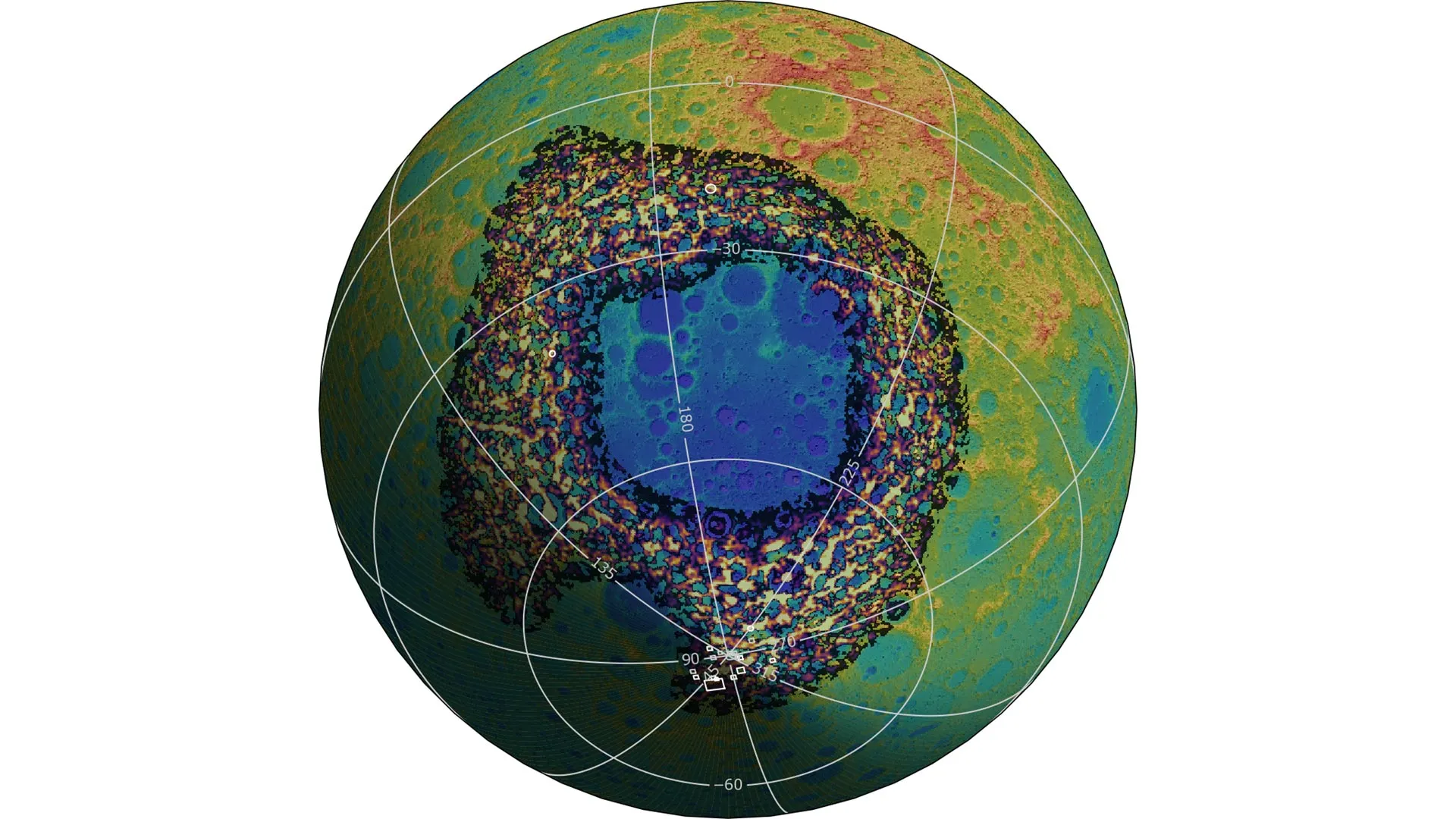
Future Artemis astronauts may be able to study rocks from deep inside the Moon without traveling far from proposed south polar landing regions. Southwest Research Institute said two companion studies found that the ancient impact that formed the South Pole-Aitken basin likely spread mantle-derived material into areas that could be reachable by upcoming missions.
The work focuses on the South Pole-Aitken basin, a vast impact structure on the Moon’s far side. According to Southwest Research Institute, the basin is the Moon’s largest and oldest known impact crater and ranks among the oldest preserved structures in the solar system, making it a key target for researchers studying the Moon’s early history.
Impact modeling traces the basin’s origin
The studies were led in part by researchers from the Center for Lunar Origin and Evolution, a NASA virtual organization led by Southwest Research Institute within the Solar System Exploration Research Virtual Institute. One paper, published in Science Advances, used computer simulations to recreate the collision that produced the basin.
Those simulations indicate that the impactor approached from the north, moved southward and struck the Moon at a shallow angle, according to the research team. The model also links that low-angle strike to the basin’s stretched and tapered shape.
Shigeru Wakita of Purdue University, lead author of the impact study, said the simulation matched the basin’s form and gave the team information about both the object that hit the Moon and the direction of the collision, according to Southwest Research Institute.
The modeling suggests the projectile was a differentiated body, meaning it had an iron core and a rocky outer portion rather than a uniform composition. Southwest Research Institute said such an object would resemble a small protoplanet or a differentiated asteroid.
According to the studies, the collision cut a deep, uneven cavity and produced enough heat to melt rock near the basin’s center. It also blasted material from the Moon’s crust and mantle outward, with much of the debris later falling back into and around the basin.
Gravity data point to buried mantle material
A second paper, published in Journal of Geophysical Research: Planets, examined where that excavated material may be today. The team used high-resolution gravity measurements and models that included both crustal and mantle material, according to Southwest Research Institute.
That analysis found evidence that the South Pole-Aitken basin contains substantial rock from the lunar mantle. The researchers said mantle-derived material appears to be mixed through the basin and its surrounding ejecta blanket.
Gabriel Gowman of the University of Arizona, lead author of the gravity study, said the location of mantle material had been a major uncertainty. According to Southwest Research Institute, his team’s models show the impact could have deposited deep lunar material that remains accessible, including trace amounts in regions being considered for Artemis landings.
Later impacts within the South Pole-Aitken basin may have excavated some of those buried deposits again and brought them to the surface, the researchers said. That could make the material available to robotic explorers or astronauts collecting samples near the lunar south pole.
William Bottke, director of the Center for Lunar Origin and Evolution and executive director of Southwest Research Institute’s Science Directorate in Boulder, Colorado, said the combined impact and gravity modeling offers guidance on where researchers should search for rocks that could help explain the Moon’s origin and evolution.
This story draws on original reporting from ScienceDaily.