
Milky Way’s rotation may shape gravitational-wave signal for LISA
A new preprint says the galaxy’s spin could bias LISA’s readings of a faint gravitational-wave background unless analysts account for it.
By Priya Raghavan · Science Reporter
3 min read
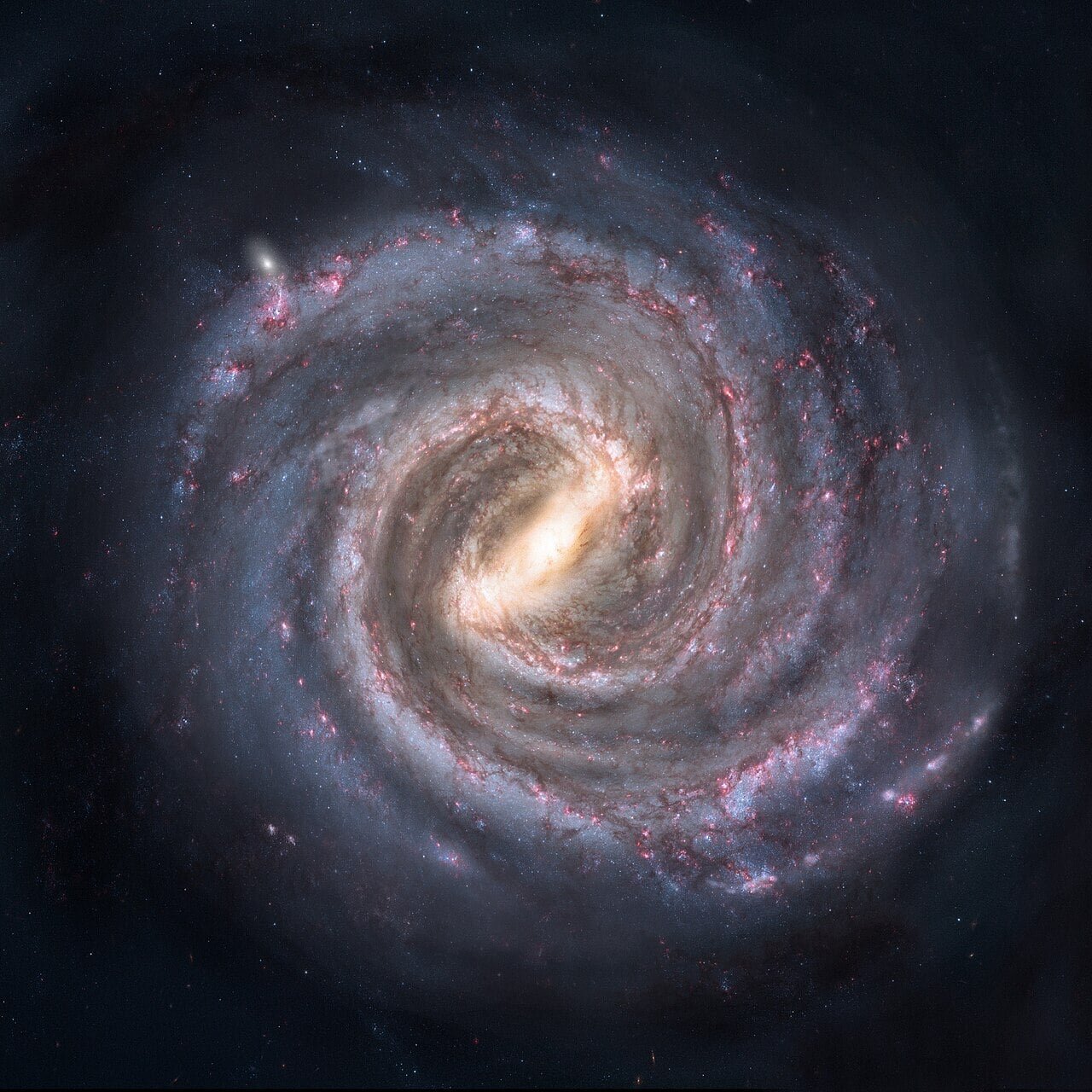
The Milky Way’s rotation may leave a measurable imprint on a steady gravitational-wave signal that the future LISA mission is expected to detect. A new preprint argues that ignoring that effect could skew estimates of the galaxy’s population of compact binary stars.
The work, by Giorgio Mentasti and co-authors and posted to arXiv, examines how the motion of stars around the galactic center changes the gravitational-wave background produced by millions of binary systems. Universe Today reported that the study focuses on a signal considered one of LISA’s most reliable targets.
LISA, the Laser Interferometer Space Antenna, is a planned European space-based gravitational-wave observatory. The mission will use three spacecraft flying in a large triangular formation to measure tiny distortions in spacetime as gravitational waves pass through.
According to Universe Today, much of the Milky Way’s low-level gravitational-wave background should come from compact binaries, especially pairs of white dwarfs. Individual systems are expected to be too faint to pick out in many cases, but their combined signal should form a persistent background across the sky.
A rotating galaxy changes the signal
Astronomers already expected that this background would vary by direction, because the galaxy is unevenly filled with stars. More sources lie toward the Milky Way’s crowded central regions than in its outer parts, so the signal should be stronger in some areas of the sky.
The preprint adds another factor: galactic rotation. Universe Today reported that stars orbit the Milky Way’s center at about 230 kilometers per second, or roughly 140 miles per second. As binary systems move toward or away from the observer, their gravitational waves are shifted by the Doppler effect.
The Doppler effect is the same broad principle that changes the apparent pitch of a moving siren and shifts light from receding objects toward redder wavelengths. In this case, the preprint applies it to gravitational waves from sources moving through the rotating galaxy.
Mentasti and co-authors calculated a formula for what Universe Today described as the rotational Doppler boost. Because each line of sight samples a different part of the Milky Way’s rotation, the effect is direction-dependent rather than uniform across the sky.
Potential bias in LISA analysis
The researchers then tested what could happen if LISA data analysis omitted the Milky Way’s rotation. Using two statistical methods, they found that the resulting errors could be comparable to the precision of the experiment, according to Universe Today.
That would affect attempts to infer properties of the unresolved galactic background. Universe Today reported that the bias could distort estimates of how many binary systems are present in the Milky Way and how massive they are.
The study also says the correction should be manageable. Accounting for the rotation would require adjusted signal templates, rather than adding new unknown parameters, according to Universe Today’s account of the work.
The finding could also give LISA another scientific use. Because the gravitational-wave background carries information about galactic motion, Universe Today reported that future observations may offer an independent way to measure the Milky Way’s rotation, separate from surveys based on starlight. Such measurements could provide another probe of the galaxy’s dark matter structure.
The preprint is titled “The Doppler effect of the Milky Way rotation on LISA” and is listed on arXiv with DOI 10.48550/arxiv.2606.11115.
This story draws on original reporting from Phys.org.