
Cell backup pathway for cysteine may point to cancer treatment targets
Montana State University researchers report a mammalian cell system that can make cysteine when the main route fails, with possible cancer implications.
By Lucas Ferreira · Science & Environment Writer
3 min read
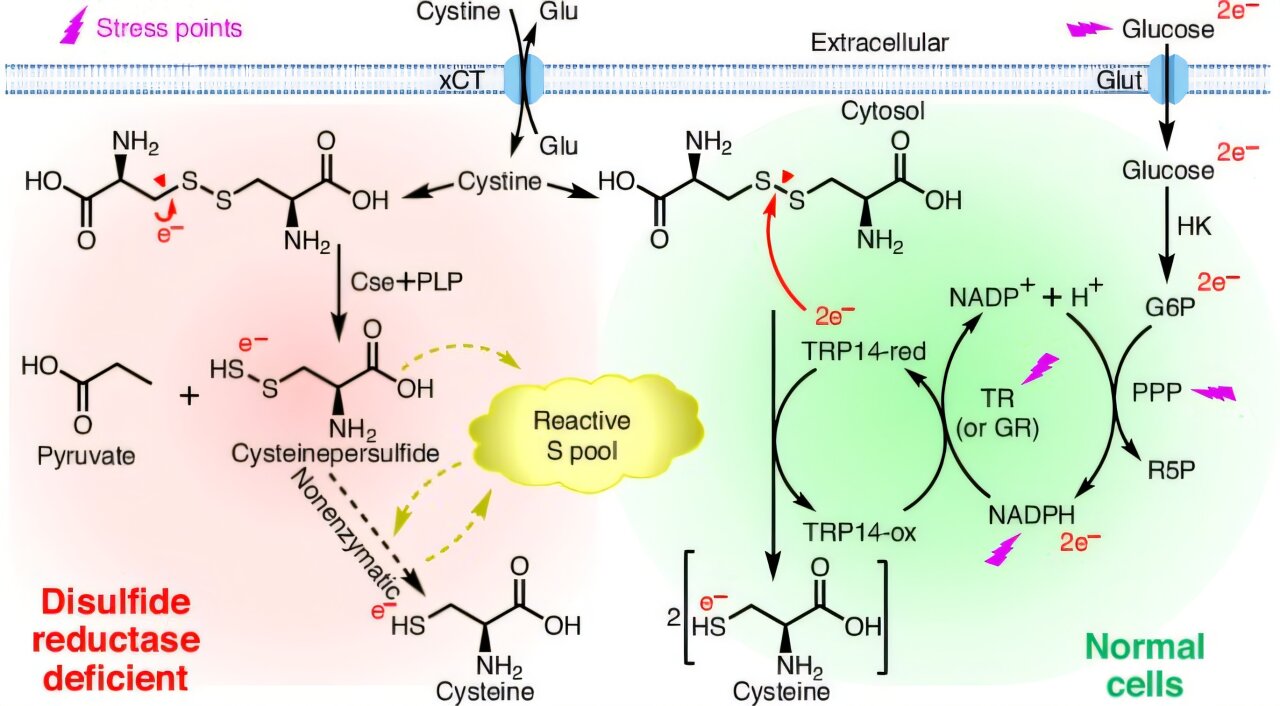
Researchers at Montana State University say they have identified a backup cellular process that can supply cysteine, an amino acid cells need to survive, when the standard system fails. The finding matters because Ed Schmidt, a molecular geneticist at MSU, said the same protective route may help some cancer cells withstand treatment.
The work was published in Nature Chemical Biology. According to MSU, Schmidt led the study from the university’s Department of Microbiology and Cell Biology in the College of Agriculture.
MSU said scientists had long understood cysteine as essential for protein production, protection from cellular damage and the formation of disulfide bonds that help proteins keep their shapes. Schmidt said cells do not rely on cysteine from outside the cell, so they must make it internally.
According to MSU, the established route involves splitting cystine, an oxidized form of cysteine, through a disulfide reductase system. Schmidt said researchers had regarded that system as necessary for living cells, but his team found mammalian cells can use another route when the main one is unavailable.
A result that began with mice
MSU said the discovery developed over nine years and began in 2014, when mice survived despite lacking the known system expected to convert cystine into cysteine. Schmidt had engineered mice whose livers lacked one or the other of the two main disulfide reductases, according to the university.
Schmidt said the liver responses in those animals led him to test whether cells could live without at least one of the two reductases. MSU said the later work took seven years and involved Peter Nagy of the Hungarian National Institute of Oncology in Budapest, whose team contributed analytical tools to the project.
The paper reports that, when the disulfide reductase route is unavailable, the backup pathway cuts a nearby carbon-sulfur bond in cystine. According to MSU, that reaction ultimately frees cysteine for the cell to use.
Why cancer researchers may care
Schmidt said the pathway may have evolved as a way for early multicellular organisms to protect cells from electrophilic toxins. According to MSU, such toxins include organic molecules made by some organisms to kill other organisms that might eat them or compete with them.
MSU said the same cellular defense may also protect some cancer cells exposed to chemotherapy, radiation therapy or immunotherapy. Schmidt said identifying the pathway could allow researchers to explore ways to disable it in cancers, potentially making those cells more vulnerable to existing therapies.
The university did not report a cancer treatment or clinical trial from the work. The finding, as described by MSU and the Nature Chemical Biology paper, identifies a cellular mechanism that could become a target for future research.
Students and collaborators
MSU said several students and former students co-authored the study. Zoe Seaford and Sydney Austad, who worked in Schmidt’s lab as undergraduates, were listed as co-first authors, according to the university.
MSU also named Martina Serrano Alvarez and Reed Noyd as undergraduate researchers who contributed, and Colin Miller as a doctoral student involved in the work. The university said other scientists and trainees from multiple institutions also contributed to parts of the study.
Sreekala Bajwa, dean of MSU’s College of Agriculture, said the work shows how research can change assumptions and support new approaches to cancer treatment. She also credited Schmidt’s team for involving students as research partners.
This story draws on original reporting from Phys.org.