
Australian spider uses spring-loaded web to catch one ant species
Researchers say a North Queensland spider builds a silk catapult that targets aggressive green tree ants one at a time.
By Priya Raghavan · Science Reporter
3 min read
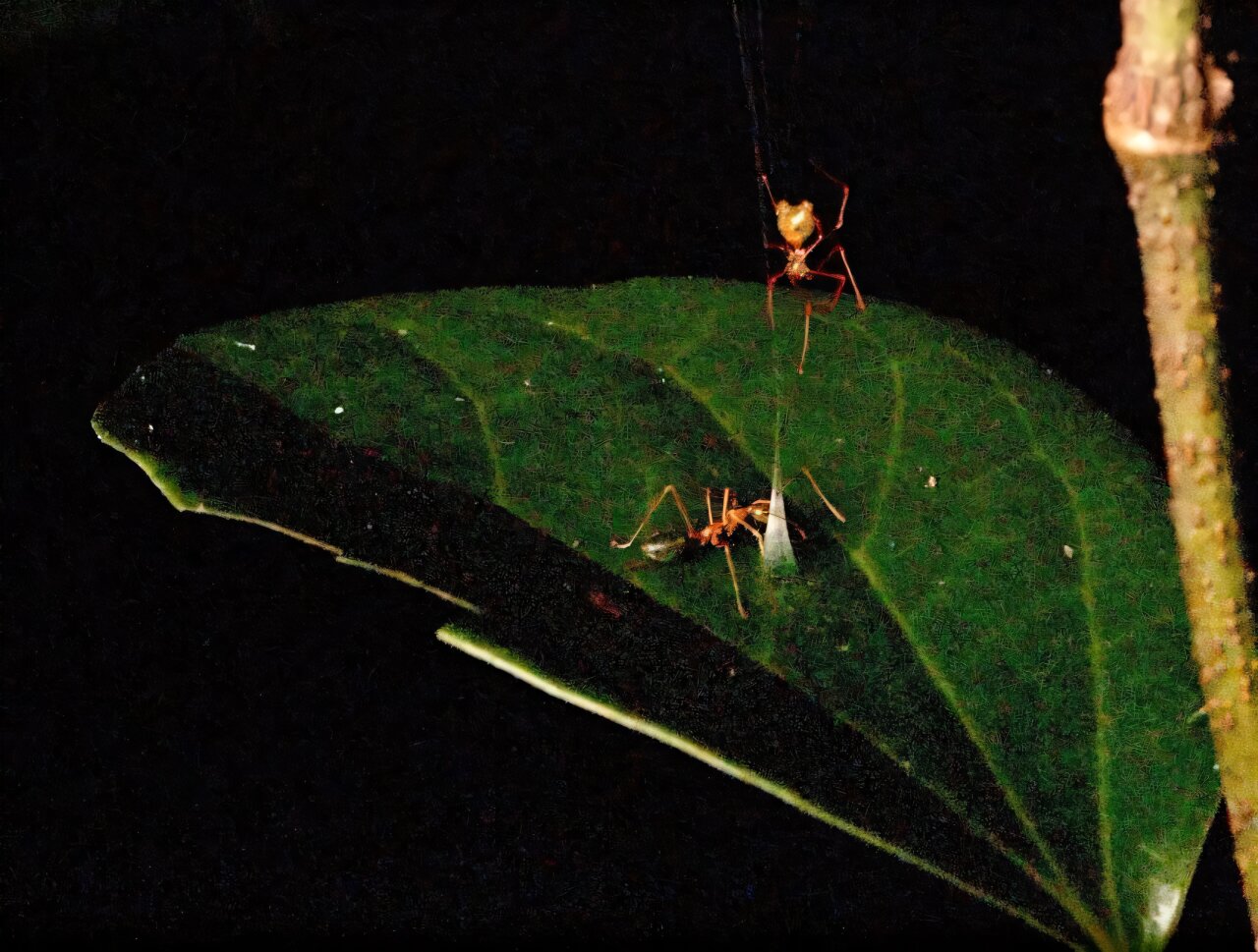
Researchers have documented a North Queensland spider that builds a spring-loaded silk trap aimed at a single prey species, the green tree ant. The finding matters because the spider appears to have evolved a web that lets it take on a dangerous ant without entering the path of a swarm, according to a study in Current Biology.
The small nocturnal spider belongs to the genus Propostira and has not yet been formally named, Macquarie University said. Researchers call it the ballista spider, after the ancient weapon that used stored energy to fire a projectile.
Macquarie University said the spider was first noticed by Professor Greg Anderson, a biomedical research scientist who also works on spider taxonomy and photography. Professor Ajay Narendra of Macquarie University and postgraduate student Pranav Joshi later spent 10 days and nights in rainforest near Cooktown observing the spider and recording its behavior with high-speed and infrared cameras.
A web built to spring
According to the researchers, the spider shelters during the day on the underside of a leaf above areas where green tree ants, Oecophylla smaragdina, are active. At night, it drops at least 50 centimeters to set an anchor point on a leaf, branch or the forest floor.
Macquarie University said the spider then spends as long as four hours building a vertical system of 15 to 60 silk tension lines, bundled into a cone close to the ground. As a final step, it adds a finer silk around the cone and quickly moves back upward.
Within seconds, according to the study, a green tree ant is drawn to the cone and attacks it. The ant’s bite releases the cone from its anchor, causing the tensioned silk to contract and throw the ant more than 30 centimeters into the spider’s main web at acceleration above 1,300 meters per second squared.
The spider does not immediately rush in, the researchers said. It waits until the ant is securely caught, then approaches and wraps the prey in silk.
Targeting a risky prey
Narendra said in the university account that ants are hazardous targets for spiders because many species carry chemical defenses, and some can sting. He also said ants can use alarm signals to summon large numbers of nestmates against a predator.
The researchers said the ballista spider appears to avoid that danger by removing a single worker from the trail or nest area and pulling it upward into the web. Narendra described the behavior as an extreme level of prey specialization, according to Macquarie University.
The team suspects the spider may add a pheromone during the last stage of web construction, Narendra said. In the researchers’ view, that chemical cue may attract worker ants and provoke the bite that triggers the trap.
Dr. Jonas Wolff of the University of Greifswald, a co-senior author who studies spider silk biomechanics, traveled to Australia to observe the spider and collected silk for laboratory testing, Macquarie University said. The analysis included scanning electron microscopy.
According to the researchers, the snare stores elastic energy in silk and releases it quickly enough to overpower the ants’ adhesive foot pads. Narendra said the mechanism has unusually high instantaneous power density compared with other specialized silk-based biological catapults.
The study, titled “Ballistic high-powered spider webs overcome dangerous prey defenses,” was published in Current Biology.
This story draws on original reporting from Phys.org.