
X-Sig health patch combines heart, pulse and muscle signals
NUS researchers say X-Sig merges electrical and mechanical body signals in one wearable patch for cuffless monitoring and gesture tracking.
By Tom Brennan · Health & Medicine Correspondent
3 min read
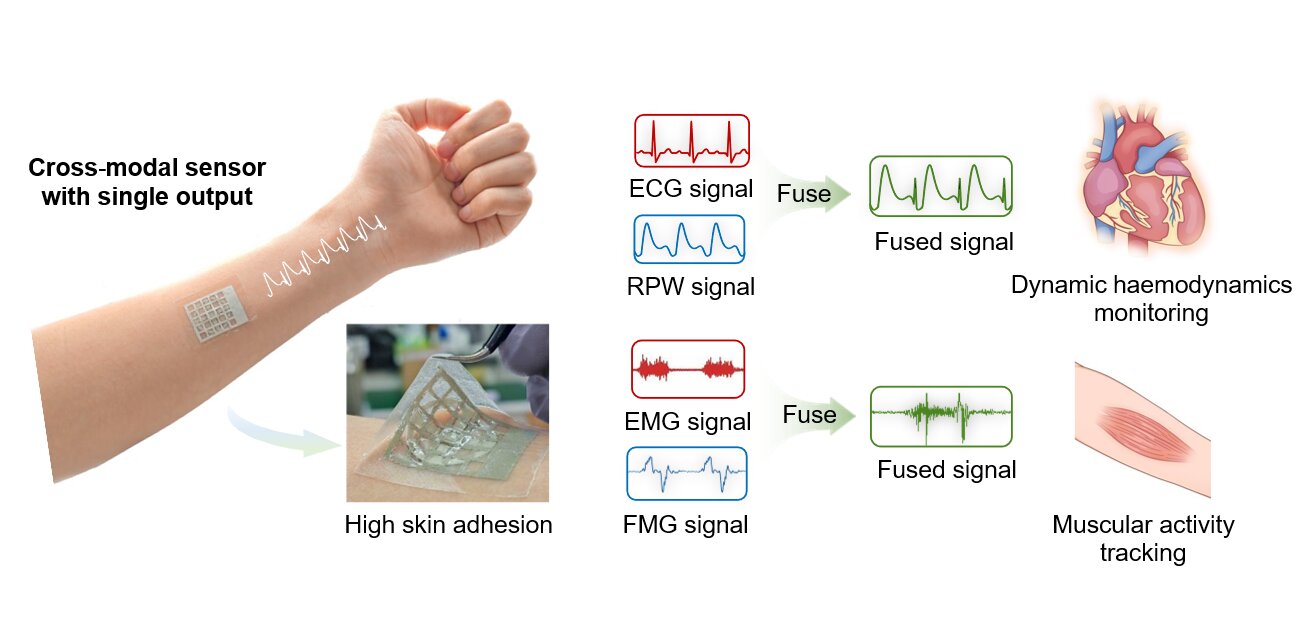
Researchers at the National University of Singapore have developed an X-Sig health patch that combines several body signals in a single wearable sensor, a design they say could make continuous monitoring less bulky and more power-efficient. The work matters because current wearable systems often need separate sensors and circuits to read electrical and mechanical activity from the body.
The team was led by Assistant Professor Liu Yuxin of the Department of Biomedical Engineering at NUS College of Design and Engineering. The study was published in Nature Sensors, according to NUS.
What is the X-Sig health patch?
X-Sig is a skin-mounted sensor that joins two kinds of physiological information before the data reaches processing electronics. It captures biopotential signals, including electrocardiography and electromyography, along with biomechanical signals such as pulse pressure waves and force changes from muscle contraction.
In plain terms, electrocardiography records the heart’s electrical activity, while electromyography records electrical activity linked to muscle movement. Mechanical signals show physical effects such as a pulse wave moving through an artery or pressure changes under the skin as muscles contract.
How the single-channel sensor works
NUS said the patch uses a cross-layered structure with a conductive electrode stacked with an ultrathin piezoelectric film. The electrode reads electrical signals, while the piezoelectric layer creates voltage when pressure is applied, allowing mechanical activity to be detected.
Because both parts produce voltage outputs, their signals can be merged at the sensor into one composite waveform, according to the researchers. That removes the need for separate analog front-end circuits for each signal type, which NUS said can reduce device size and energy demands.
The electrode is built from three engineered polyurethane layers with different roles: elasticity, adhesion and conductivity. NUS said separating those functions helped the electrode stick firmly to skin while keeping low electrical impedance, and the team reported better performance on those measures than commercial gel electrodes.
The sensor layers are perforated so adhesive can contact the skin through small openings, helping the patch stay attached on curved areas of the body. NUS said no skin irritation was observed after 24 hours of continuous use, and that the electrode materials can be recycled by sequential washing with water and ethanol.
Blood pressure and gesture tests
In a wrist test over the radial artery, X-Sig recorded ECG and pulse wave signals at the same time. A machine-learning algorithm then used heart rate and pulse arrival time, the delay between the heart’s electrical trigger and the pressure wave reaching the wrist, to estimate blood pressure without a cuff.
Compared with a standard cuff-based monitor, the system’s predicted values differed on average by 0.27 mm Hg for systolic pressure and 0.33 mm Hg for diastolic pressure, NUS reported. The researchers said that met Class A, the highest accuracy grade under the Institute of Electrical and Electronics Engineers standard for cuffless blood pressure devices.
The team also said the system tracked expected blood pressure changes as volunteers shifted among sitting, standing, breath-holding and brief exercise.
In a separate forearm demonstration, X-Sig was used to classify hand gestures by combining EMG and force myography in one channel. NUS said the fused signal reached 96.4% accuracy across 10 gestures, compared with 72.1% using EMG alone and 82.9% using force myography alone.
The researchers also reported that the combined signal needed 70 training samples per gesture to reach high accuracy. They said they have shown the sensor can capture ECG, EMG, pulse waves and force myography at one body site, with possible uses in cuffless cardiovascular monitoring, prosthetic control and rehabilitation.
This story draws on original reporting from Medical Xpress.