
MAP1B study links cell scaffold proteins to brain development timing
Researchers found cytoskeleton proteins inside neural stem cell nuclei, where MAP1B appears to affect brain development programs.
By Tom Brennan · Health & Medicine Correspondent
3 min read
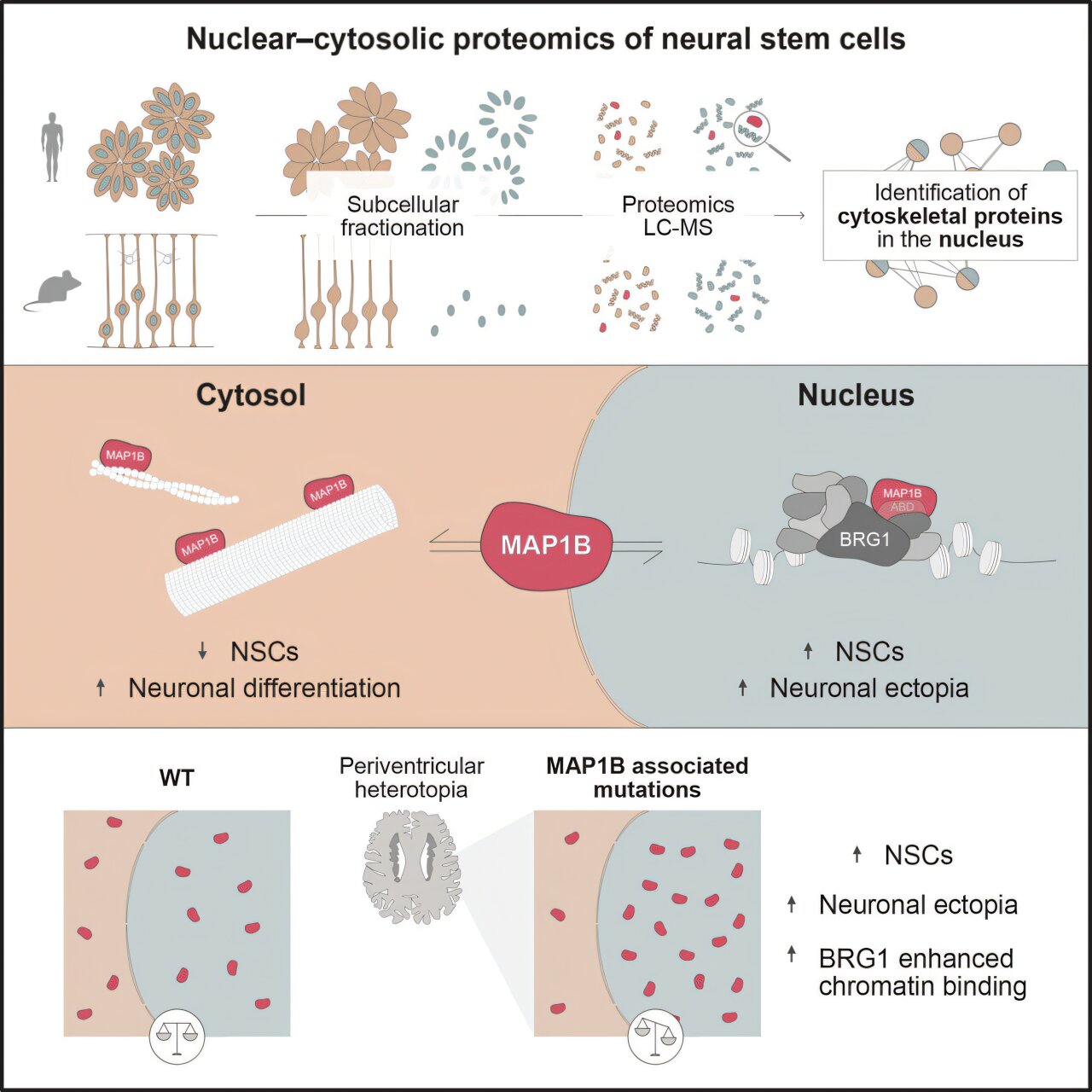
Proteins known for giving cells structure and helping them move may also influence genetic programs during brain development, according to researchers at Helmholtz Munich and Ludwig Maximilian University. Their study, published in Cell, suggests that mutations in the cytoskeletal protein MAP1B can disrupt neural development earlier than previously understood.
The team studied neural stem cells, which generate specialized nerve cells as the brain forms. According to the researchers, proper development depends not only on which nerve cells are produced, but also on when they appear and where they settle in developing tissue such as the cerebral cortex.
Scientists have often examined the cytoskeleton and the cell nucleus as separate systems, the Helmholtz Munich-led team said. The cytoskeleton acts as an internal support network, while the nucleus controls many gene-regulation programs.
In the new work, the researchers analyzed proteins in the nucleus and cytoplasm separately. They used neural stem cells from embryonic mouse brains and human neural stem cells made in the laboratory from reprogrammed body cells.
The analysis found many cytoskeleton-related proteins inside neural stem cell nuclei, according to the study. Dr. Florencia Merino, first author of the paper and a former Ph.D. student in Magdalena Götz’s laboratory, said the striking finding was the number of such proteins detected in the nucleus, not the presence of one or two.
The team then focused on MAP1B because earlier work had linked MAP1B mutations to periventricular heterotopia, a developmental disorder in which some neurons end up in the wrong place in the brain. In that condition, according to the researchers, nerve cells that should move into neuronal layers remain below them.
Experiments showed that MAP1B had different roles depending on where it was active in the cell. In the cytoplasm, the protein helped neural stem cells become nerve cells, while in the nucleus it helped preserve the stem cell state for a longer period, according to the study.
Götz, director of the Institute of Stem Cell Research at Helmholtz Munich and a professor at Ludwig Maximilian University, said MAP1B’s function depends on its cellular location because it binds to different protein complexes in the cytoplasm and nucleus. The researchers said that distinction changes how periventricular heterotopia can be understood.
Rather than viewing the disorder only as a problem of neuronal migration, the study indicates that the process can begin earlier in neural stem cells. According to the team, disrupted MAP1B activity can prolong stem-cell programming, leading some resulting nerve cells to be specified incorrectly, move more slowly and fail to reach their correct positions.
The researchers also tested human models by generating neural stem cells and three-dimensional brain organoids carrying MAP1B mutations found in people with periventricular heterotopia. In those organoids, mutant MAP1B built up more strongly in the nucleus, and neurons appeared in locations that would not match normal development, according to the study.
The team reported that MAP1B interacts in the nucleus with the BAF protein complex, which helps control which parts of DNA are accessible for gene reading. In neural stem cells with disease-associated MAP1B mutations, a key BAF component showed altered binding near genes tied to the stem cell state, cell movement and the cytoskeleton.
Merino said the work shows MAP1B is connected in the nucleus to molecular machinery that regulates developmental programs. Götz’s team said it now plans to test whether other cytoskeleton-associated proteins perform similar nuclear roles and whether related mechanisms occur in other stem cells and developmental processes.
This story draws on original reporting from Medical Xpress.