
Lower antibiotic doses improve mouse model for pancreatic cancer microbiome studies
National Taiwan University researchers say a refined mouse model reduced harm while linking gut microbes to pancreatic tumor growth and chemotherapy response.
By Tom Brennan · Health & Medicine Correspondent
3 min read
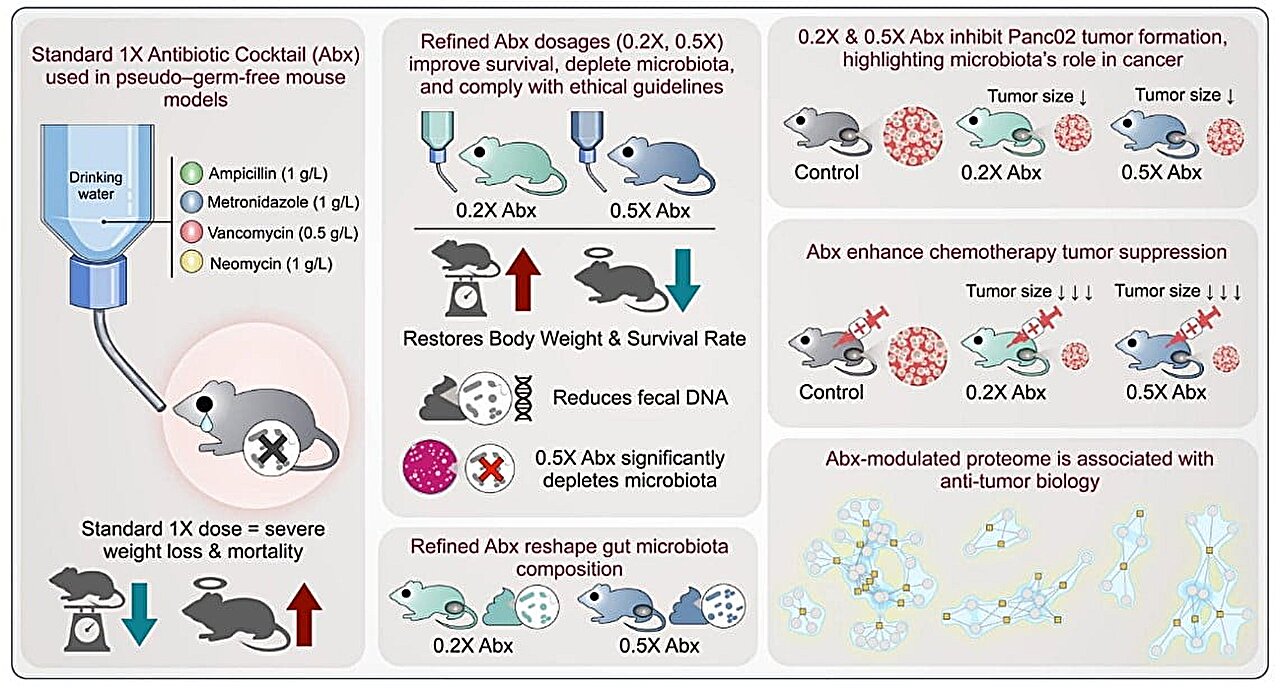
National Taiwan University researchers say they have improved a common mouse model used to study the gut microbiome, reducing animal harm while preserving the model’s core purpose. In the same work, the team reported that changing gut bacteria with antibiotics slowed pancreatic tumor growth in mice and strengthened the effect of gemcitabine chemotherapy.
The study, published in the Journal of Advanced Research, focused on pseudo-germ-free mice. Researchers use these animals after antibiotics sharply reduce their gut bacteria, allowing scientists to test how microbes affect disease and treatment response.
National Taiwan University said the standard approach can create serious welfare problems. High-dose antibiotic cocktails can lead to reduced eating and drinking, steep weight loss and death in some mice, according to the university.
The research team tested lower concentrations of a commonly used antibiotic mixture to see whether microbiota depletion could be maintained with fewer side effects. National Taiwan University said the reduced-dose regimens still drove down gut bacterial levels, while mice had less body weight loss and better survival than under harsher dosing.
The researchers also examined whether adding sucrose would make the antibiotic mixture easier for mice to consume. According to the study summary from National Taiwan University, sucrose did not show clear advantages and may have encouraged the growth of bacteria that remained after treatment.
Testing the model in pancreatic cancer
After refining the model, the team used it to study pancreatic ductal adenocarcinoma, a major form of pancreatic cancer. National Taiwan University said mice receiving the lower-dose antibiotic regimens developed smaller tumors than untreated mice.
The university said comparable results were seen in germ-free mice, adding support to the idea that gut microbes can help drive pancreatic tumor progression. The findings do not establish a human treatment, but they add evidence from animal models that the microbiome can affect cancer behavior.
The team then tested antibiotics together with gemcitabine, a chemotherapy drug used for pancreatic cancer. National Taiwan University said the combination produced stronger tumor suppression than either antibiotics or gemcitabine alone.
Protein analysis of tumor tissue pointed to changes in cancer-related pathways in antibiotic-treated mice, according to the university. Those changes included lower activity in tumor-supporting metabolism and inflammation, along with increased signals tied to tumor cell stress and death.
Wei-Kai Wu, a co-corresponding author at the Graduate Institute of Microbiology, said the study offers a safer and more reproducible pseudo-germ-free mouse model for examining how gut microbes affect disease. Wu said lowering the antibiotic dose improved animal welfare while still reducing microbiota effectively.
Ming-Shiang Wu, a distinguished professor of internal medicine at National Taiwan University, said the results point to an important role for the gut microbiome in pancreatic tumor growth and chemotherapy response. He said microbiome modulation could become a useful strategy to support future cancer treatment.
The paper is titled “Refining antibiotic cocktail regimens for pseudo-germ-free mice and their impact on gut microbiome and pancreatic tumor proteomics.” Its DOI is 10.1016/j.jare.2025.08.015.
This story draws on original reporting from Medical Xpress.