
CDC model says Ebola outbreak could exceed 20,000 cases in worst case
The agency said the Bundibugyo Ebola outbreak in Congo and Uganda could grow sharply if isolation rates stay low and medical tools remain scarce.
By Priya Raghavan · Science Reporter
3 min read
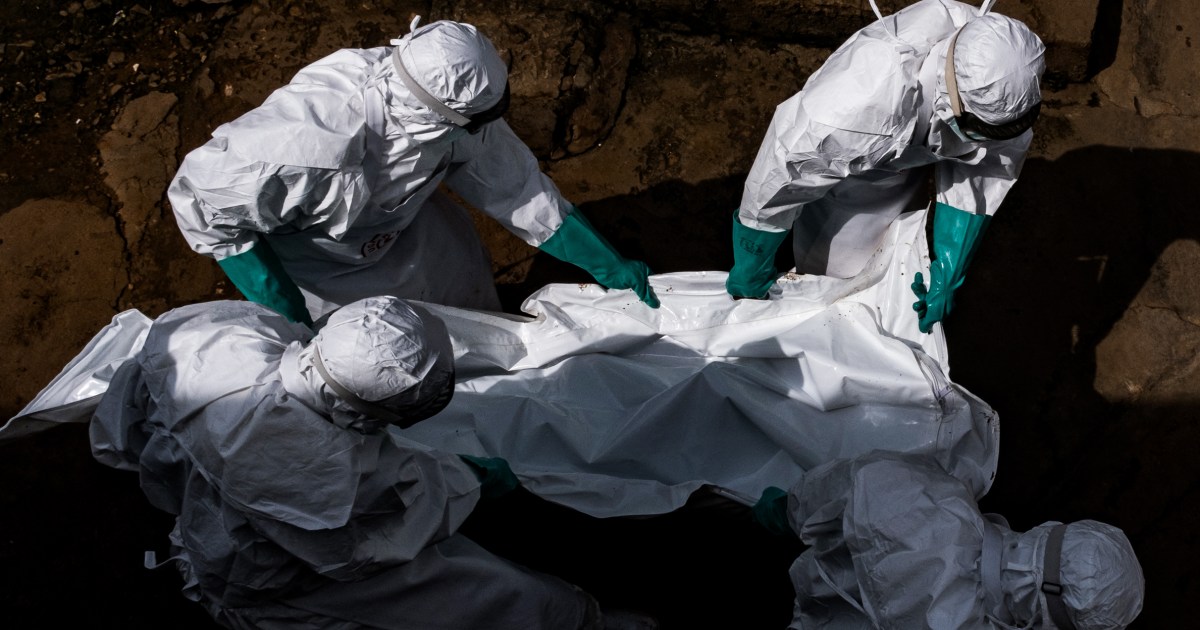
A CDC risk assessment says the Ebola outbreak in the Democratic Republic of the Congo and Uganda could rise above 20,000 cases and 2,000 deaths under a worst-case scenario. The warning matters because the outbreak involves the Bundibugyo strain, a rare form of Ebola for which the CDC says there are no available vaccines or treatments.
The Centers for Disease Control and Prevention published the modeling Friday using data available through May 24, when about 50 deaths had been reported. The agency said the worst-case estimate assumes only 20% of people with Ebola isolate and that access to medical countermeasures remains limited.
The World Health Organization has reported 397 confirmed cases and 65 deaths in the outbreak.
CDC says model is a planning tool
Jason Asher, director of the CDC’s Center for Forecasting and Outbreak Analytics, told reporters Friday that the analysis should be used to guide response planning rather than read as a prediction. He said the models depend on current data and the agency’s understanding of conditions on the ground.
Asher said the work is meant to support action, according to NBC News. The CDC said the projections remain limited by unknowns, including how the Bundibugyo strain is spreading, how many infected people are in isolation and how widely the outbreak may move in the coming months.
Even with stronger control measures, the CDC said risk remains. In a more favorable scenario in which about 70% of cases isolate, the agency found roughly a 1 in 5 chance that the outbreak could pass 10,000 cases within three months.
Experts urge faster response
Dr. Krutika Kuppalli, an infectious diseases physician at UT Southwestern Medical Center and a former World Health Organization medical officer, described the projections as concerning in comments reported by NBC News. She said the CDC analysis shows the outbreak could still be controlled with the right response.
Kuppalli said the findings should push the international community to act, according to NBC News. Lawrence Gostin, director of the World Health Organization Collaborating Center for National and Global Health Law, said he welcomed the CDC assessment and called it a step in the right direction.
Gostin also pointed to the 2014-2016 West Africa Ebola epidemic, when CDC projections helped draw attention to the crisis, according to NBC News. The CDC says that outbreak remains the largest recorded, with more than 28,000 cases and more than 11,000 deaths.
Officials still do not know how many cases are being missed in Congo and Uganda. NBC News reported that the early response was slowed in part because standard Ebola tests failed to detect the Bundibugyo strain, and that the outbreak’s center in Ituri province lies in a conflict zone.
Dr. Satish Pillai, who is leading the CDC’s Ebola response, told reporters that detection and isolation appear to be on the lower end. He said the report was intended to show the need to gather resources to contain the outbreak.
U.S. risk remains low, CDC says
A separate CDC report released Friday said the risk to the general U.S. population remains low. Pillai said the agency issued that assessment because of public concern, not because it sees a high domestic threat.
No U.S. cases linked to the outbreak have been reported, according to NBC News. The outlet reported that Dr. Peter Stafford, an American surgeon who contracted Ebola while working in Congo, was flown to Germany for treatment; his wife and four children were also taken there after exposure, while another doctor, Patrick LaRochelle, was sent to the Czech Republic for monitoring.
This story draws on original reporting from NBC News.