
UK businesses count Brexit costs as vote reaches 10-year mark
Executives and economists cited higher trade costs, weaker output and labor strains, though one Brexit-backing manufacturer still rejects rejoining the EU.
By Hana Yoshida · Markets Reporter
3 min read
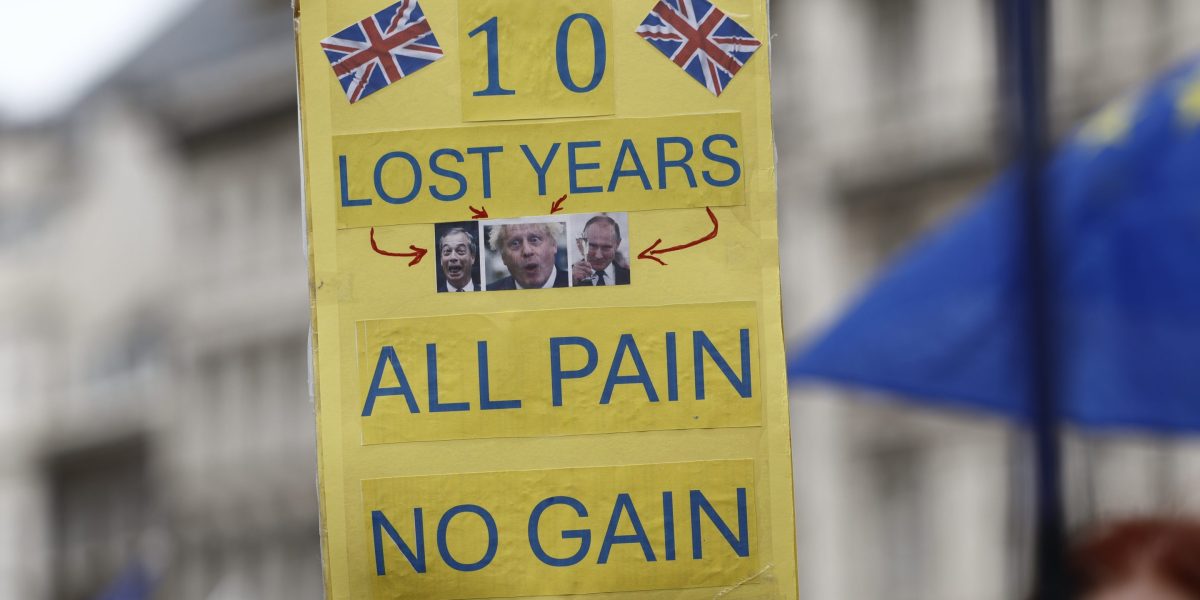
Ten years after Britain voted to leave the European Union, British companies are still dealing with higher trade costs, weaker investment and tighter labor rules, according to reporting by The Associated Press. The anniversary has sharpened a divide between business leaders who say Brexit damaged growth and supporters who argue the project was weakened by politics.
Simon Boyd, managing director of REIDSteel, told the AP he still backs the decision to leave the EU. His company, based in Christchurch on England’s south coast, employs about 130 people and makes prefabricated steel structures for customers as far away as Ghana and Barbados, according to the AP.
Boyd acknowledged that Brexit has fallen short of some campaign promises, saying the results have been slow. He blamed the outcome on politicians he said lacked commitment to carrying it out, as well as shocks including the COVID-19 pandemic and wars in Ukraine and the Middle East, the AP reported.
Economists point to a weaker economy
Economists cited by the AP said Britain lost wealth by leaving the EU single market, which had given businesses easier access to a bloc of 27 countries and about 450 million people. Creon Butler, director of the global economy and finance program at Chatham House, told the AP that the choice to leave has made Britain poorer.
A recent report published by the National Bureau of Economic Research found that Britain’s economy is weaker than it likely would have been without Brexit. The researchers, based in Britain, Germany and the United States, compared the U.K. with 33 countries, including European neighbors, the U.S., Canada and Japan.
The report estimated that Brexit cut U.K. gross domestic product by 6% to 8%, reduced investment by 12% to 13% and lowered productivity by 3% to 4%. The AP reported that costs rose first during years of uncertainty over the future U.K.-EU relationship, then again after Britain formally left the bloc on Jan. 31, 2020, as new trade rules took effect.
Cars, restaurants and trade feel the strain
Mike Hawes, chief executive of the Society of Motor Manufacturers and Traders, told the AP that Brexit added costs and pressure to Britain’s auto industry. Carmakers had warned before the vote that extra paperwork around vehicle and parts shipments would hurt an industry built around cross-border supply chains in Europe, the AP reported.
Brexit supporters pointed to the ability to sign independent trade agreements as a key benefit of leaving the EU. Britain has since signed deals with countries including Australia, India and the United States, according to the AP, but government figures show EU countries still account for 41% of British exports and half of imports.
The end of free movement also cut off a labor source many British employers had used, especially after the EU expanded eastward in 2004, the AP reported. Oli Khan, president of the Bangladesh Caterers Association UK, told the AP that curry restaurants felt betrayed after backing Brexit on assurances that more visas would become available for South Asian cooks.
Public frustration has grown
Prime Minister Keir Starmer had opened talks with the EU on rebuilding closer ties to help Britain’s stagnant economy, according to the AP. The AP also reported that Starmer said Monday he is stepping down.
A May survey by Ipsos, the Policy Institute at King’s College London and UK in a Changing Europe found that 48% of 2,245 British adults said Brexit was going worse than they expected. That was up from 28% in March 2021; 9% said it was going better than expected, while about one in three said it was going as expected.
Boyd told the AP the decisive vote remains the 2016 referendum, when 51.9% of voters, or 17.4 million people, chose to leave. He said Britain should not rejoin the EU, comparing such a move to boarding the Titanic again while giving up life vests.
This story draws on original reporting from Fortune.