
States press ahead with AI rules despite federal pushback
Lawmakers in both parties are advancing targeted AI bills as Congress stalls and the White House urges limits on state regulation.
By Hana Yoshida · Markets Reporter
4 min read
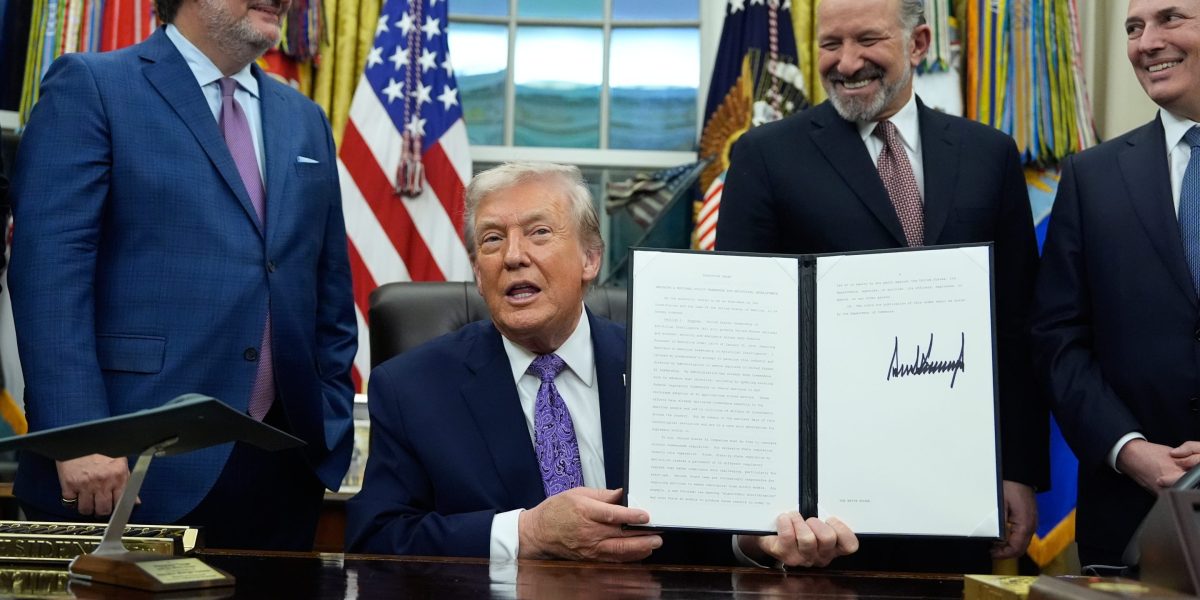
State lawmakers are moving ahead with artificial intelligence rules even after President Donald Trump warned them against regulating the technology, according to The Associated Press. The push matters because Congress has not produced broad federal AI legislation, leaving states to decide how to oversee chatbots, workplace tools and advanced AI developers.
The state efforts have become more focused after earlier, broader bills ran into resistance from governors who said they could slow industry growth, AP reported. New measures tend to address specific uses of AI, including how companies disclose chatbot interactions, how employers use automated systems and how developers prepare for severe risks.
White House seeks federal control
Trump has treated AI as a national and economic security priority, AP reported. He has argued that a patchwork of state rules could burden an industry spending trillions of dollars and competing with China.
In an executive order, Trump directed the attorney general to form a task force to challenge state AI laws deemed more than “minimally burdensome,” according to AP. The order also told the Commerce Department to identify problematic regulations and raised the possibility of limiting broadband and other grants to states with AI laws.
The White House said it would not target state laws meant to stop fraud or protect consumers and children, AP reported. The administration later issued a national policy framework urging Congress to preempt state AI laws that conflict with its regulatory approach while passing legislation on children, intellectual property and free speech.
AP reported that the White House has not indicated it has sued over a state AI law or withheld funds under the order. In a statement cited by AP, the White House said the administration is “eager to work with partners” on its framework.
States target chatbots and high-risk systems
Justine Gluck, policy director at the Future of Privacy Forum, told AP that more AI bills have been introduced this year than last year, including by Republicans. The nonprofit advocates for data privacy in technology and includes members from industry, academia and civic groups.
In Illinois, Democratic Gov. JB Pritzker is considering a bill that draws from laws passed in California and New York, AP reported. The measure would require developers of large advanced AI models to create safety protocols aimed at preventing severe harms such as biological weapons attacks, power outages or large-scale hacks.
AP reported that the Illinois bill would also require an independent auditor to review whether developers are following their own policies. Democratic state Sen. Mary Edly-Allen, the bill’s sponsor, dismissed Trump’s warning, telling AP: “I don’t know if you’ve met Illinois, but we’re pretty independent.”
States have also passed chatbot laws in both Republican- and Democratic-led states, including Colorado, Connecticut, Idaho, Iowa, Nebraska and Oregon, according to AP. Many of those laws require companies to disclose when users are interacting with AI instead of a person, limit chatbot interactions with minors, give parents control over children’s access or protect data shared with chatbots.
Connecticut recently enacted rules for companion chatbots that maintain ongoing relationships with users, AP reported. Under those provisions, the systems cannot interact with minors unless they are designed not to encourage self-destructive behavior and give parents tools to manage use.
Workplace and content rules advance
Colorado in May required companies using AI in areas such as employment, education, housing and banking to tell people when the technology influences decisions about them, AP reported. The law revised a 2024 measure aimed at AI discrimination after pressure from Democratic Gov. Jared Polis.
Connecticut required employers using employment-related AI systems to notify workers or applicants when they are dealing with AI, according to AP. Connecticut, Washington and Utah also required AI developers to embed information in digital content so users can determine whether photos, video or similar material was created or altered by AI.
In California, lawmakers are advancing a proposal called the “No Robo Bosses Act of 2026,” which would bar employers from relying only on AI to fire or discipline workers, AP reported. They are also considering expanded chatbot rules, including a ban on using chatbot outputs to children for advertising.
Some Republican-led states have pulled back. AP reported that the Florida House declined to advance Gov. Ron DeSantis’ AI “Bill of Rights,” while a Utah bill modeled on New York and California laws stalled after the White House sent lawmakers a one-sentence memo saying it was “categorically opposed” to the proposal.
This story draws on original reporting from Fortune.