
SpaceX tops $2.4 trillion after record-setting market debut
The rocket company’s IPO raised $85.7 billion, putting it far ahead of past listings while raising fresh questions about profitability.
By Hana Yoshida · Markets Reporter
3 min read
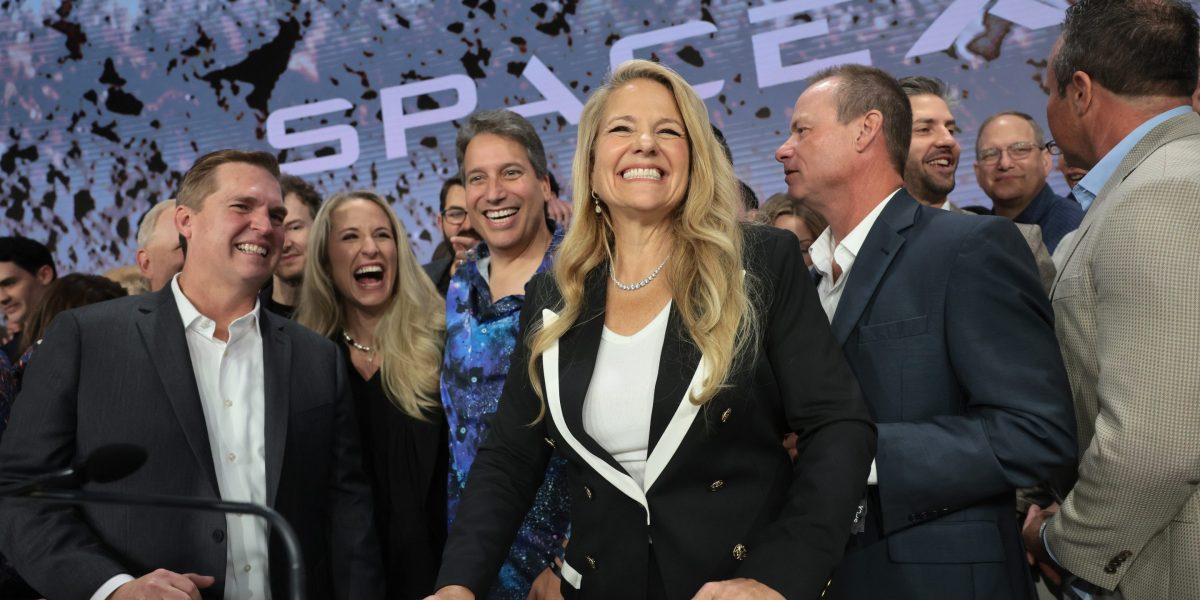
SpaceX’s shares climbed again Monday, lifting the rocket and satellite company’s market value above $2.4 trillion after a record-setting IPO. The debut matters because the offering dwarfed previous listings and immediately tested investor appetite for one of the most closely watched private companies in technology.
According to Fortune, SpaceX raised $85.7 billion in proceeds in its public offering, which valued the company at $1.75 trillion. The company began trading at $150 a share and was at $186 by Monday afternoon, Fortune reported.
The stock rose 19% in its first session and was up 16% on its first full trading day, according to Fortune. Sharp first-day gains are common in hot IPOs: Axios reported that Airbnb rose 112% in its 2020 Nasdaq debut, while Fortune said Figma jumped 252% on its first day.
Gwynne Shotwell, SpaceX’s president, joined company leaders to ring the opening bell at the Nasdaq MarketSite on June 12, according to a Getty Images caption cited by Fortune.
How the listing compares
Fortune reported that the closest historical comparison is Saudi Aramco, which listed on Saudi Arabia’s Tadawul exchange on Dec. 11, 2019. The state-owned oil company was valued at $1.7 trillion and raised $25.6 billion, according to Fortune.
Saudi Aramco’s value moved above $2 trillion within days of its listing, Fortune reported, citing The New York Times. Before Aramco, Alibaba held the record for the largest IPO, raising $21.8 billion at a valuation of $167.6 billion, according to Fortune.
Eric Hoffmann, chief data officer at compensation consulting firm Farient Advisors, told Fortune earlier this month that IPO promotion can help build demand and increase the amount a company raises. Fortune quoted Hoffmann as saying the strategy was “marketing 101.”
Profit questions remain
A strong start does not settle the case for long-term investors. Fortune pointed to Facebook’s 2012 IPO as a reminder: Nasdaq later paid shareholders $26.5 million to settle a class-action lawsuit over technical problems tied to that offering.
Fortune reported that investors were skeptical at the time of Facebook’s roughly $100 billion valuation because its advertising business had not yet proved itself at scale. Three months after the IPO, Facebook shares traded at about half their offering price, though the company later recovered and now has a market capitalization of $1.51 trillion, according to Fortune.
SpaceX faces its own test. In its S-1 filing, the company reported $18.7 billion in 2025 revenue, up from $14.1 billion in 2024, while posting a $4.9 billion net loss last year, according to Fortune.
The filing said SpaceX could not predict whether it would sustain its recent revenue growth or when it would return to profitability, Fortune reported. Fortune also said the IPO made Elon Musk, already the world’s richest person, a trillionaire on paper.
Market lead under scrutiny
Fortune described SpaceX as the dominant company in the space business, despite being founded 24 years ago. The company was responsible for more than half of all rocket launches in 2025 and 83% of the total mass sent to orbit, according to Fortune.
Morningstar analysts Nicholas Owens and Suryansh Sharma wrote that SpaceX leads globally in launch economics and satellite-based connectivity, but said competition could increase if Blue Origin, Rocket Lab or Chinese startups improve their technology. The analysts estimated SpaceX’s value at $780 billion, Fortune reported, equal to 44% of the IPO valuation.
This story draws on original reporting from Fortune.