
SociaVault Labs report reframes creator pricing around engagement
The 2026 report introduces a cost-per-engagement index as influencer budgets move toward measurable returns.
By Hana Yoshida · Markets Reporter
3 min read
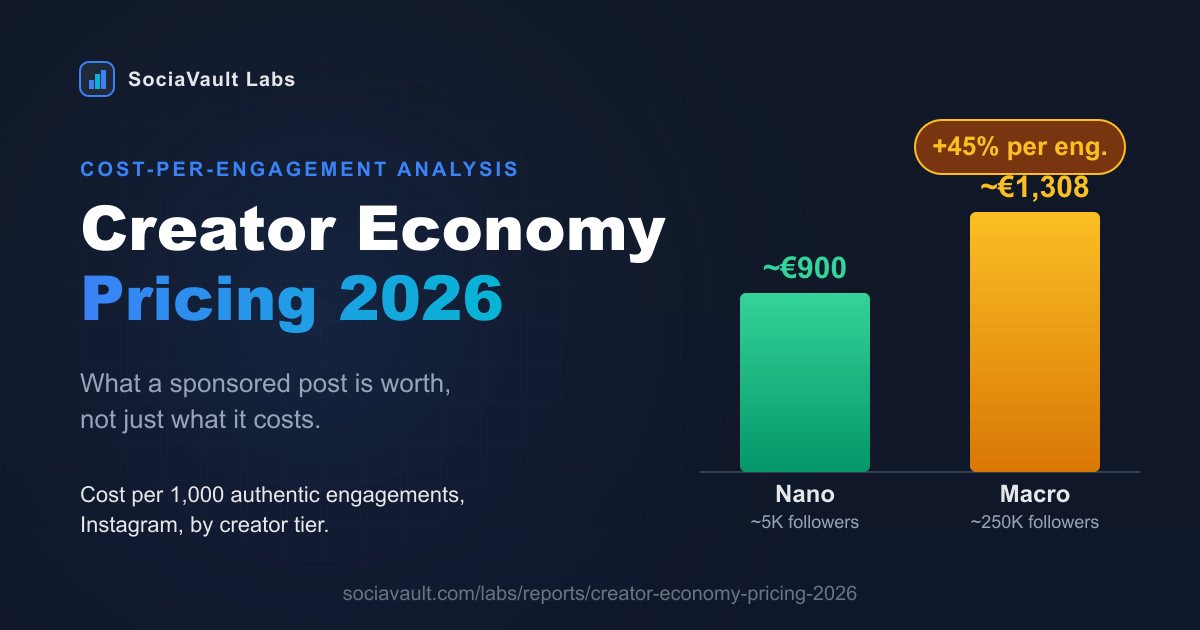
SociaVault Labs has released a 2026 creator-economy pricing report that puts engagement, rather than follower count or flat post fees, at the center of influencer pricing. The report lands as brands put more pressure on creator marketing budgets to show measurable returns.
The State of Creator Economy Pricing 2026 compiles public pricing information from Instagram, TikTok and YouTube, then compares those rates with the research division’s engagement benchmarks. Its main contribution is a cost-per-1,000-authentic-engagements index designed to show what advertisers are paying for actual audience response.
That framing challenges the way many influencer deals are still quoted. Rate cards often start with platform, audience size and content format, but they can hide large gaps in performance between creators with similar followings.
SociaVault Labs found that macro creators, defined as accounts with 100,000 to 500,000 followers, cost about 45% more per authentic engagement than nano creators with fewer than 10,000 followers. The report says the gap reflects a pricing pattern in which fees rise faster than engagement as audiences get larger.
The analysis also found that TikTok creators tend to produce engagement at several times the efficiency of Instagram creators within comparable follower tiers. That does not mean cheaper campaigns in every case, but it points to why marketers are testing budgets against outcomes rather than relying only on posted rates.
Ola, founder of SociaVault, said the report was built to give brands and creators a clearer reference point than competing rate cards. He said dividing campaign cost by the engagement it generates makes the pricing advantage of smaller creators easier to measure.
The creator-economy pricing report also includes a niche engagement multiplier. That section says categories such as education and parenting can produce stronger engagement per follower than categories such as fashion at similar audience sizes, which could affect how both sides price sponsorships.
The report cites public market estimates showing global influencer marketing reached about $32.55 billion in 2025, within a broader creator economy valued near $250 billion. It also cites projections that the creator economy could approach $480 billion by 2027.
Other findings point to a market that is still expanding while pricing becomes more uneven:
- A majority of multinational brands planned to raise influencer marketing budgets in 2025.
- Average collaboration costs softened as the number of available creators increased.
- Per-post rates ranged from about $5 to $100 for the smallest creators to $10,000 or more for the largest accounts.
- Pay structures are moving toward performance-based models tied to measurable results.
SociaVault Labs said the report relies on publicly available data and aggregated internal benchmarks, and that it does not identify individual accounts. For marketers, the bigger point is the shift from paying for reach in broad terms to comparing the cost of the engagement a campaign is likely to produce.