
Schools lag on AI rules as students turn to chatbots for homework
College Board says 84% of surveyed high school students used generative AI for schoolwork in 2025, while educator surveys show few districts have formal policies.
By Maya Lindqvist · Senior Technology Correspondent
3 min read
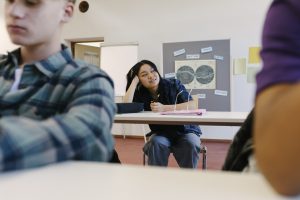
Generative AI is now common in high school homework, while many districts still lack clear rules for how students may use it. College Board, the nonprofit that runs the SAT and AP exams, said 84% of surveyed high school students reported using generative AI for schoolwork in 2025.
The rapid spread of chatbots has sharpened a familiar problem for teachers: a finished assignment may no longer show what a student actually knows. Brett DeJager, an assistant professor of psychology and education at the University of Wisconsin-Stout Polytechnic, said his survey of school professionals suggests educators are worried about cheating and about whether assignments still provide reliable evidence of learning.
Educators cite cheating, plagiarism and assessment concerns
DeJager said his study, conducted from spring 2025 to spring 2026, included 303 public school educators and other school professionals in Wisconsin. The respondents included teachers, administrators, IT staff, technology directors, school psychologists and counselors. He also surveyed 132 school professionals elsewhere in the United States.
DeJager said the results are not nationally representative, but they offer a view of how some K-12 professionals are responding to generative AI. In his Wisconsin group, about 65% of respondents identified academic dishonesty and plagiarism as concerns. In the broader national sample, 74% did so.
Respondents also pointed to the difficulty of judging student learning when AI is involved. DeJager said 47% of Wisconsin respondents who answered that question named assessment as a concern, compared with 53% in the national group.
Asked about effects on student behavior, mental health or engagement, 29% of Wisconsin respondents and 40% of national respondents selected increased reliance on AI from a list of options, according to DeJager. Reduced critical thinking or problem-solving was selected by 19% of Wisconsin respondents and 33% of national respondents.
Detection software has limits
Some teachers have turned to AI-detection software, but research cited by DeJager shows those tools can be unreliable. A 2025 national survey of public school teachers in grades six through 12, cited by the Center for Democracy and Technology, found 43% regularly used detection apps and another 27% had tried them.
One study of 14 detection tools found false-positive rates as high as 50% and false-negative rates as high as 100%, depending on the product, according to DeJager. The same study found that about 20% of AI-generated text was labeled as human-written, rising to about 52% after manual editing and 71% after machine paraphrasing.
Other researchers cited by DeJager found detectors wrongly flagged writing by nonnative English writers as AI-generated at an average rate of 61.3%.
District policies remain limited
Formal district guidance remains uneven. DeJager said 33% of Wisconsin respondents and 29% of national respondents reported that their district had a formal AI policy.
Researchers behind the Artificial Intelligence Assessment Scale have argued that educators should state clearly what level of AI use is allowed for each assignment, based on the learning outcome being measured. Under that approach, one task might ban AI so a teacher can see independent writing, while another might permit AI for brainstorming or ask students to evaluate an AI-generated answer.
DeJager said some teachers are already changing assignments by requiring students to explain their process, add oral components, write more in class or complete paper-and-pencil tasks when independent thinking needs to be visible. He said many educators in his survey also reported using AI themselves for planning, communication, documentation, differentiated instruction, administrative work and student support.
The challenge for schools, according to DeJager, is to design work that still lets teachers judge what students understand when polished text can be generated in seconds.
This story draws on original reporting from Fortune.