
US China decoupling push would require $13.7 trillion, analysis finds
EY-Parthenon estimates the US, eurozone and UK would need $23.6 trillion over 25 years to reduce dependence on China in exposed sectors.
By Hana Yoshida · Markets Reporter
3 min read
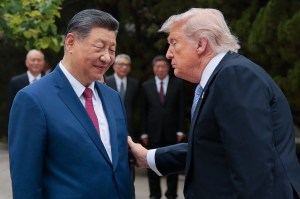
The United States would need to spend $13.7 trillion over 25 years to cut its dependence on China in highly exposed industries, according to a new EY-Parthenon analysis reported by Fortune. The estimate points to the scale of the challenge facing President Donald Trump’s effort to reduce reliance on Chinese supply chains.
EY-Parthenon calculated that the U.S., eurozone and U.K. together would need an additional $23.6 trillion in investment over the same period to replace China-linked capacity in vulnerable sectors. According to EY-Parthenon, the money would have to cover infrastructure, research and development, manufacturing, software, transport networks and worker training.
Trump has escalated pressure on China through tariffs, Fortune reported. Those measures include a 10% import tax under Section 122 that expires later this month, along with Section 301 duties ranging from 7.5% to 100% tied to alleged unfair trade practices such as forced labor.
The tariff push builds on earlier federal efforts to increase U.S. production, including former President Joe Biden’s CHIPS Act, which was designed to support domestic semiconductor manufacturing, Fortune reported.
The U.S. remains a major buyer of Chinese goods. Apollo Academy data cited by Fortune showed the U.S. receives 14% of China’s exports, down from 20% in 2017.
United Nations Comtrade data cited by Fortune showed that in 2024 China supplied 45% of U.S. smartphone and telephone equipment imports, worth $51.5 billion, and 76% of U.S. toy imports, worth $14.4 billion. China customs data cited by Fortune showed export growth rose 27% last month from a year earlier, after double-digit annual declines for much of the year.
Cost pressure from reshoring
Mats Persson, EY-Parthenon’s U.K. macro and geostrategy leader, told Fortune that the figures show how hard it is to pursue protectionist policy in an integrated global economy. Persson said efforts such as domestic manufacturing incentives and AI hardware export bans can support economic independence during uncertain periods, while trade has also relied on lower-cost overseas production.
Persson told Fortune that Chinese factory prices for some components are 20% to 100% lower than Western prices because of production scale and dense supply chains. EY-Parthenon said recreating those supply chains outside China would push inflation structurally higher by about 1% to 2%.
Persson said the U.S. would need spending comparable to an Inflation Reduction Act each year to address the resulting price pressure. Fortune noted that the 2022 law authorized about $891 billion for clean energy production, prescription drug costs and deficit reduction.
For the European Union, taxpayer-funded supply-chain and infrastructure changes would require the EU budget to effectively double, according to EY-Parthenon. “We’re not going to achieve these levels of investments,” Persson told Fortune.
Where the U.S. has advantages
Persson told Fortune the U.S. is better placed than Europe to increase local production because of its deep capital markets, the dollar’s reserve-currency role and greater energy independence. He also said U.S. reliance on China for critical minerals would limit semiconductor supply-chain independence.
The U.S. could still improve manufacturing productivity by developing more supply-chain workers, Persson said. Deloitte and The Manufacturing Institute have projected that 2.1 million manufacturing jobs may go unfilled by 2030, according to Fortune.
Persson told Fortune that China’s long-term industrial policies have made it highly efficient, while the EU faces the added difficulty of coordinating policy across 27 member states. He said trade patterns remain unstable, pointing to Europe’s former dependence on Russian oil and gas and the shift after Russia’s invasion of Ukraine.
Persson said he does not expect a return to earlier levels of globalization in the next couple of decades, but also does not see globalization ending. He told Fortune the next phase is likely to be uneven and difficult to predict.
This story draws on original reporting from Fortune.