
Rare 1776 Declaration copy found in British archives
A volunteer uncovered an Exeter printing of the Declaration of Independence among Royal Navy papers tied to a captured American privateer.
By Maya Lindqvist · Senior Technology Correspondent
3 min read
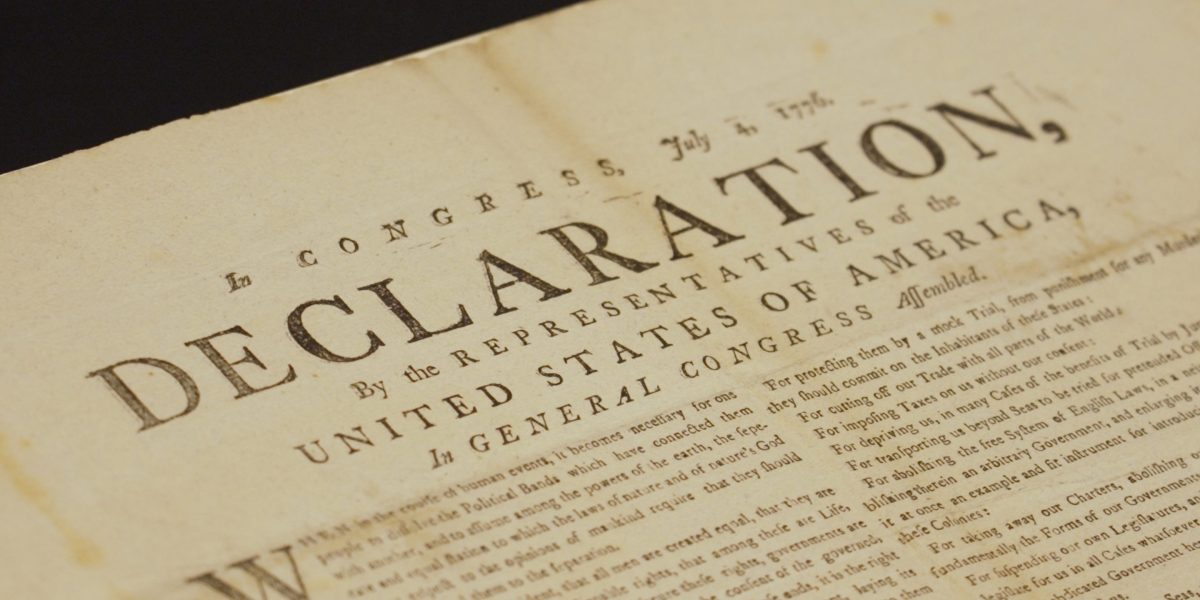
A volunteer at Britain’s National Archives has uncovered a rare early printing of the U.S. Declaration of Independence in a file of Royal Navy correspondence. The find, announced by the National Archives and reported by The Associated Press, adds a newly identified surviving copy to the record as the United States marks 250 years since independence.
Michael Scurr, a retired insurance executive, found the document last May while working through letters from an 18th-century British naval captain, according to the AP. Scurr has volunteered at the archives for 11 years, spending Thursday mornings cataloging material for researchers.
The document was folded inside papers connected to the British capture of the American privateer Dalton on Christmas Eve 1776, the AP reported. It had been listed only as “another paper” in an enclosure to a report on the seizure.
Scurr told the AP he realized what he had when he unfolded the paper and saw “Declaration” printed at the top. The National Archives later identified it as an original copy of the Exeter printing, produced in Exeter, New Hampshire, between July 16 and July 19, 1776.
A copy made to spread the news
The National Archives said the printing was made days after the Declaration was adopted on July 4, 1776, as the 13 colonies worked to circulate the news that they had broken from Britain. The newly identified document is one of 11 known original copies of that Exeter printing, according to the archives.
The archives said it is the only known copy of that version outside the United States. The institution displayed the document in London on Thursday ahead of the anniversary weekend, the AP reported.
Amanda Bevan, who leads the National Archives project cataloging Royal Navy captains’ correspondence from the American Revolution, told the AP the document’s wartime context gives it added weight. She said it was captured from a ship operating under the Continental Congress, with orders signed by John Hancock, its president.
Bevan said the discovery also points to a part of the Revolutionary War that receives less public attention: Americans who fought at sea against British commerce and the Royal Navy. The AP reported that the Dalton was an 18-gun privateer, a privately owned vessel authorized by the Continental Congress to fight for the new nation.
Taken after a seven-hour chase
According to the AP, the Dalton was captured off Portugal by HMS Raisonnable, a 64-gun British warship commanded by Capt. Thomas Fitzherbert. The chase lasted seven hours on Christmas Eve 1776.
The Dalton’s 120 crew members were imprisoned in Plymouth, England, where conditions were harsh, the AP reported. One prisoner, Charles Hebert, who was 19 when captured, later described hunger, illness and repeated punishment in journals he kept during more than two years in captivity before a prisoner exchange.
Bevan told the AP that the Declaration may have been read aloud aboard the Dalton along with the captain’s orders, as was customary. She said the copy helped place the sailors’ fight in the broader language of an ideal rather than a private grievance.
Matthew Skic, director of collections and exhibitions at the Museum of the American Revolution in Philadelphia, told the AP the document creates a direct link to the Dalton’s captain and the spread of independence news beyond America. He said the discovery shows historians still have more to learn about the Revolution, even after 250 years.
This story draws on original reporting from Fortune.