
Nomagic tests AI model for warehouse robots in live customer sites
The warehouse automation company says its new robot control model has cut human interventions in early customer deployments.
By Sofia Marchetti · World Affairs Correspondent
3 min read
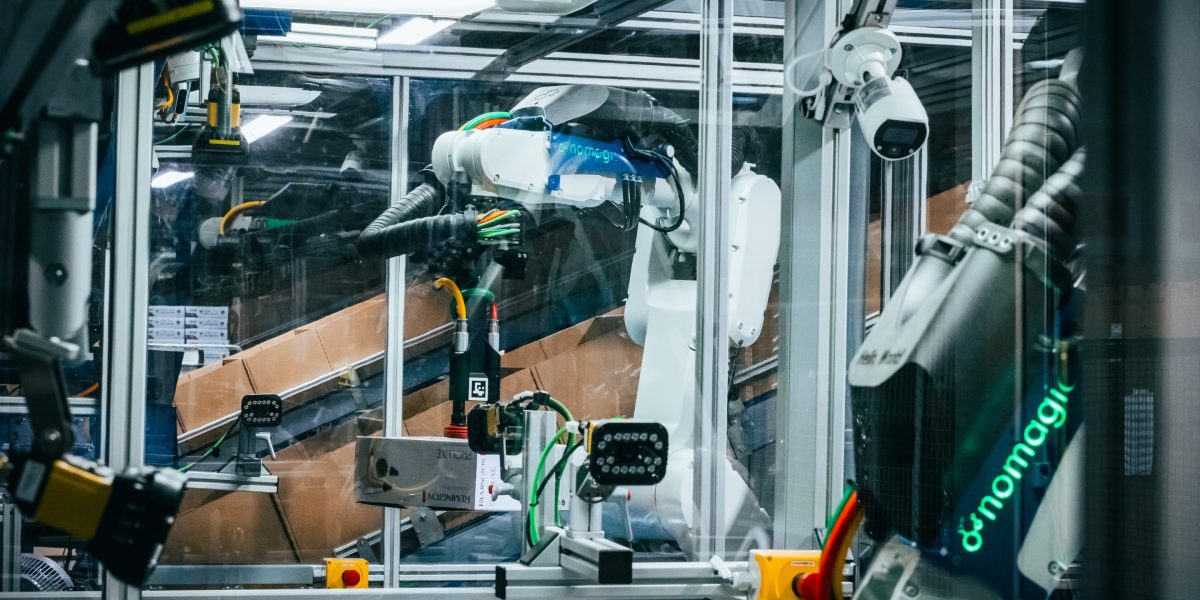
Nomagic says it has put a new AI control model for warehouse robots into live use with paying customers, a step the company says has improved reliability in real operations. The claim matters because many robotics AI systems still struggle to move from demonstrations to production sites where errors can break the economics of automation.
Fortune reported that Nomagic, which has European headquarters in Warsaw and U.S. headquarters in Sandy Springs, Georgia, created an AI research lab earlier this year under Markus Wulfmeier, a former Google DeepMind robotics researcher. Wulfmeier is now the company’s chief scientist.
The lab’s first deployment uses a vision-language-action model, according to Nomagic. Such models can identify objects, process written instructions and direct physical movements by a robot.
Nomagic told Fortune that it is using the model to address common exceptions in warehouse work, where a robot stalls and needs human help. The company said the early rollout has cut the rate of robot-triggered human interventions by roughly half in live operations.
The first customer named by Nomagic is Brack.Alltron, which Fortune described as Switzerland’s second-largest e-commerce platform. The company has been using Nomagic robots for warehouse order picking and packing.
Brack.Alltron founder and owner Roland Brack told Fortune that the added AI capability has changed how the robots operate, saying they can now better understand their surroundings and support autonomous shifts during nights and Sundays while helping the company meet peak demand without adding pressure on workers.
Nomagic is taking a different route from many robotics AI developers, Fortune reported. Instead of starting with a broad system meant to control many kinds of robots across many tasks, the company is building models aimed at strong performance on specific warehouse jobs and hopes to extend from there.
The company also acknowledged that its model is not reliable enough on its own for full production use. Nomagic said its older robotics software works as a safety and error-control layer around the AI system, allowing the product to operate in customer warehouses while the model improves.
Kacper Nowicki, Nomagic’s co-founder and chief executive, told Fortune that reliability standards in physical settings are high and said the company built its surrounding control system to meet customer requirements from the start. Nowicki and Wulfmeier said they expect stronger models to reduce the need for parts of that control layer over time, according to Fortune.
Wulfmeier told Fortune that rare real-world cases are one of the hardest problems in robotics, comparing the issue to the delays seen in autonomous vehicle deployment. He said simulation and human remote-control training can help robots reach partial competence, but that level is not enough for warehouse economics if human workers must step in often.
Nomagic says its advantage comes from data collected from robots already working in customer facilities. The company told Fortune its installed fleet produces millions of successful picks each month, including two million with Zalando alone.
The company recently won the 2026 International Intralogistics and Forklift Truck of the Year Award for its Shoebox Picker, according to Fortune. The award recognized a system built to handle two-piece shoeboxes without their lids coming loose, a difficult warehouse automation task.
This story draws on original reporting from Fortune.