
India and Japan widen security and technology ties
Modi and Takaichi agreed in New Delhi to expand cooperation across defense, maritime security, chips, AI and economic resilience.
By Sofia Marchetti · World Affairs Correspondent
2 min read
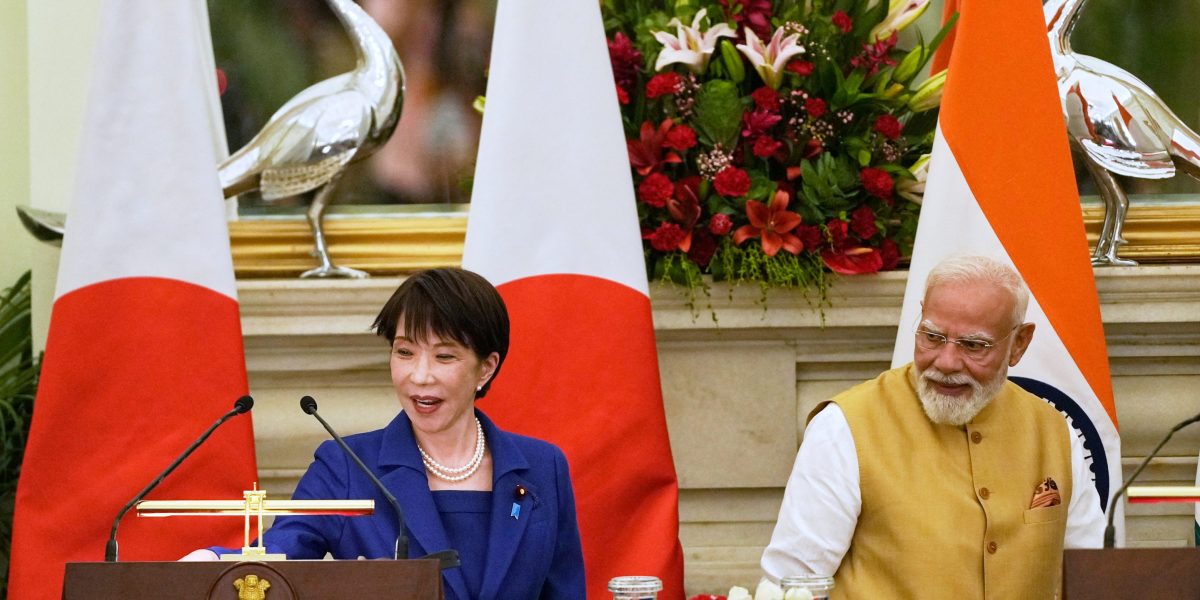
India and Japan moved to tighten defense, maritime and technology cooperation after talks between Prime Minister Narendra Modi and Japanese Prime Minister Sanae Takaichi in New Delhi on Thursday. The agreements matter because both governments are linking trade, supply chains and regional security more closely in the Indo-Pacific, according to the Associated Press.
Modi said after the meeting that the two countries adopted a road map on economic security and would work together on naval radio antenna systems, the AP reported. He also said India and Japan agreed to expand cooperation in artificial intelligence, shipbuilding, biogas, semiconductors and other critical technologies.
“India and Japan view economic security as a shared security interest,” Modi said, according to the AP.
Takaichi was in India for a three-day visit tied to the 16th annual India-Japan summit, the AP reported. The meeting followed Modi’s visit to Tokyo last year, when Japan committed to raise investment in India to more than $61 billion over the next decade.
Japan already ranks among India’s largest foreign investors and has supported major infrastructure work in the country, including the Mumbai-Ahmedabad high-speed rail project, according to the AP. About 1,400 Japanese companies operate in India, and nearly half are in manufacturing, the AP reported.
Indian government data cited by the AP showed bilateral trade reached $27.5 billion during India’s 2025-26 fiscal year. The same data showed Japanese investment in India totaled $3.2 billion from April through December 2025.
The security language in the talks also reflects the two countries’ role in the Quad, the grouping that includes India, Japan, the United States and Australia. The AP reported that the Quad promotes cooperation on regional security, maritime affairs and defense as a counterweight to China’s expanding influence in the Indo-Pacific.
Takaichi said Japan and India share support for Tokyo’s vision of a free and open Indo-Pacific grounded in freedom of navigation and respect for international law, according to the AP. She said broader maritime security cooperation was particularly important for peace and stability in the region.
China pushed back against that framing on Thursday. Chinese Foreign Ministry spokesperson Guo Jiakun said at a regular briefing in Beijing that some countries speak of “freedom and openness” while seeking “confrontation and division,” the AP reported.
Guo said the region wanted peace, development and cooperation. “Asia-Pacific needs stability, not turmoil; focus on cooperation, not division,” he said, according to the AP.
The AP reported that Ken Moritsugu contributed reporting from Beijing.
This story draws on original reporting from Fortune.