
Hamilton’s debt strategy casts a long shadow over U.S. fiscal risks
The national debt now stands at $39 trillion, even as the Treasury market remains central to global finance.
By Maya Lindqvist · Senior Technology Correspondent
3 min read
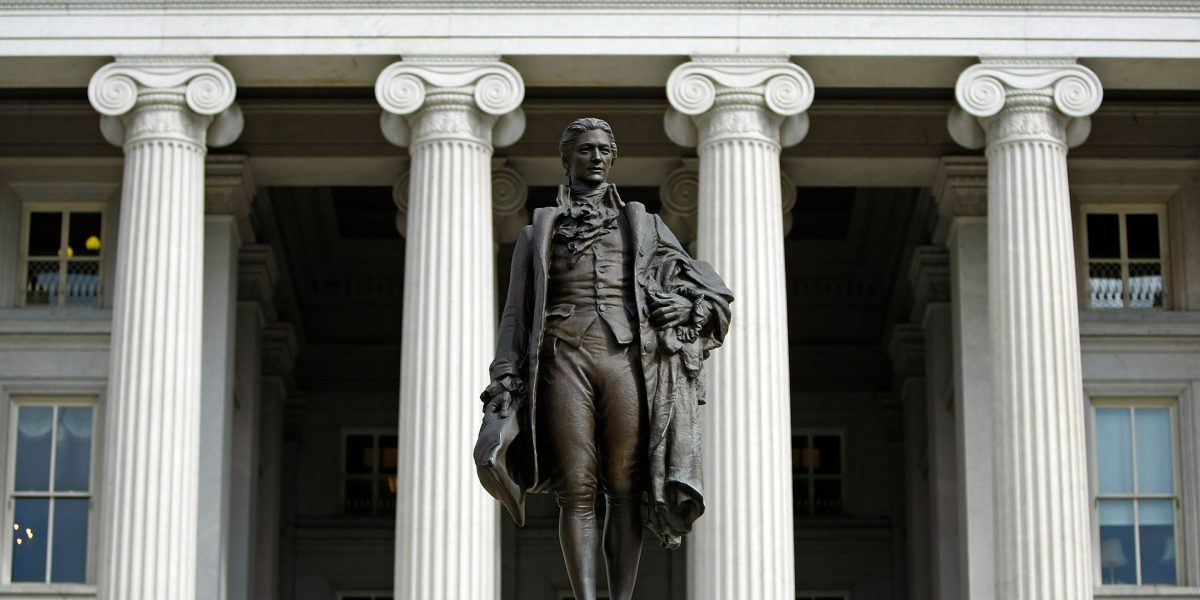
The U.S. national debt has reached $39 trillion, putting fresh pressure on federal finances and the bond market, Fortune reported. The concern is sharpened by a historical irony: the same willingness to honor and centralize debt helped the early republic build the credit standing that still supports American financial power.
As the country marks 250 years since the Declaration of Independence, Fortune traced a key part of U.S. financial history to Alexander Hamilton’s 1790 plan for Revolutionary War obligations. Hamilton, the first Treasury secretary, pushed the federal government to assume state debts and combine war-era borrowing into a national debt, according to Fortune.
How debt helped build U.S. credit
During the Revolutionary War, the Continental Congress borrowed from domestic and foreign lenders, while states also accumulated liabilities, Fortune reported. Hamilton argued that the new federal government should recognize those obligations rather than disown debts incurred before the Constitution created the current system.
Fortune reported that many investors had expected the young United States to default or force creditors to accept less than full repayment. By committing to pay, Hamilton’s plan gave the government an early reputation for reliability and helped create demand for U.S. obligations.
That credibility soon had practical effects, according to Fortune. Treasury debt began trading in European markets, and the government was able to borrow at lower cost, with later borrowing helping finance the Louisiana Purchase.
More than two centuries later, Treasury securities remain embedded in global finance. Fortune reported that they are widely treated as among the safest assets, held by central banks and companies, and tied to the dollar’s role as the leading reserve currency.
SIFMA data cited by Fortune show the Treasury market has more than $30 trillion in outstanding securities and more than $1 trillion in daily trading volume. Fortune reported that investors are still buying new U.S. debt, though some recent auctions required higher yields to attract enough demand.
Warnings over the debt path
The fiscal picture has worsened as debt service rises. Fortune reported that publicly held debt is now about the size of the U.S. economy, while annual interest costs total $1 trillion, exceeding the defense budget.
Fortune reported that federal red ink has grown sharply over the past two decades. The publication said lawmakers have continued to cut taxes in ways that reduce revenue while avoiding changes to the largest spending drivers, including Social Security and Medicare.
The Penn Wharton Budget Model recently estimated that a federal debt level above 210% of gross domestic product would mark an outer limit, Fortune reported. Above that point, PWBM warned, no feasible labor income tax could cover interest payments at returns investors would accept.
PWBM said that beyond the solvency limit, default on Treasury debt or on pay-as-you-go transfers such as Social Security becomes close to certain in inflation-adjusted terms, according to Fortune. The debt-to-GDP ratio is about 100% now.
The Congressional Budget Office forecasts that ratio will reach 175% by 2056, Fortune reported, leaving the 210% level decades away on that path. PWBM cautioned, however, that rising health care costs and Medicare spending could bring the limit closer.
Under PWBM’s scenarios cited by Fortune, the U.S. has 25 years in a lower-growth case, 22 years with medium growth and 19 years with higher growth before reaching the debt maximum. PWBM also said that if health care costs follow their historical growth rate, there is a 25% chance of reaching that point in 14 years.
This story draws on original reporting from Fortune.