
G7 weighs AI and supply-chain reliance as China looms over summit
Experts say the Evian summit is exposing allied concerns over U.S. control of AI access and China’s grip on clean-energy supply chains.
By Sofia Marchetti · World Affairs Correspondent
3 min read
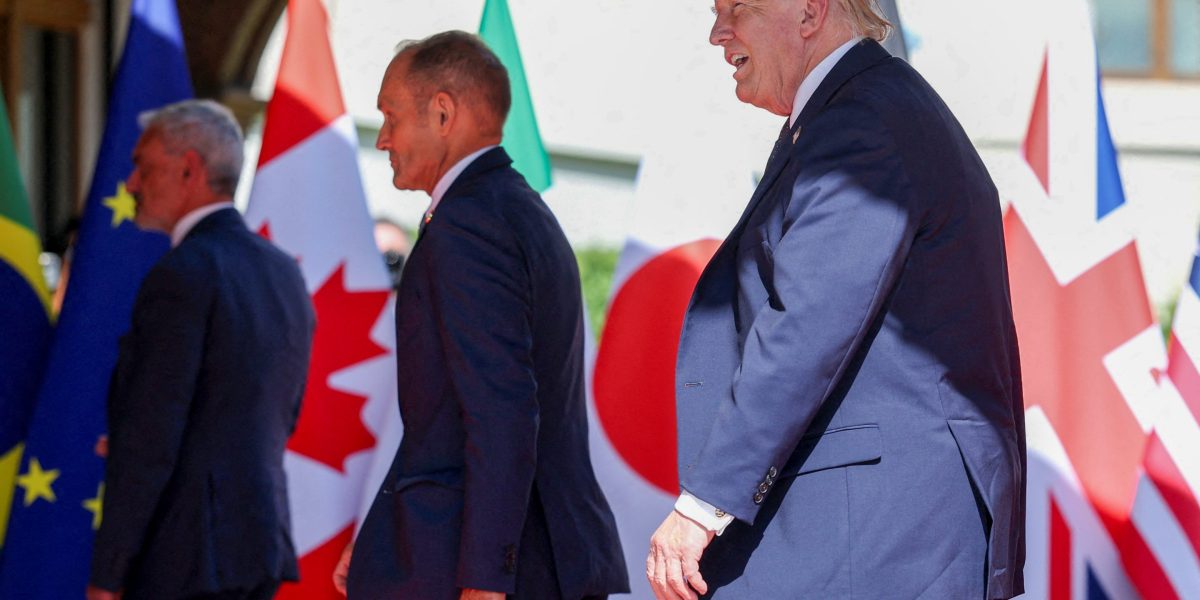
G7 leaders meeting in Evian are confronting two linked dependencies: access to U.S.-built AI systems and reliance on Chinese supply chains for energy technologies, according to policy experts cited by Fortune. The tension matters because allied governments are trying to coordinate on AI and economic security while the world’s two leading AI powers, the United States and China, sit at the center of both debates.
The summit in the French Alpine town runs through Wednesday and includes discussions on Ukraine and the Middle East, Fortune reported. Its agenda also includes AI and the broader goal of reducing global economic imbalances, a phrase experts said points in part to China’s role in manufacturing and critical minerals.
Andrea Renda, research director at the Centre for European Policy Studies, told Fortune that the Trump administration’s export controls on Anthropic’s Fable 5 and Mythos 5 frontier models will be a key issue in the AI talks. Renda said the other G7 members are upset that Washington has created different access rules for non-U.S. users of Claude Fable 5, and he described the move as a sign that U.S. AI power could be used against traditional allies.
Reuters reported that AI executives attending the summit include OpenAI’s Sam Altman, Anthropic’s Dario Amodei and Meta’s Alex Wang, among 11 AI CEOs. Even with those companies represented, Agathe Demerais, a senior policy fellow at the European Council on Foreign Relations, told Fortune that G7 promises to take a more inclusive approach to AI are unlikely to draw much interest from the United States.
Demerais said the reason is the concentration of AI power in the United States and China, leaving other G7 economies with limited room to lead. Rest of World has reported that the two countries control 90% of global computing power, and Stanford’s 2026 AI Index found that nearly eight in 10 AI companies launched in the G7 last year were based in the United States.
China is not at the G7 summit. Bloomberg reported that French President Emmanuel Macron had considered inviting Chinese President Xi Jinping, and Fortune reported that Xi held what Alisha Chhangani of the Atlantic Council’s GeoEconomics Center described as an unprecedented call with Macron before the summit.
Chhangani told Fortune that China’s position in the discussion is reflected in the summit’s language on reducing imbalances. She said that phrase refers to concerns over China, industrial overcapacity and trade deficits, adding that Europe has come to the issue later than the United States.
Matt Pearl, director of the Strategic Technologies Program at the Center for Strategic and International Studies, told Fortune that Macron is using China’s prominence in the talks to show Washington that Europe has other potential partners. Pearl said the move gives Europe some leverage as it faces U.S. export controls on AI on one side and Chinese influence over critical minerals on the other.
A memo prepared for the G7 by leading economists said China’s control over critical minerals used in green-energy technologies can deepen dependence, encourage protectionist policies and raise national security concerns among U.S. allies. Pearl told Fortune that Europe faces difficult choices because a disruption in Chinese mineral supplies or clean-energy supply chains would be severe, while losing access to leading AI models would also create major problems.
This story draws on original reporting from Fortune.