
Data center power lines test eminent domain limits
Utilities seeking land for data center power lines are raising new public-use fights as AI demand strains the grid.
By Hana Yoshida · Markets Reporter
3 min read
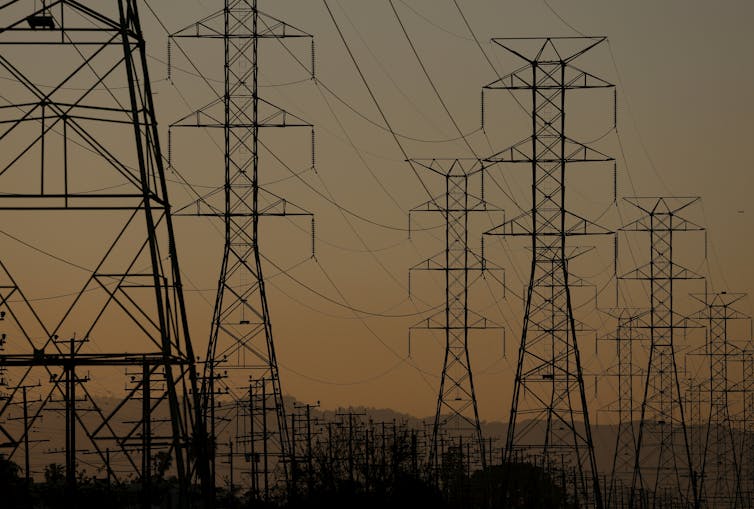
Power companies are turning to eminent domain to secure land for transmission lines tied to the data center buildout, according to Aaron Walayat, a University of Dayton law professor writing in The Conversation. The fights matter because AI facilities are increasing electricity demand while many residents oppose having them nearby.
Pew Research Center found that the United States has more than 3,000 data centers, with about 1,500 more in development. Gallup polling cited by Walayat found that 7 in 10 Americans oppose AI data centers in their own communities, pointing to concerns about utility costs, pollution, noise and the loss of open space.
President Donald Trump has promoted AI development as important to economic and national security, according to White House materials cited by Walayat. Data centers, which house servers that run large language models such as ChatGPT, also require large amounts of water and power, Walayat wrote.
Grid demand drives land fights
Data centers accounted for more than 4% of U.S. electricity use in 2024, according to Pew Research Center. Walayat wrote that more facilities will require more transmission lines, and those lines often must cross private property.
Utilities usually can try to buy easements from landowners for power lines. If owners decline, Walayat wrote, companies may seek to use eminent domain through government authority or powers delegated to utilities.
Walayat pointed to activity in states including Georgia and Pennsylvania, where power companies have looked to eminent domain as part of transmission expansion plans. The legal issue is sharper when a line appears to serve a private data center rather than a broad set of customers.
The public-use test
The Fifth Amendment allows private property to be taken without an owner’s consent only for public use and with just compensation, according to the National Constitution Center material cited by Walayat. Most condemnation actions are handled by state and local governments, though the federal government also has eminent domain authority.
States may allow private entities such as power or water companies to use that power, Walayat wrote, but the rules differ by state. In Texas, for example, the state Supreme Court has said a common-carrier project must serve the public and cannot exist only for the builder’s exclusive use.
The U.S. Supreme Court has read “public use” broadly, Walayat wrote. In its 2005 Kelo v. City of New London decision, the court allowed New London, Connecticut, to take homes for private redevelopment around a Pfizer facility on economic development grounds.
That redevelopment did not occur, and Pfizer later left New London, according to accounts cited by Walayat. After the Kelo decision, 45 states passed eminent domain reform laws, and some state high courts have applied their own constitutions more narrowly than federal law.
Walayat cited Michigan, Ohio and Oklahoma as states where supreme courts have barred taking private property and transferring it to another private party solely for economic development. He wrote that landowners may have better chances under state constitutions than in federal court, although courts often allow utilities to use eminent domain.
Courts have split on transmission lines
State court rulings on power-line condemnations have varied, according to Walayat. The supreme courts of South Dakota and Vermont upheld seizures by power companies after finding that some in-state power service or grid reliability benefits satisfied public-use requirements.
Mississippi reached a different result in 1984, Walayat wrote. The state Supreme Court rejected a utility’s condemnation effort for a line that would have run from Mississippi into Louisiana without benefiting Mississippi customers.
Those cases suggest that transmission projects meant to support reliability for in-state customers are more likely to qualify as public use, Walayat wrote. Landowners may still challenge projects by arguing that a new line chiefly benefits a private data center or customers outside the state.
This story draws on original reporting from Fortune.