
Carney says Anthropic curbs show risk of dependence on US AI
Canada’s prime minister tied new U.S. limits on Anthropic models to his push for broader trade and technology ties.
By Daniel Okafor · Business Editor
3 min read
Canadian Prime Minister Mark Carney said U.S. limits on Anthropic’s latest artificial intelligence models show the risk of depending too heavily on a small group of American technology providers. His remarks put AI supply and access on the agenda as Group of Seven leaders prepare to meet in France.
Carney spoke Sunday in Ireland before traveling to the G7 summit in Evian-les-Bains, France, according to The Associated Press. He said AI would be a major topic in discussions Monday night.
Anthropic said Friday that it had taken its newest models, Fable 5 and Mythos 5, offline to comply with a Trump administration directive aimed at blocking use by foreign nationals, the AP reported. The controls are the most far-reaching U.S. move so far to limit access to advanced AI models, according to the AP.
Anthropic models pulled back
Anthropic, which is based in San Francisco, had released Fable widely earlier in the week, the AP reported. Fable is a restricted version of Mythos, a more powerful model whose availability Anthropic has already limited because of cybersecurity concerns.
Anthropic said when it announced Mythos on April 7 that the model was capable enough to beat human cybersecurity experts at finding and exploiting software weaknesses, according to the AP. The company said that was why access had been confined to selected customers.
Carney said the episode showed what can happen when countries and companies rely too much on particular models, according to the AP. He said no party had necessarily acted improperly, but said governments would be making a mistake if they failed to draw a lesson and broaden their options.
Carney also said he had spent 45 minutes discussing AI with French President Emmanuel Macron on Friday night, the AP reported. He cautioned that the summit would not produce a simple declaration of success because the issues are complicated.
Canada links AI access to trade strategy
Carney connected the AI restrictions to Canada’s wider effort to reduce dependence on the United States in trade and technology, according to the AP. More than 70% of Canadian exports go to the U.S., and Carney has set a target of doubling exports to other markets over the next decade.
The AP reported that President Donald Trump’s trade war has cooled investment. Carney does not have a separate bilateral meeting scheduled with Trump at the G7, even though the U.S.-Mexico-Canada trade agreement is due for renewal.
Carney said USMCA talks at the summit would be handled by the main negotiators, according to the AP. He named Dominic LeBlanc, Canada’s minister responsible for U.S. trade, Janice Charette, Canada’s chief negotiator, U.S. Trade Ambassador Jamieson Greer and Treasury Secretary Scott Bessent as participants in those discussions.
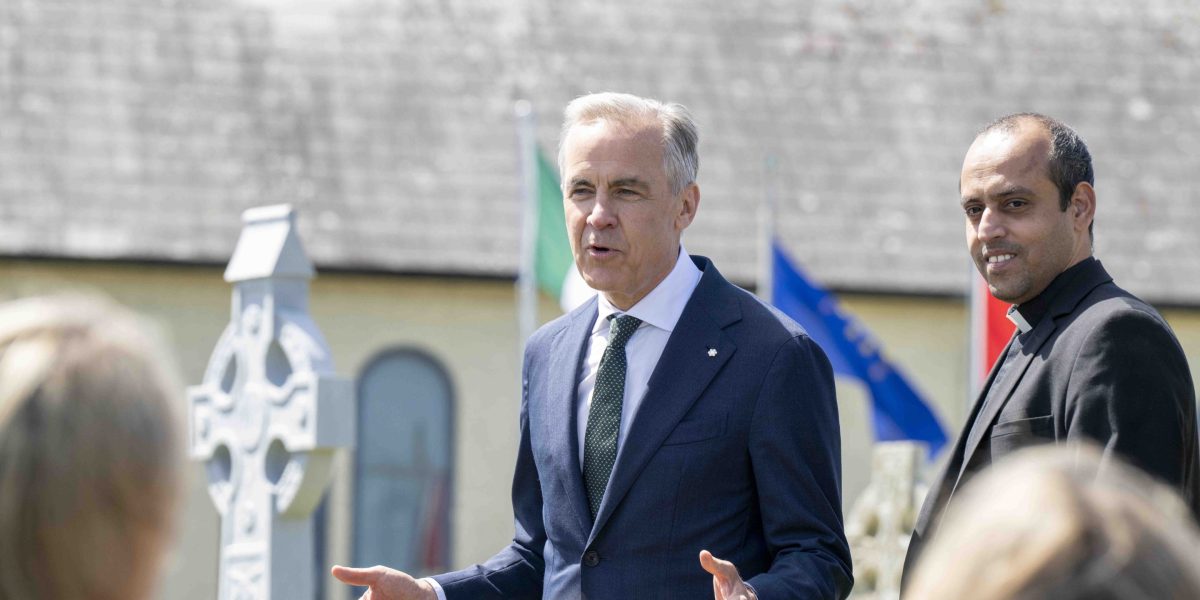
Earlier Sunday, Carney visited Aghagower, the County Mayo village where his grandparents, Robert Carney and Nora Moran, lived before moving to Canada in the 1920s, the AP reported. Local resident Owen Morgan, who attended with his 17-month-old son, Malachy, told the AP that people in Mayo were proud of Carney and admired his defense of Canadians.
This story draws on original reporting from Fortune.