
Bezos says AI will create a labor shortage as job fears persist
The Amazon founder used a Paris tech conference to argue AI will expand demand for workers while promoting his startup Prometheus.
By Sofia Marchetti · World Affairs Correspondent
3 min read
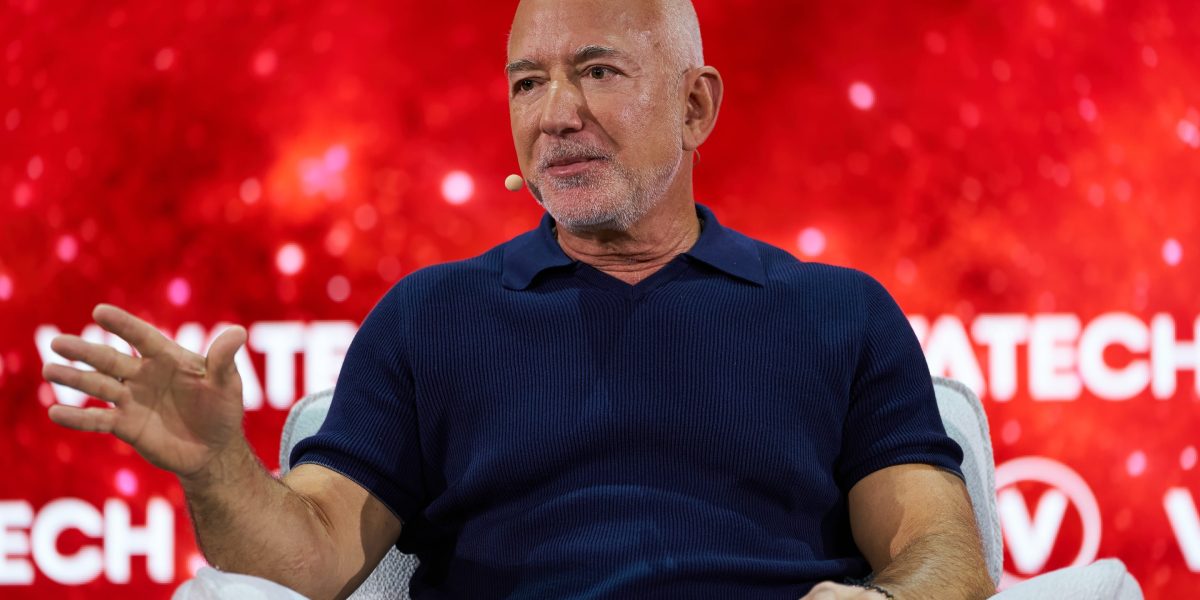
Jeff Bezos told the VivaTech conference in Paris that artificial intelligence will create more demand for workers, a view that runs against widespread fears of AI-driven layoffs. His remarks matter because major companies are already cutting jobs while executives and economists debate whether the technology will displace workers or raise productivity enough to create new roles.
Speaking Wednesday with Blue Origin CEO David Limp, the Amazon founder rejected the idea that AI will make people unnecessary in the economy. “I know there’s a lot of concern that many people have, including many smart people, that AI is going to make humans redundant,” Bezos said. “I totally disagree with this point of view. And I think, in fact, AI is going to create a labor shortage.”
Bezos argued that people have “endless” ambitions and projects, and that AI will lower the barriers that currently limit what they can do. In his view, that would increase the need for human work rather than shrink it.
He made a similar case in a May interview with CNBC, using a comparison between bulldozers and shovels to argue that new tools can raise output and expand opportunity. CNBC reported that Bezos also predicted productivity gains could bring deflation and pushed back on fears that skilled workers such as radiologists and software engineers would be broadly replaced.
Job concerns remain high
Public concern over AI’s labor impact remains broad. A Reuters/Ipsos poll published this month found that half of U.S. respondents feared AI could cost them, or someone in their household, a job.
Warnings have also come from policy and tech leaders. A Federal Reserve governor said in February that a “jobless boom” in which many workers become “essentially unemployable” was “totally possible.” Anthropic CEO Dario Amodei has predicted “unusually painful” disruption in white-collar work, though Fortune reported that Amodei and OpenAI CEO Sam Altman later softened earlier warnings ahead of their companies’ expected IPOs.
The debate is playing out during a difficult stretch for technology workers. Fortune reported that tech layoffs through May 2026 topped 115,000, nearing the total for all of 2025, with Meta, Amazon and Snap among companies that cited AI as a factor in cuts. Goldman Sachs has estimated that AI is eliminating about 16,000 U.S. jobs a month, with entry-level and Gen Z workers hit hardest. A CFO survey cited by Fortune found AI-related layoffs could be nine times higher in 2026 than last year.
Prometheus and the physical economy
Bezos also used the VivaTech appearance to discuss Prometheus, the AI startup he co-founded in November 2025 with former Google X scientist Vik Bajaj. Fortune reported that the company has raised $12 billion at a valuation of about $41 billion, making it one of the largest early-stage AI fundraises on record.
Prometheus is focused on engineering and manufacturing, including aerospace, automotive work and drug development, according to Fortune. In a CNBC interview, Bezos described the company’s goal as building an “artificial general engineer,” a design system that can model, predict and improve physical products such as jet engines and pharmaceuticals. He called it “a very, very modern version of CAD.”
Bezos has also corrected descriptions of Prometheus as a robotics company. In a CNBC interview, he interrupted a question that framed the startup that way and said, “We have nothing to do with robotics.”
At VivaTech, Bezos tied his broader technology agenda to space exploration. He said lower launch costs and access to materials from asteroids, near-Earth objects and the moon could allow the most polluting industries to move off Earth. McKinsey has projected a 30% shortfall in magnetic rare earth minerals by 2035, according to Fortune.
Limp also gave an update on Blue Origin’s New Glenn launch pad in Cape Canaveral, Florida, after a May explosion. He said reconstruction has started, but did not provide a launch schedule.
This story draws on original reporting from Fortune.