
Atlas robot delivers World Cup ball at Brazil-Norway halftime
Boston Dynamics’ humanoid Atlas appeared pitchside in a World Cup first as Hyundai used the match to show its robotics ambitions.
By Hana Yoshida · Markets Reporter
3 min read
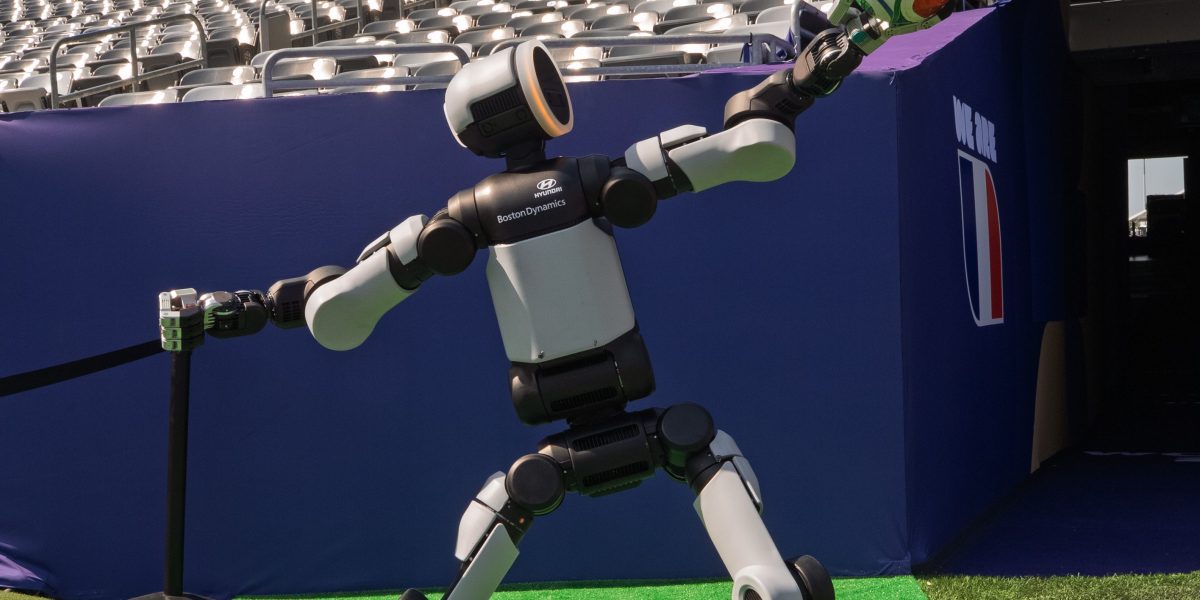
A humanoid robot named Atlas delivered the match ball during halftime of Brazil and Norway’s Round of 16 World Cup game at New York/New Jersey Stadium on Saturday, Fortune reported. The appearance put Boston Dynamics’ human-shaped machine before about 80,000 spectators in the stadium and a global television audience.
According to Fortune, the five-foot robot walked along the pitch, performed goal celebrations modeled on Harry Kane, Erling Haaland, Matheus Cunha and Son Heung-min, then gave the ball to the referee. Fortune reported that the moment was the first of its kind in FIFA World Cup history.
Atlas was built by Boston Dynamics, which is owned by Hyundai Motor Company. Sungwon Jee, Hyundai Motor Company’s executive vice president and global chief marketing officer, told Fortune the World Cup appearance was meant to introduce Atlas publicly and show how robots could become useful partners for people.
How Atlas learned the soccer routine
Boston Dynamics describes Atlas as a fifth-generation humanoid robot designed for demanding industrial work, Fortune reported. The robot is fully electric, about human-sized, has 56 independent points of movement, can reach 2.3 meters and can lift as much as 110 pounds, according to the report.
Fortune reported that Atlas can also replace its own batteries without human help. Alberto Rodriguez, Boston Dynamics’ director of robot behavior, told Fortune that the robot’s actions are now learned through training rather than written as fixed instructions.
Rodriguez told Fortune that Atlas learned soccer movements in a way closer to how large language models are trained than how a conventional factory robot is programmed. The company showed Atlas video of professional players and used human motion-capture recordings, including data from Boston Dynamics engineers performing the moves, according to Fortune.
Those examples were fed into a physics simulation, where Atlas could repeat the actions millions of times across cloud GPUs, Fortune reported. According to the report, the robot completed in about 24 hours a training process that would take a human athlete about a year of physical trial and error.
Grass created a specific challenge, Rodriguez told Fortune, because feet can slip or catch on the surface. Boston Dynamics adjusted Atlas’ training so it could walk and run on concrete as well as more difficult surfaces such as a soccer pitch, he said.
Engineers also made the simulated training harder by changing friction, moving the ball, adding obstacles and giving Atlas false information about its feet or the ball’s position, Rodriguez told Fortune. He said the goal was to build behaviors that could hold up when real-world conditions were imperfect.
Hyundai’s robotics push
Hyundai Motor Group bought a controlling stake in Boston Dynamics from SoftBank in 2021, Fortune reported. Hyundai has sponsored FIFA for 27 years, according to Jee.
Fortune reported that Hyundai has pledged $26 billion in U.S. investment over four years, including a robotics manufacturing site near Savannah, Georgia. The facility is expected to be able to make 30,000 Atlas units a year by 2028, according to the report.
Atlas is already being tested in Hyundai factory settings, with early work focused on part sequencing in auto manufacturing, Fortune reported. Jee told Fortune that Hyundai sees robotics as part of its competitive strategy, along with autonomous systems and smart infrastructure.
This story draws on original reporting from Fortune.