
AI payoff delay raises market repricing risk, economist says
Apollo’s Torsten Slok says AI returns remain concentrated in tech, leaving market valuations exposed if broader productivity gains take longer.
By Hana Yoshida · Markets Reporter
3 min read
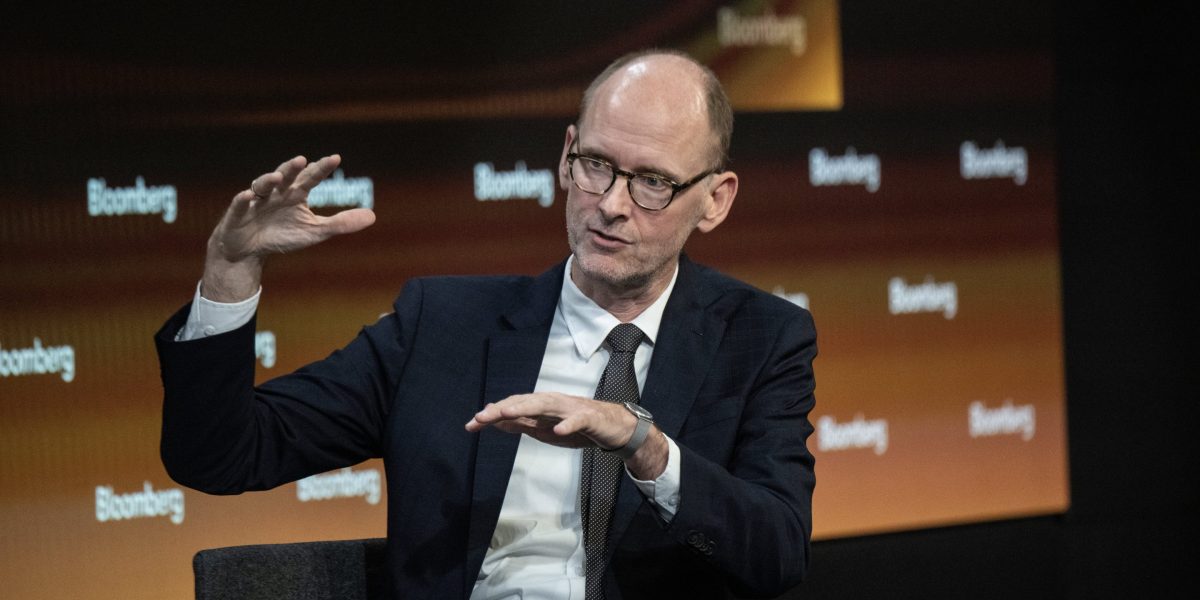
Apollo Global Management chief economist Torsten Slok warned that investors may be expecting artificial intelligence to lift corporate profits faster than most companies can make it work. In a recent Apollo blog post, Slok said the delay could leave AI-linked market valuations vulnerable to a sharp repricing.
Slok’s argument centers on the difference between technology companies and the rest of the economy. He said software and tech businesses have been able to fold AI into operations more readily, while many large companies face slower adoption because of regulation, data-security demands and the difficulty of changing workflows.
“The key issue is the length of the ROI runway outside the tech sector,” Slok wrote, referring to return on investment. He said current earnings expectations may be running ahead of the time companies need to produce financial gains from AI spending.
Profit gains remain concentrated in big tech
Slok cited Bloomberg and Macrobond data showing that profit margins for the Magnificent Seven rose from about 15% to 25% between the first quarters of 2023 and 2026. Over the same period, he said, margins for the other 493 companies in the S&P 500 stayed near 10%.
The Bloomberg 500 Index showed a similar divide, according to Slok’s analysis, with profit margins around 12% during that span. He warned that if market prices keep reflecting expectations for broad AI-driven earnings while actual returns lag, investors could face a “painful repricing.”
Slok also pointed to a 2025 MIT study that found only 5% of companies had achieved meaningful returns from generative AI pilot projects. He said companies may pull back on AI spending if they do not see results quickly.
Companies are finding limits in automation
Fortune reported that Ford has hired 350 veteran engineers, including former employees, to help train younger staff and fix AI tools that were not performing as needed. The automaker is still using AI vision systems across 33 plants worldwide, with more than 1,000 cameras conducting assembly-line inspections, but executives said human expertise remains central.
Ford executive Charles Poon told reporters that AI depends on the quality of the information used to train it. He said the company had not paid enough attention in prior years to the experience of its most knowledgeable engineers.
IBM also shows the mixed labor picture around AI, according to Fortune. After cutting thousands of jobs last year as it spent more on cloud services, IBM said in March that it would triple entry-level hiring in the United States across its business units and argued that AI-first workplaces still need more workers.
Cost remains another obstacle. Nvidia applied deep learning executive Bryan Catanzaro said earlier this year that AI remains more expensive than human labor, Fortune reported. Slok said corporate efforts to optimize token use signal that companies are trying to control AI costs while still searching for productivity gains.
Adoption takes time and money
Peter Cappelli, a management professor at the University of Pennsylvania’s Wharton School, told Fortune that companies often underestimate how much work is required to turn AI into measurable returns. He said technology sellers tend to describe what is possible, while paying less attention to what is practical.
Cappelli studied Ricoh’s use of AI to process insurance-claim administration, a case published in Harvard Business Review. According to Fortune, the project required about $500,000 in outside consulting fees and $200,000 a month in AI fees, making the work three times more expensive than manual processing at one point.
Ricoh ultimately raised the division’s productivity threefold, Cappelli said, while reducing headcount from 44 to 39 employees. His conclusion supports Slok’s warning: AI may produce productivity gains, but the payoff can require more time and upfront cost than investors currently assume.
This story draws on original reporting from Fortune.