
UK moves to ban support for Iran’s Revolutionary Guard
Draft rules would make backing the IRGC and two other groups a criminal offence under new state-threat powers.
By Lucas Ferreira · Science & Environment Writer
3 min read
The British government is seeking parliamentary approval to designate Iran’s Islamic Revolutionary Guard Corps as a national security threat, a step that would criminalise support for the organisation in the UK. The move matters because ministers say the new powers are aimed at state-backed activity including sabotage, interference and attacks on people in Britain.
In a statement on Monday, the government said it had submitted draft regulations to Parliament targeting the IRGC under new powers for foreign state proxies. Al Jazeera and Reuters reported that the measure follows a series of anti-Semitic attacks in the UK.
If Parliament approves the regulations, people could face criminal charges for inviting support for the IRGC, expressing support for it, helping it carry out UK-related activity, taking actions likely to materially assist it, or accepting material benefits from it or on its behalf, according to the government statement cited by Al Jazeera and Reuters.
The government also named two other bodies as the first groups to be designated under the new state-threat powers: the Islamic Movement of Companions of the Right, described as an Iran-backed group, and Russia’s GRU Volunteer Corps. The Islamic Movement of Companions of the Right claimed seven attacks on Jewish sites in Britain earlier this year, according to Al Jazeera and Reuters.
British police have investigated attacks on Jewish-linked locations in London as anti-Semitic hate crimes, including the burning of four ambulances belonging to a Jewish community charity in March. Three men were charged with arson in April, according to earlier reporting cited by Al Jazeera.
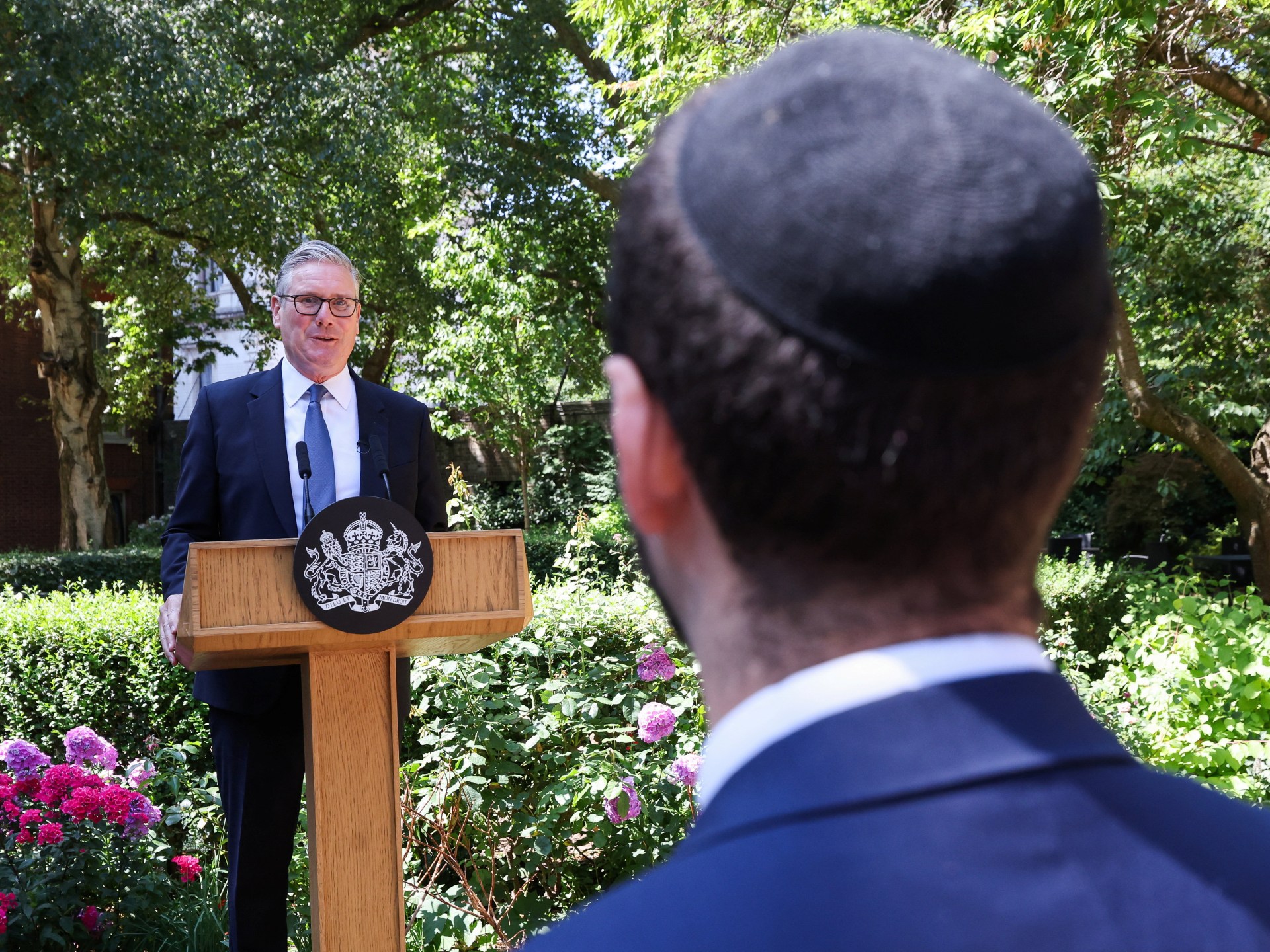
The government said that, once the rules are approved, people who carry out sabotage such as arson on behalf of the designated groups could face life imprisonment. Caretaker Prime Minister Keir Starmer said the powers would help prosecutors jail people carrying out work for such organisations in Britain.
Home Secretary Shabana Mahmood said Iran and Russia were using proxies and criminals in the UK, and said the three groups had been designated so that those working for them could be pursued and jailed. The legislation gives ministers powers similar to proscription for foreign state proxies deemed a threat to national security, according to the government.
Under the new approach, prosecutors would not have to prove a separate foreign power link in cases involving groups that have already been designated. Al Jazeera’s Charlie Angela, reporting from London, said the designation could take effect as early as Friday if Parliament approves it later this week.
The British government said the IRGC has used proxies and criminal networks to target people abroad, especially Jewish communities and Iranian dissidents. Tehran has previously denied using proxies, according to Al Jazeera and Reuters.
Angela said the measure would likely worsen relations between London and Tehran. Al Jazeera reported that Foreign Secretary Yvette Cooper had summoned Iran’s ambassador to the Foreign Office and questioned him.
The government also said Russia uses the GRU Volunteer Corps for intelligence-gathering and covert hostile activity, and accused it of having a record of targeting the UK and its allies.
This story draws on original reporting from Al Jazeera.