
Historic Vandenberg launch towers demolished for SpaceX use
Space Launch Complex-6 is being cleared for Falcon missions after decades tied to canceled military and shuttle programs.
By Hana Yoshida · Markets Reporter
3 min read
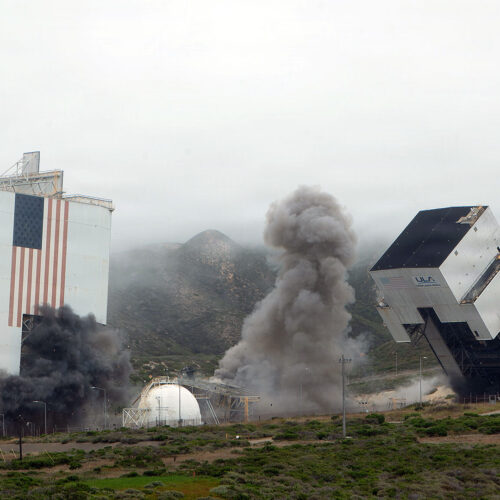
Crews at Vandenberg Space Force Base demolished three major structures at Space Launch Complex-6 on June 16, clearing a historic California pad for SpaceX Falcon launches. Ars Technica reported that the controlled blasts removed hardware from a site long associated with canceled military human-spaceflight plans and the unfulfilled idea of West Coast space shuttle missions.
Space Launch Delta 30 said the demolition took place at Vandenberg in Southern California and was completed at 11 a.m. PDT. According to Ars Technica, charges first brought down the access tower, then the mobile service tower and finally the remaining assembly building.
Col. James T. Horne III, commander of Space Launch Delta 30, said in a Vandenberg statement that “Space Launch Complex-6 represents six decades of American innovation” and reflects a continuing effort to secure U.S. space capabilities. Horne said the modernization work is being done with industry partners and builds on earlier programs at the site.
A pad with a long delayed launch history
Ars Technica reported that SLC-6, often pronounced “slick-six,” began in 1966 as part of the Air Force’s Manned Orbiting Laboratory program. That effort aimed to send military astronauts into orbit using systems adapted from NASA’s Gemini program, but the Air Force canceled it in June 1969 before the pad hosted a launch.
The Air Force later selected the complex for dedicated Department of Defense space shuttle missions, according to Ars Technica. The plan included basing the orbiter Discovery in California, and the pad was built around a different approach than Kennedy Space Center, with shuttle stacking done directly at the launch site.
That shuttle plan also ended without an operational launch from SLC-6. Ars Technica reported that NASA’s prototype orbiter Enterprise was placed on the pad with an external tank and solid rocket boosters in 1985, but the Challenger disaster in 1986 led the Defense Department to reconsider its use of the shuttle.
After a short-lived Titan IV revival effort in the early 1990s, the complex finally supported operational launches later that decade, Ars Technica reported. Lockheed Martin’s LMLV-1 flew from the site in 1995, followed by Athena I and Athena II missions in 1997 and 1999 carrying payloads for NASA and Space Imaging, later GlobalEye.
Boeing, and later United Launch Alliance, leased the pad and changed the shuttle-era buildings for Delta IV missions, according to Ars Technica. The site supported 10 Delta IV launches for the National Reconnaissance Office, with the most recent SLC-6 launch being a Delta IV Heavy on Sept. 24, 2022.
SpaceX plans next phase
SpaceX signed a lease for SLC-6 in 2023, Ars Technica reported. The company has launched Falcon 9 rockets from Vandenberg’s Space Launch Complex-4 since 2013, and the new pad will support Falcon 9 and Falcon Heavy missions.
A 2025 environmental impact study said SpaceX expected another 18 months of work to modify SLC-6, including building two landing pads for reusable Falcon 9 first-stage boosters. According to that study, Falcon Heavy launches could begin as soon as 2030, depending on the National Reconnaissance Office’s requirements.
Ars Technica also reported that SpaceX previously acquired the 76-wheel Orbiter Transporter System developed for the shuttle-era California site. The company now uses that vehicle in Florida to move flown Falcon 9 first stages from Cape Canaveral facilities to launch pads.
This story draws on original reporting from Ars Technica.