
Senteon adds Microsoft Office hardening to endpoint security platform
The new Productivity Hardening module adds 213 CIS-aligned Office settings and takes Senteon’s automated configurations past 3,000.
By Maya Lindqvist · Senior Technology Correspondent
2 min read
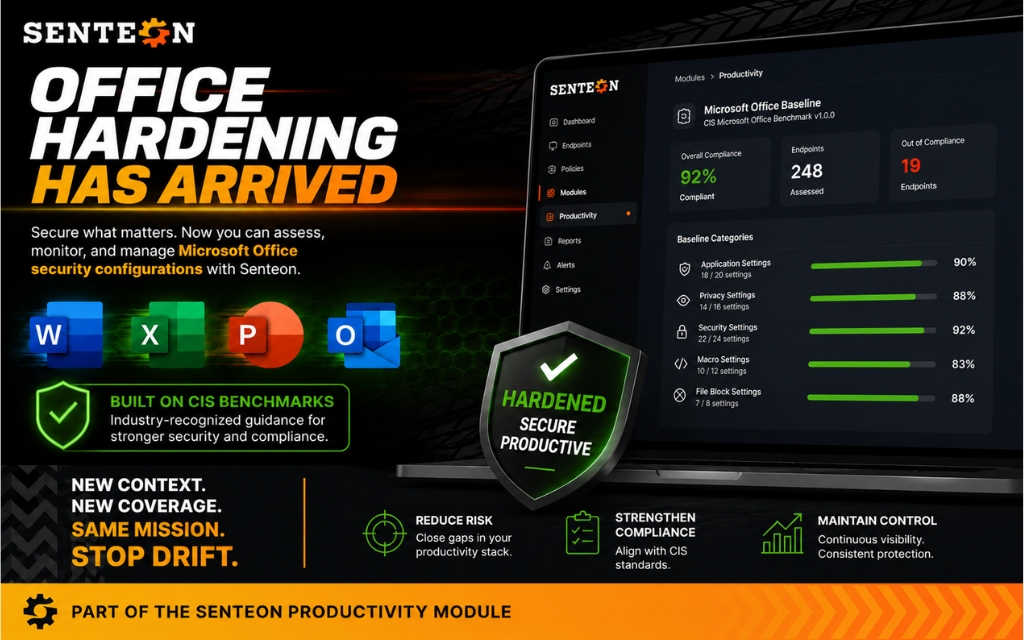
Senteon has added Microsoft Office hardening to its automated endpoint security platform, extending its coverage beyond operating systems, browsers and other endpoint components. The release matters for enterprise IT teams because Office applications are common business tools and a frequent target for attacks that abuse macros, settings and user behavior.
The new Productivity Hardening module starts with Microsoft Office and includes 213 security settings aligned with CIS Benchmarks, Senteon said. With the addition, the company says its platform now automates more than 3,000 endpoint security configurations.
Microsoft Office remains a core application suite for many organizations, with Word, Excel, Outlook and PowerPoint used across departments and devices. Security programs often put more attention on operating systems and browsers, while application-level settings can receive less routine oversight.
Senteon’s Office support is designed to apply approved settings, check whether they remain in place and restore them if they change. The company positions that as an alternative to managing Office security through one-time policy deployments, scripts or manual Group Policy work.
Henry Zhang, Senteon’s chief executive, said employees spend much of their workday inside Office applications and attackers often look there for an opening. He said the new module is meant to help organizations secure the application suite while keeping configurations consistent over time.
What the module covers
The Microsoft Office hardening module is available immediately as part of Senteon’s Productivity Hardening release. It adds automated configuration management for Office to the company’s existing endpoint hardening coverage.
According to Senteon, the release enables organizations to:
- Apply 213 Microsoft Office security settings aligned with CIS Benchmarks
- Monitor endpoints for unauthorized configuration changes
- Remediate configuration drift automatically
- Keep security baselines consistent across users and devices
- Reduce administrative work tied to security configuration management
- Support security and compliance programs with standardized settings
Configuration drift is a common operational problem in endpoint security. A device may start with an approved baseline, then fall out of line because of user changes, software updates, troubleshooting or policy conflicts.
Senteon says its platform continuously validates endpoint configurations and returns settings to an approved state when drift occurs. That approach is intended to keep controls active after initial deployment, rather than relying on periodic audits or manual checks.
The Office release broadens Senteon’s platform across Windows operating systems, Office, browsers and other endpoint components. For security teams, the announcement reflects a broader move in endpoint management toward continuous configuration enforcement instead of one-time hardening projects.