
Satellite pair sharpens test of Einstein’s frame-dragging effect
Researchers used laser ranging to track LARES-2 and LAGEOS, cutting uncertainty in Earth’s frame-dragging measurement to 0.2%.
By James Whitfield · Staff Writer
3 min read
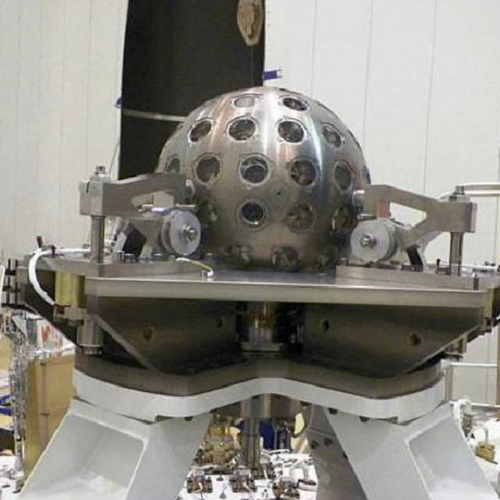
A laser-tracked satellite has delivered the most precise measurement yet of how Earth’s rotation drags space-time, according to a team led by physicist Ignazio Ciufolini of the Wuhan Institute of Physics and Mathematics. The result tests a prediction of Albert Einstein’s general theory of relativity and tightens limits on alternative theories of gravity.
The work, published in Nature, measured the terrestrial Lense-Thirring effect, also called frame dragging. General relativity predicts that a spinning mass pulls nearby space-time around with it, an effect easiest to see near fast-rotating, extremely massive objects such as black holes.
Earth produces the same effect, but far more weakly. Ciufolini’s team reports that its measurement reduced the uncertainty from several percent to 0.2 percent.
A dense target in orbit
The experiment centered on LARES-2, the Laser Relativity Satellite 2, built by the Italian Space Agency. The satellite is a solid sphere of Inconel 718, a dense nickel-chromium alloy, a little more than 40 centimeters wide and weighing 294.8 kilograms.
LARES-2 carries 303 corner-cube retroreflectors but has no thrusters, solar panels or onboard electronics, according to the researchers. Its dense, compact design gives it the lowest area-to-mass ratio of any satellite in medium-Earth orbit, reducing the effect of non-gravitational forces such as light pressure from photons.
A Vega-C rocket placed LARES-2 in orbit in July 2022 at an altitude of about 12,265 kilometers. Once there, ground stations fired short laser pulses at the satellite and measured the returning light, allowing researchers to locate it to about 1 millimeter.
The team used roughly 200,000 observations collected from July 2022 through June 2025.
Canceling Earth’s ordinary gravity noise
Earth’s uneven shape makes the measurement hard. The planet’s equatorial bulge shifts satellite orbits through ordinary Newtonian gravity by amounts much larger than the relativistic frame-dragging signal.
Ciufolini and physicist John Archibald Wheeler had earlier proposed a way to suppress that interference: use two satellites in supplementary orbits, with inclinations that add to 180 degrees. In that setup, the Newtonian effects from Earth’s oblateness cancel, while the Lense-Thirring effect adds in the same direction.
LARES-2 was paired with LAGEOS, a NASA laser-ranging satellite launched in 1976. The inclinations of LARES-2 and LAGEOS added to 180.01 degrees, close enough for the experiment, according to the team.
The researchers also had to account for the K1 lunisolar tide, a disturbance caused by the Moon and Sun changing Earth’s shape and gravitational field. Ciufolini described that tide as the experiment’s main obstacle.
To remove it, the team analyzed one full 1,050-day precession cycle of the satellites. They also subtracted six smaller tidal components with known periods from 135 to 910 days.
After those corrections, the combined satellite data showed a steady drift of about 61.3 milliarcseconds per year. The researchers identified that drift as the frame-dragging signal predicted by general relativity.
Limits on rival gravity models
The result agreed closely with Einstein’s theory, with a reported error of one to two parts per thousand based on the team’s statistical models. Ciufolini said the measurement also narrows the range of possible versions of Chern-Simons theory, an alternative framework that modifies Einstein’s equations and predicts a different amount of frame dragging.
The study does not rule out Chern-Simons theory, according to Ciufolini, but it restricts the forms it can take. The same analysis also improved the measurement of the K1 tide’s strength, which he said could aid Earth science research, including indirect studies related to earthquakes.
Ciufolini said laser-ranged satellites such as LARES-2 and LAGEOS can remain useful for hundreds of years. More tracking data could further improve future measurements of frame dragging.
This story draws on original reporting from Ars Technica.