
Sacramento deputies use magnet-equipped drone to pull knife from suspect
The sheriff’s office promoted the operation as drone use grows across U.S. law enforcement and draws scrutiny from civil liberties groups.
By Maya Lindqvist · Senior Technology Correspondent
3 min read
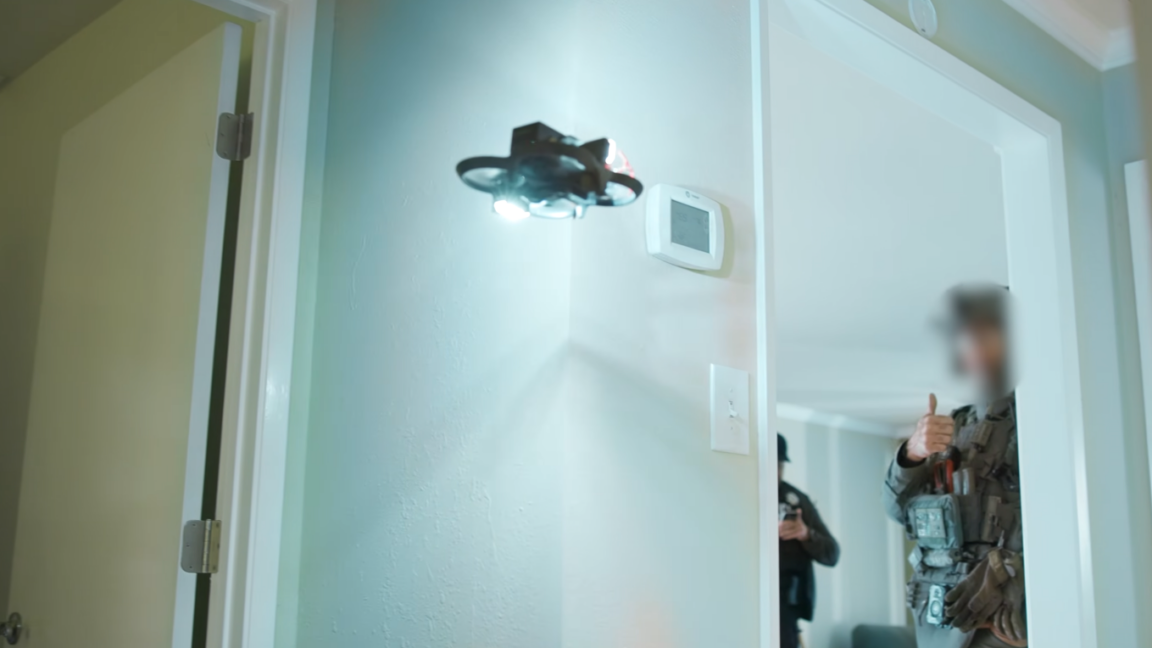
The Sacramento County Sheriff’s Office says a small drone fitted with a dangling magnet removed a knife from the hand of an unresponsive suspect during a SWAT operation in California. The incident highlights how police agencies are experimenting with drones beyond surveillance, even as civil liberties groups warn that the technology needs stronger limits.
In videos posted June 22 to Facebook and Instagram, the sheriff’s office described the case as a “nationwide first.” The office said deputies had surrounded a residence after a known felon and parolee-at-large had earlier been seen with a firearm.
According to the sheriff’s office, a first drone found the suspect in a garage. The agency said the person was armed with a knife and a firearm and was not responding to negotiators.
Footage shared by the office shows the suspect wearing a gray hoodie, lying facedown on a chair or sofa and holding a knife in an outstretched hand. A second drone, flown by an operator using first-person-view goggles, entered the garage with a magnet suspended from a cable.
The drone used the magnet to attach to the knife blade and pull it from the suspect’s hand. The video then shows the drone carrying the spinning knife outside, where officers could recover it. The sheriff’s office did not make clear what happened to the gun it said the suspect had possessed.
Sheriff Jim Cooper told The Hill on NewsNation that the suspect initially responded to law enforcement but “may have overdosed.” Cooper credited a patrol officer with suggesting the magnet and said the tactic “possibly saved someone’s life, preventing us from taking a life.”
The sheriff’s office praised what it called the drone pilot’s creativity and precision. Some commenters on the agency’s Facebook post pointed out that the suspect did not appear to be moving. Vic Moss, CEO and co-founder of the Drone Service Providers Alliance, wrote in a Facebook comment: “The dude was comatose. You could’ve disarmed him with a marshmallow. But congrats on good use of the drone.”
Drones expand in police work
The episode comes as drones have become common equipment for police departments and sheriff’s offices. The Electronic Frontier Foundation’s Atlas of Surveillance database lists more than 1,800 U.S. law enforcement agencies that have operated drones.
Most police drone use remains focused on scouting, overhead views and surveillance. Cooper told The Hill that Sacramento deputies use drones “all the time” to fly into houses, garages and dog doors.
The sheriff’s office has also promoted its SCOUT team, short for Sheriff’s Craft Observation, Utilizing Technology, including a March 2026 video about one of its drone operators. In an October 2025 Sacramento County incident reported by KCRA, a man with a rifle shot down one of the sheriff’s office drones before officers negotiated his surrender.
The EFF said in 2025 that “drone as first responder” programs were spreading, with companies marketing systems that can give police faster aerial views and broader surveillance tools. The group named vendors including Flock Safety, Axon and Skydio, and Brinc with Motorola Solutions; Flock’s drones include automated license plate readers, according to the company.
Beryl Lipton, a senior investigative researcher at the EFF, wrote that drone cameras can record homes, backyards and people’s movements from unusual angles. She said agencies need clear rules on retention, audits and use, including when cameras should not be recording.
Sacramento County’s 2025 annual report listed 18 drones in the sheriff’s office inventory, including multirotor drones made by DJI and Autel and a fixed-wing Event 38 model capable of vertical takeoff and landing. KCRA reported that county supervisors unanimously approved buying 27 more drones in September 2025, with a starting price of $5,000 each, as part of a roughly $1 million package that also included a robot, a BearCat armored vehicle and other equipment.
This story draws on original reporting from Ars Technica.