
Russia’s reusable Amur rocket slips toward 2031 flight tests
Roscosmos is now focused on a first-stage demonstrator, with early hop tests planned for 2028, according to a Russian rocket official.
By James Whitfield · Staff Writer
3 min read
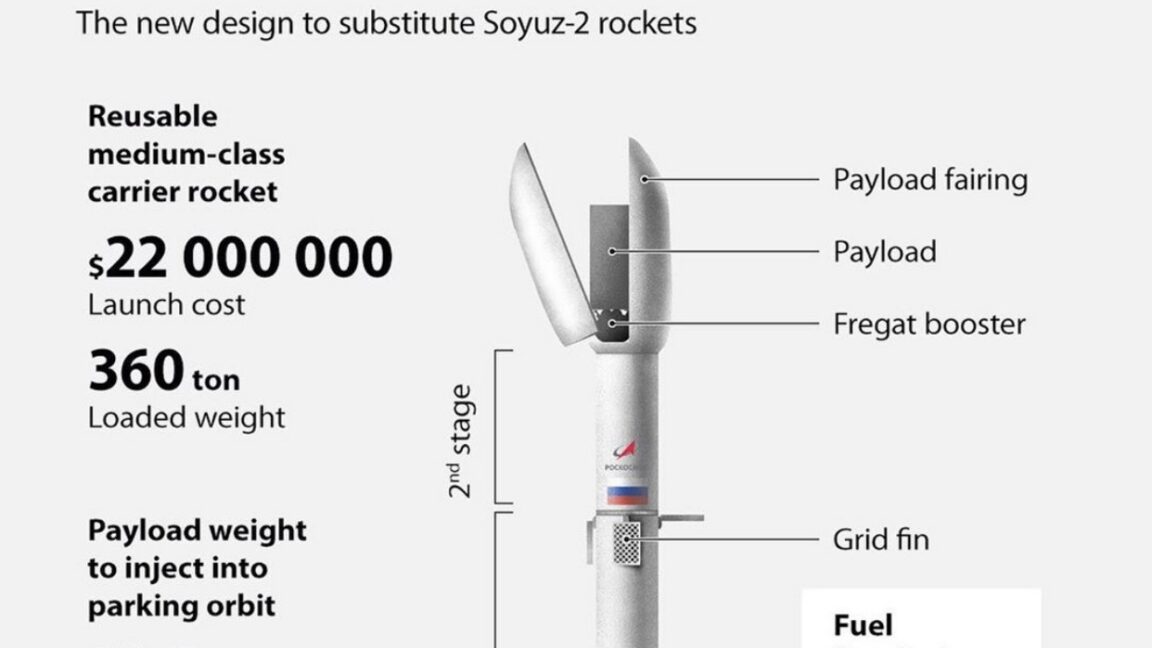
Russia’s planned reusable Amur-LNG rocket appears to be years behind its original schedule, delaying Moscow’s effort to field a booster comparable in concept to SpaceX’s Falcon 9. Dmitry Baranov, Roscosmos’ deputy director general for rocket programs, told the Russian business outlet RBC that work is now centered on a first-stage demonstrator rather than an orbital vehicle.
Roscosmos announced Amur-LNG nearly six years ago as a methane-fueled rocket with a reusable first stage. At the time, Russian space officials said the rocket was expected to debut in 2026, according to Ars Technica.
The planned vehicle was designed to carry 10.5 metric tons to low Earth orbit when flying in reusable mode, Ars Technica reported. Its design placed it in the same broad category as Falcon 9, which SpaceX regularly launches and lands in the United States.
Demonstrator tests targeted for 2028
Baranov told RBC that the first-stage test vehicle is expected to conduct two flights starting in 2028. In the first test, the vehicle would rise to less than 1 kilometer while keeping its engine running, then return to its launch site.
The second test would go higher, reaching 10 kilometers, according to Baranov’s description to RBC. That flight would include an engine shutdown, a restart, and a landing on deployable legs.
Ars Technica compared the planned vehicle to SpaceX’s Grasshopper test program, which was used in the early development of Falcon 9 booster recovery. Russian officials have also said the RD-0169A engine intended for Amur is in early test-firing stages, Ars Technica reported.
Soyuz 2 remains the workhorse
Baranov said the goal is for Amur to replace Soyuz 2, the rocket now used for Russia’s crew and cargo flights to the International Space Station, according to RBC. He did not give RBC a new date for that replacement.
A separate sign of the schedule came in May at the International Security Forum, where a Roscosmos State Corporation booth displayed a placard saying Amur-LNG flight tests would begin in 2031, according to Ars Technica. That would place the first flight tests five years later than the date discussed when the project was unveiled in 2020.
The delay comes as other countries and companies press ahead with reusable rocket work. Ars Technica reported that China recently launched an orbital mission and recovered its booster, while Japan’s space agency has been running hop tests and Honda has carried out vertical reuse testing.
In the United States, SpaceX continues routine booster landings, Ars Technica reported. Blue Origin has shown it can land and re-launch a large orbital booster, although its New Glenn booster is temporarily grounded, and companies including Stoke Space, Rocket Lab and Relativity Space are pursuing reusable or partially reusable rockets.
Russia’s reusable rocket plans therefore remain at an early test-vehicle stage, even as Amur-LNG is still intended to succeed one of the country’s central launch systems. Based on the dates described by RBC and Roscosmos materials cited by Ars Technica, orbital flight tests are now not expected before 2031.
This story draws on original reporting from Ars Technica.