
EU AI hiring skews toward builders as governance deadline nears
Axipro found a seven-to-one gap between AI development and governance hiring across eight European markets, with Sweden and France showing the widest imbalance.
By Hana Yoshida · Markets Reporter
3 min read
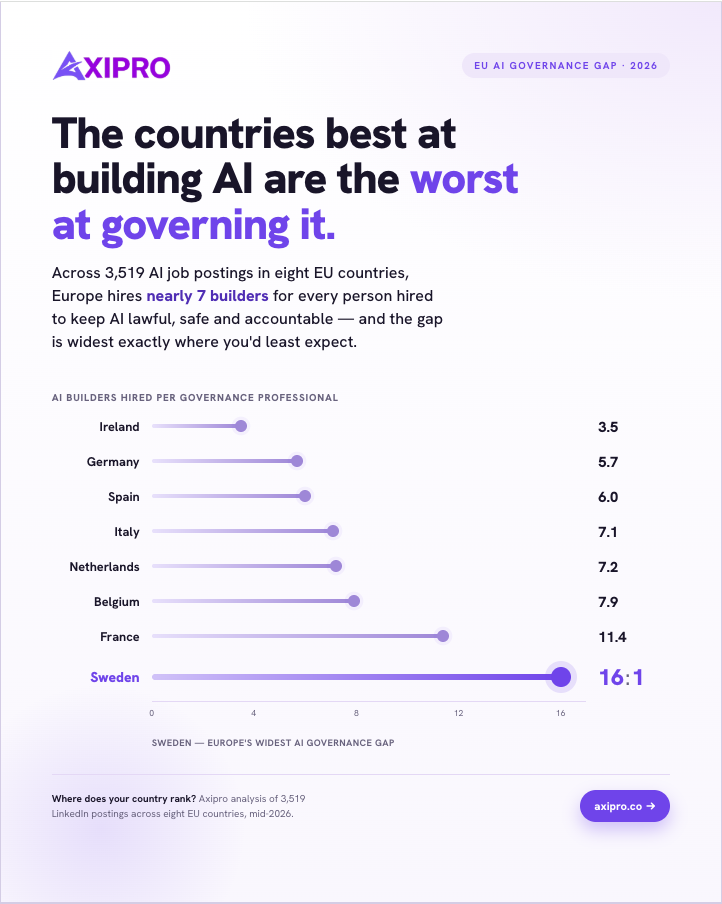
European companies are hiring far more people to build AI systems than to oversee them, raising compliance questions ahead of a key EU AI Act transparency deadline. A new study by Axipro found roughly seven AI development roles for every one AI governance role across 3,519 job postings in eight countries.
The imbalance was sharpest in Sweden, where the study counted 16 builder jobs for every governance job. France followed at 11 to one, while Ireland was the most balanced market at 3.5 to one.
Axipro attributed Ireland’s lower ratio in part to the concentration of U.S. technology headquarters in Dublin, where global compliance programs may be shaping local hiring. The study framed Sweden’s result as notable because of the country’s strong engineering labor market.
The findings land as companies prepare for the EU AI Act’s Article 50 transparency obligations, which take effect on 2 August 2026. Those rules remain on schedule even after the Council approved the Digital Omnibus on 29 June, delaying the law’s high-risk regime until December 2027.
Potential penalties under the AI Act remain unchanged at up to €35 million or 7% of global turnover. For companies expanding AI programs, the hiring split may signal whether compliance work is keeping pace with product development.
Axipro also found that fewer than three in 10 governance job postings mentioned the AI Act in the role description. The firm said that suggests some governance hiring may not be aimed at specific legal requirements such as conformity assessments and technical documentation.
“Surveys measure anxiety; job postings measure money,” said Ali Hayat, Axipro’s chief executive and founder. “98.5% of organizations tell researchers their AI governance staffing is inadequate, yet their hiring budgets are flowing to the side of the business that creates regulatory exposure, not the side that manages it.”
Hayat said companies should account for the time needed to recruit governance staff and prepare documentation before the deadlines arrive. That warning reflects a broader issue in AI regulation: compliance work often depends on legal, risk, engineering and product teams sharing evidence about how systems are designed and monitored.
The study found governance hiring concentrated among large companies. Nearly half of the governance postings came from enterprises with more than 5,000 employees, and two-thirds came from financial services and IT consulting, sectors that already have established compliance functions.
Other sectors appeared less active in the postings reviewed. Healthcare and government administration each had four governance roles across the eight countries, despite facing serious obligations under the AI Act.
Axipro’s EU AI Act hiring gap study also cited external salary data from the VerifyWise AI Governance Salary Report 2026, which put day rates for independent AI governance consultants in mature markets at $800 to $2,000. The report linked those rates to demand that grew 150% year over year.
Axipro is a compliance and trust infrastructure firm headquartered in Bahrain with global operations. Its services cover frameworks including SOC 2, ISO 27001, ISO 42001, HIPAA, GDPR and EU AI Act compliance.