
Czinger 21C pairs 1,250 hp with 3D-printed hypercar engineering
The $2.35 million hybrid hypercar is also a showcase for Divergent’s additive manufacturing system, Ars Technica reports.
By James Whitfield · Staff Writer
4 min read
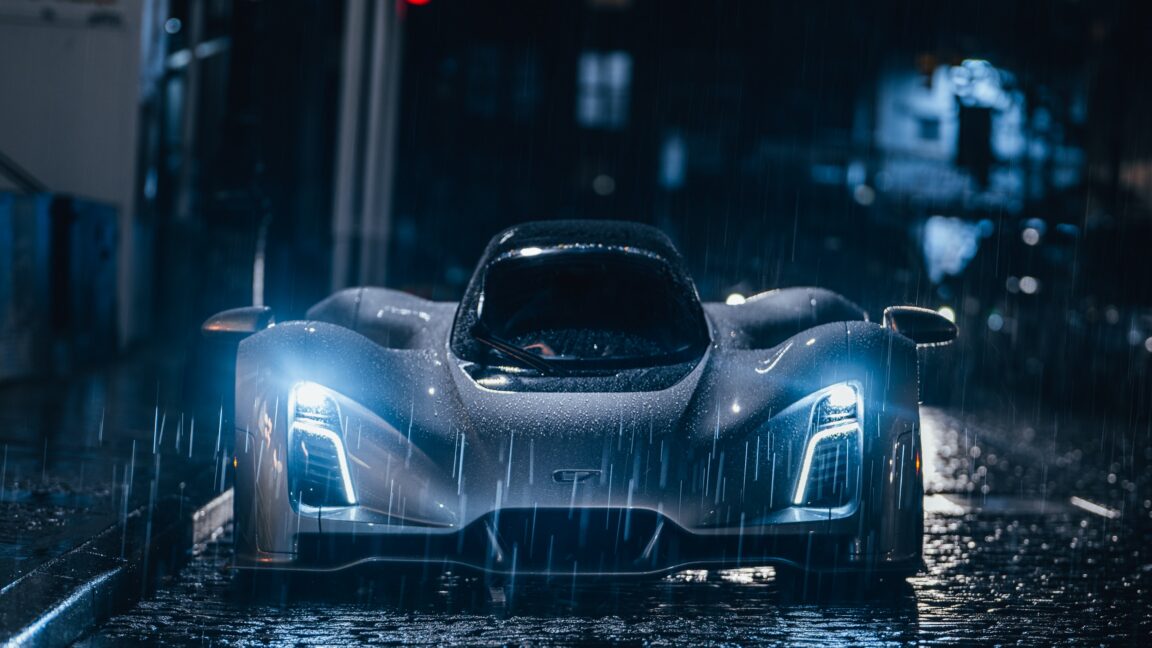
Czinger’s 21C puts 1,250 hp into a limited-run hybrid hypercar while serving as a public test case for a different way to build vehicles. Ars Technica reported that the car’s significance lies as much in its software-led, additively manufactured structure as in its acceleration figures.
According to Ars Technica, the carbon-fiber-bodied 21C uses a bespoke 2.88-liter twin-turbo flat-plane-crank V8 that revs to 11,000 rpm. Czinger pairs it with three electric motors: one at each front wheel and a crank-driven starter-generator. Total output is rated at 1,250 hp and 691 lb-ft of torque.
The car uses a seven-speed automated manual transaxle, which Ars Technica said was selected for weight and torque-handling reasons. In Vmax form, the 21C weighs less than 3,700 pounds with fluids, reaches 60 mph in 1.92 seconds, runs the quarter mile in 8.6 seconds and has a top speed of 253 mph, according to the report.
Czinger prices the 21C at $2.35 million, placing it near cars such as the Koenigsegg Jesko and Aston Martin Valkyrie, Ars Technica reported. Production is capped at 80 units, with final assembly done largely by hand at the company’s Area 21 facility in Torrance, California.
A manufacturing showcase
Czinger Vehicles was founded in 2019 by Kevin Czinger and Lukas Czinger as an extension of Divergent Technologies, according to Ars Technica. Divergent, based in Los Angeles, develops generative design software, large metal 3D-printing systems and automated assembly processes.
Ars Technica reported that Divergent’s technology has been used by defense and aerospace groups including Lockheed Martin, Raytheon and the U.S. Department of Defense, as well as automakers including Bugatti and McLaren. On the 21C, the same approach shapes parts such as suspension components and the gearbox case.
Rather than designing parts around casting, stamping, forging or machining, Divergent’s software sets shapes based on load, stiffness, crash and packaging needs, according to Ars Technica. The system tests many possible geometries and places material where the company says it is structurally needed, producing lattice-like forms that can then be printed from powdered metals.
Czinger says its current printers make about one kilogram of metal parts per hour, Ars Technica reported. A large and complicated part such as the 21C’s rear subframe takes about two days to print.
Max Morice, Czinger Vehicles’ head of brand communications, told Ars Technica that the company sees the process as useful beyond its own hypercar. “The goal is for this manufacturing process to be the way everything is built,” Morice said, adding that the same space could make parts for Czinger, Aston Martin, Bugatti and others without tool-change delays.
Track hardware for the road
Ars Technica reported that the 21C’s main structure is a single-piece carbon-fiber safety cell developed in-house. The driver sits in the center, while the passenger sits directly behind in a tandem layout.
The suspension uses pushrod-actuated double wishbones, inboard springs and electronically adjustable dampers, according to the report. Braking hardware includes six-piston front calipers with 16.1-inch carbon-ceramic discs and four-piston rear calipers with 15.4-inch carbon rotors.
Czinger also plans to add a BrakeNode component later this year, Ars Technica reported. Developed with Divergent’s design and printing methods, the part combines the caliper mount, suspension connection and brake-fluid passage into one structure that Czinger says is lighter and stiffer than a conventional assembly.
What it is like to drive
During a road drive in the 21C Vmax, Ars Technica reported that entry requires climbing over prominent sills that also house 2.2-kWh battery packs. The car has dihedral doors, but the central seating layout still makes getting in more involved than in a typical sports car.
The car offers Street, Sport, Track and Track+ modes, according to Ars Technica. Street mode favors electric drive at lower speeds, Sport brings the combustion and electric systems together for full output, and Track adds heavier steering, sharper throttle response and stronger energy recovery. Czinger says Track+ lowers ride height by 25 mm and stiffens the suspension to levels comparable with GT3 race cars.
Ars Technica described the 21C as surprisingly manageable on public roads, despite limited rear visibility and the adjustment required by the central driving position. Under hard acceleration, the report said the V8 and single-clutch gearbox deliver a rawer, more mechanical feel than many road cars, matching the 21C’s role as both a hypercar and a demonstration of Divergent’s production method.
This story draws on original reporting from Ars Technica.