
CaraComp launches AI face checks for romance scam concerns
Euclid Squared’s new tool compares faces in about five seconds and exports a forensic report as AI-made fake profiles become easier to produce.
By James Whitfield · Staff Writer
3 min read
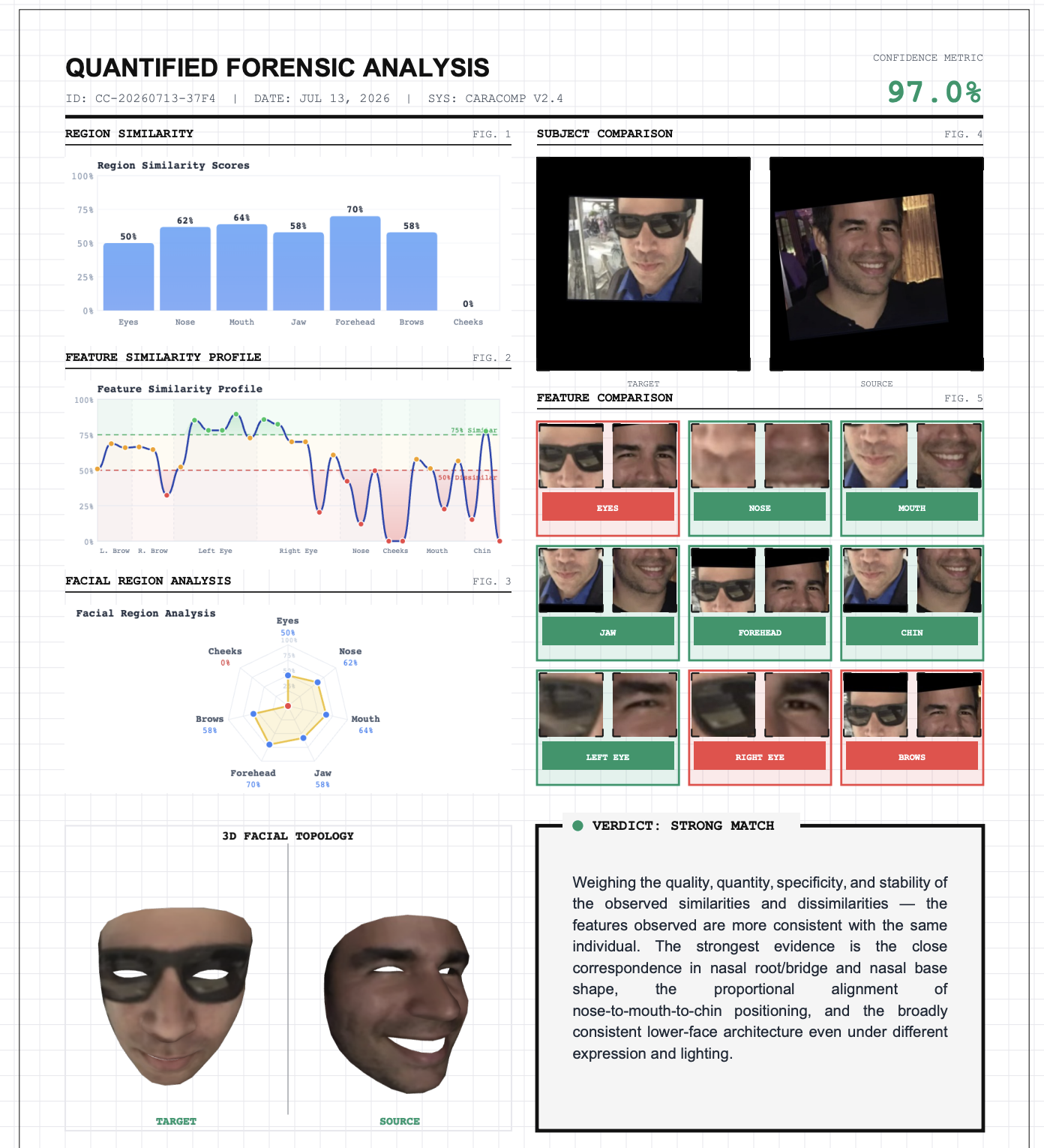
Euclid Squared Inc. has launched CaraComp, an AI face-comparison platform built to help consumers and investigators check whether two faces in photos or video appear to be the same person. The product is aimed at a growing problem for dating-app users, families and fraud teams: fake online identities made more convincing by generative AI.
Reported romance-scam losses have continued to climb. According to the U.S. Federal Trade Commission, consumers reported $1.16 billion in losses from romance scams in the first nine months of 2025, up 22% from a year earlier.
CaraComp compares faces in uploaded images or video and returns a similarity score from 0% to 100% in about five seconds. The platform uses multiple facial-recognition and image-processing AI models, then cross-checks results with verification code before assigning confidence ratings to its findings, the company says.
The launch puts a consumer-facing wrapper around technology more often associated with law enforcement, private investigation and enterprise fraud work. For ordinary users, the question may be whether a dating profile photo matches another image connected to a suspected real identity. For investigators, the same function can support case work involving surveillance footage, insurance claims or online aliases.
Report built for case files
The main feature Euclid Squared is pushing beyond the match score is a downloadable forensic report. Each comparison produces a PDF formatted for case files and includes more than 20 data points per image, including estimated age range, facial hair, eyewear, face obstruction, image brightness and sharpness.
The report also maps facial landmarks around the eyes, nose and mouth, with overlays showing the areas the system measured. Emotional-expression analysis and image-quality scoring are included, giving users more context about whether a poor or altered-looking image may affect the comparison.
For contested comparisons, CaraComp includes an AI-written forensic narrative that explains observations in plain language. Kieffer Ramirez, founder of Euclid Squared, said the goal is to show users the evidence behind a result rather than only a percentage.
The company positions the tool as useful for private investigators, insurance fraud teams, detectives, open-source intelligence researchers and consumers checking suspicious online profiles. Its privacy pitch is also part of the product: uploaded images are deleted after processing, and CaraComp does not create or search a public face database, according to Euclid Squared.
Beyond single photos
CaraComp also supports video face search, batch comparisons of one face against many images, and group detection when multiple faces appear in an image or video. Those features matter because scam checks rarely rely on one clean headshot; users may have screenshots, profile photos, social media images or short clips of uneven quality.
The AI face comparison tool for romance scam checks enters a market shaped by two competing uses of artificial intelligence. Generative tools can create fake profile pictures, alter stolen images or produce face-swapped media, while verification tools try to flag mismatches and support human review.
Facial comparison software still depends on image quality, angle, lighting and the availability of a meaningful second image. CaraComp’s pitch is that a fast score paired with a more detailed report can help users decide whether an online identity deserves further scrutiny.