
Old diffraction effect offers simpler route to structured light
NTU Singapore researchers say a laser and tiny disc can create optical skyrmions, light patterns studied for future computing and communications.
By Lucas Ferreira · Science & Environment Writer
3 min read
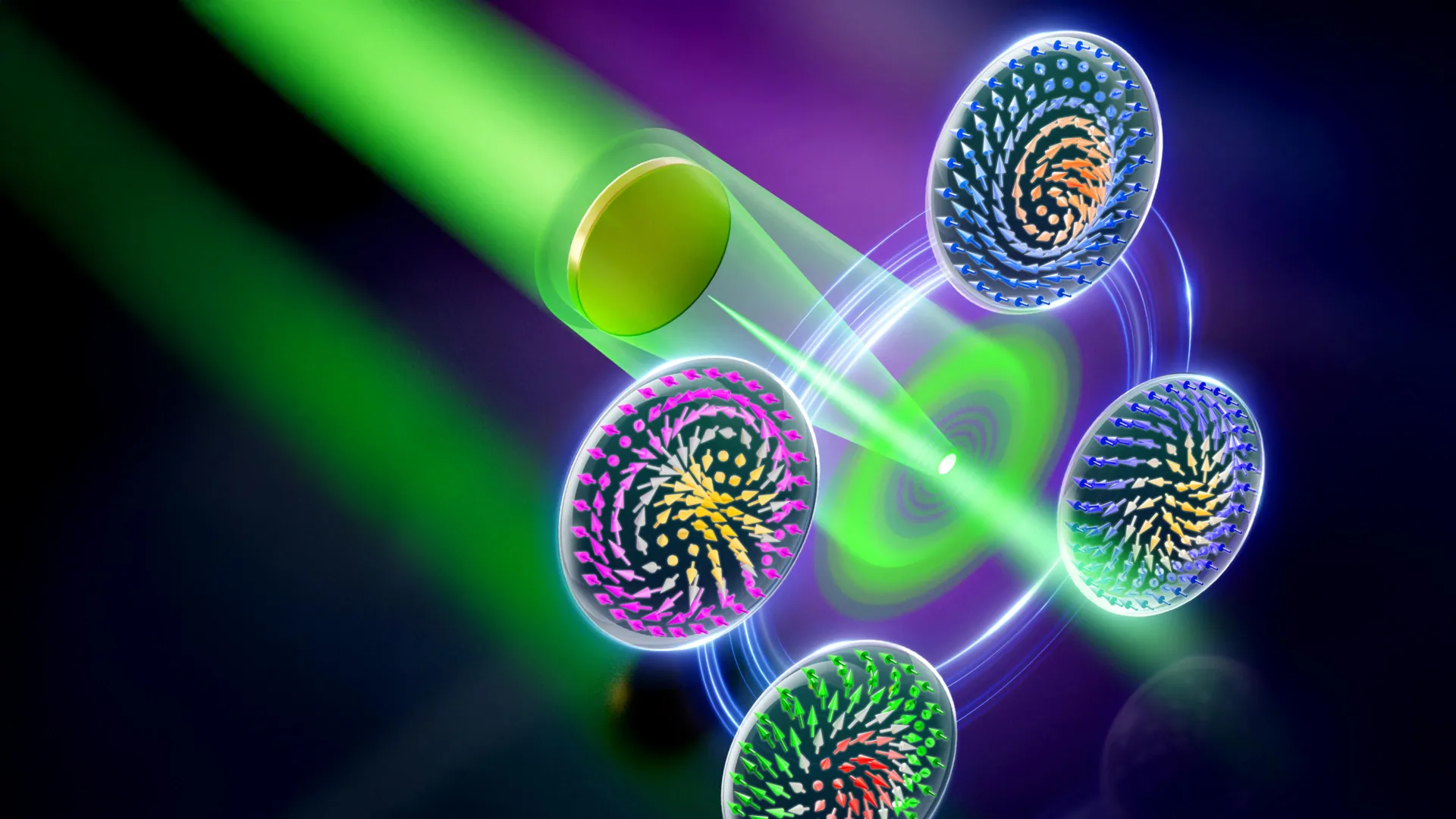
Researchers at Nanyang Technological University in Singapore have used a centuries-old optics effect to make optical skyrmions, complex light patterns that scientists are studying for future information technologies. The work matters because the method avoids the costly engineered materials often used to create these structures.
The NTU Singapore team reported the findings in Optica, according to materials released by the university and carried by ScienceDaily. The study was led by Nanyang Assistant Professor Shen Yijie of NTU’s School of Physical and Mathematical Sciences and School of Electrical and Electronic Engineering.
Optical skyrmions are stable, swirling arrangements within light fields. Researchers are interested in them because their structure could help encode or store information, with possible uses in data storage, communications and computing, according to NTU Singapore.
Instead of using metamaterials, the NTU researchers generated the patterns by directing a laser at a small circular disc. The university said the setup uses the Poisson spot, an optical phenomenon first tied to early 19th-century debates about whether light behaves as particles or waves.
How the old effect works
The Poisson spot appears when coherent light, such as a laser, passes around a circular object and forms a bright point in the middle of the object’s shadow. Wave theory predicted the effect because light diffracts, or bends and spreads, around barriers and through openings.
NTU Singapore said that observation helped support the wave model of light more than 200 years ago. The new study gives the same phenomenon a role in modern research on topological light structures.
Shen said, according to NTU Singapore, that the result is notable because the skyrmions can be made through light bending around an object, rather than through complex artificial materials or specialized fabrication. He said the lower technical barrier could make the field easier for more researchers to study.
Four skyrmion patterns in one light spot
The team found that the Poisson spot arrangement could produce up to four related topological patterns at the same time. NTU Singapore identified them as spin skyrmions, Stokes skyrmions, electric field skyrmions and magnetic field skyrmions.
Spin describes rotation-like properties of light, while Stokes parameters describe polarization, or the direction in which light waves vibrate as they move. Electric and magnetic field patterns describe other vector properties of the same light field.
According to the university, producing several skyrmion types in one system may let scientists compare how these patterns arise and change under shared conditions. Computer simulations in the study represented the structures as arrays of arrows showing how different light properties shift across the Poisson spot.
Light can be shaped through intensity, phase, polarization, spin and its electric and magnetic field vectors. NTU Singapore said these features can form topological structures, meaning patterns that remain stable under certain distortions.
Shen said the experiment showed that different vector components of light can form topological structures together, while not necessarily producing identical patterns. The university said that comparison could help researchers study links among light’s electric, magnetic and other physical properties.
Possible uses remain future work
Skyrmions were first proposed in particle and nuclear physics and later became prominent in condensed matter physics and magnetic materials, according to NTU Singapore. Optical skyrmions are a newer area of study, treating comparable stable structures inside light fields.
The university said earlier methods often depended on metamaterials, microscopic engineered structures designed to control light in ways ordinary materials cannot. By using a simpler optical setup, the researchers say the new work could support future studies in photonics, materials, information processing and next-generation computing.
The paper, titled “Optical skyrmions in Poisson spots,” was authored by Jun Yao, Xi Xie, Yuan Meng, Sheng Sun, Jun Hu, Yijie Shen and Yuanjie Yang. It appeared in Optica in 2026.
This story draws on original reporting from ScienceDaily.