
NASA marks U.S. 250th with red, white and blue space images
Chandra X-ray Observatory released four NASA deep-space composites and three sonifications for the United States’ 250th anniversary.
By Priya Raghavan · Science Reporter
3 min read
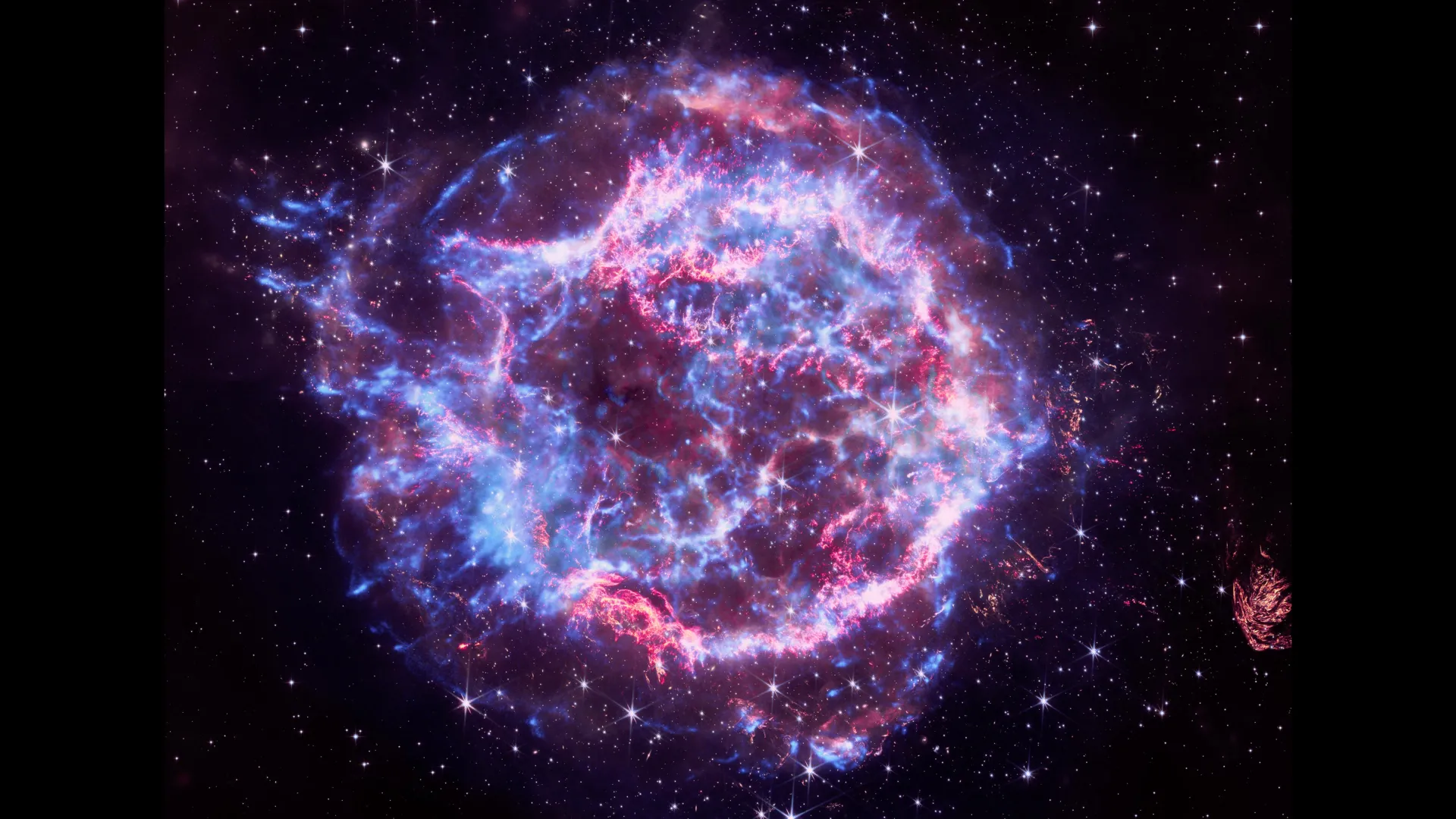
NASA marked the United States’ 250th anniversary with a set of deep-space images colored in red, white and blue, according to the Chandra X-ray Observatory. The release pairs a national milestone with views of objects that astronomers use to study star death, star birth, galaxy growth and dark matter.
The Chandra X-ray Observatory said the collection includes four composite images built from Chandra data and observations from other telescopes. The observatory also announced three new sonifications, which convert astronomical data into sound.
Four targets across the universe
One image shows Cassiopeia A, a well-known supernova remnant in the Milky Way, according to Chandra. The composite combines Chandra X-ray observations, shown in blue and purple, with infrared data from NASA’s James Webb Space Telescope, shown in red and white.
Chandra said its X-ray view traces the blast wave from the exploded star and identifies elements in the debris, including iron, calcium and oxygen. Webb’s infrared observations show the expanding material left by the explosion and dust spread through the remnant.
A second image features NGC 3603, which Chandra described as a Milky Way nebula containing a large cluster of young stars. In the composite, Chandra X-ray data in red and white show diffuse emission near the center and many bright point sources across the field.
The NGC 3603 view also uses NASA Hubble Space Telescope data in optical, infrared and ultraviolet light, according to Chandra. Those observations show stars crowded near the center, while gas and dust extend across the lower part of the nebula.
Star formation and dark matter
The third image focuses on NGC 4736, also known as Messier 94, Chandra said. The spiral galaxy is shown using Chandra X-ray observations at several energies, together with visible-light images taken by astrophotographers using ground-based telescopes.
Chandra said Messier 94 contains a bright inner ring where stars are forming rapidly. Scientists think gas moving inward through the galaxy’s oval-shaped structure may be feeding that burst of star formation, according to the observatory.
The final image shows ZwCl 0024+1652, a distant galaxy cluster used in dark matter studies, according to Chandra. Processed Hubble observations in blue show evidence associated with dark matter, while another Hubble view shows the cluster’s galaxies in yellow and white.
Chandra’s X-ray data add a red glow from superheated gas inside the cluster, the observatory said. That hot gas contains more mass than all of the cluster’s galaxies combined, according to Chandra.
The release underscores how space images often combine information from several instruments rather than a single snapshot. In this case, Chandra said the composites use color choices tied to the anniversary while presenting observations across X-ray, infrared, ultraviolet, optical and visible wavelengths.
This story draws on original reporting from ScienceDaily.