
Researchers say nature prescribing should account for ecological quality
A Swansea-led study says biodiversity and habitat condition may affect how well nature-based health programs support well-being.
By Priya Raghavan · Science Reporter
3 min read
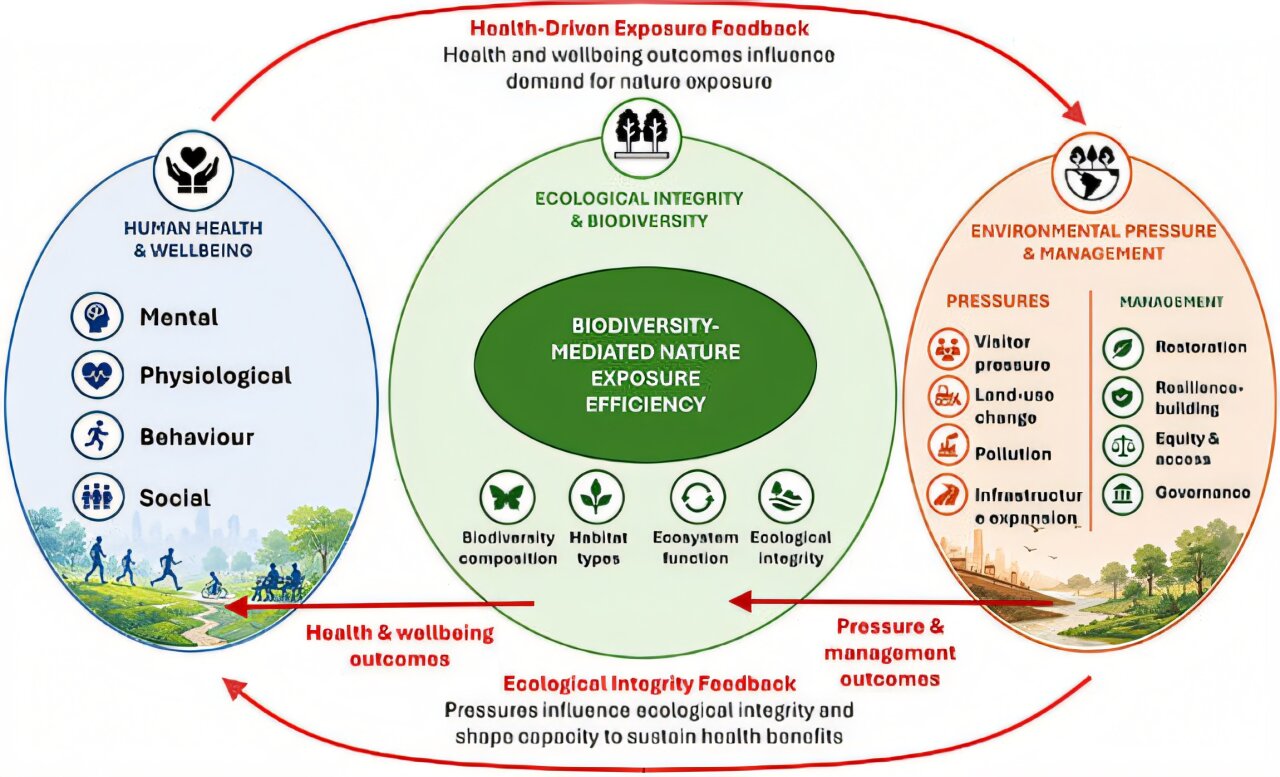
A Swansea University-led study says nature prescribing programs should look beyond access to green space and assess the ecological quality of the places patients are sent. The finding matters as nature-based health care expands across the NHS and researchers raise concerns about links between biodiversity loss and human well-being.
The study, published in Environmental Research Letters, argues that parks, woodlands, wetlands and other outdoor settings should not be treated as interchangeable in health research. According to Swansea University, the work introduces a framework that connects biodiversity, ecological condition and environmental sustainability with well-being outcomes in nature prescribing.
A framework for people and ecosystems
Researchers from Swansea University and the University of Bayreuth developed what they call a One Health Sustainability Framework. Swansea University said the framework brings together public health, ecology and sustainability science to examine how habitat quality and ecosystem integrity may influence nature-based health programs.
Nature-based social prescribing commonly encourages people to spend time in outdoor settings such as parks and woodlands. The researchers said much of the evidence base has considered exposure to nature in broad terms, while paying less attention to differences between types of environments.
Dr. Konstans Wells, lead author and a researcher at Swansea University's Centre for Nature-Based Solutions, said current research still has limited evidence on how the ecological features of different places affect well-being. According to Wells, the framework is intended to shift research from asking whether nature helps health toward identifying which forms of nature, and what level of exposure, may support health sustainably.
The researchers said a species-rich woodland or wetland may affect well-being differently from a closely cut playing field or a heavily managed park. They also said more complex ecosystems, including woodlands, wetlands and species-rich grasslands, differ from more simplified green spaces in ways that could affect both health benefits and the durability of those benefits.
Pressure on natural spaces
The authors also linked the issue to environmental capacity. Swansea University said expanding nature-based health programs could increase demand on natural places, adding pressure on ecosystems if conservation needs are not considered alongside human health goals.
Dr. Menna Brown, a co-author whose work focuses on nature-based social prescribing in NHS and community health care settings, said nature-based social prescribing is becoming a larger part of preventive health care. Brown said the next research challenge is to understand how different natural settings contribute to outcomes and how programs can benefit both people and nature.
Brown said a One Health approach can help researchers determine which environments work best, for which groups and in what circumstances. Swansea University said that evidence is needed if nature prescribing is to be developed in a way that is both informed by research and environmentally sustainable.
Measuring health and habitat together
The framework builds on nature-based health research at Swansea University. Brown and Dr. Catherine Jenkins, a GP and honorary Swansea University researcher, recently led work on an evaluation toolkit for nature-based social prescribing, according to the university.
The study authors said future evaluations could add ecological indicators, including biodiversity and habitat condition, to the health measures already used in such programs. They said this could help researchers test whether different natural environments affect not only the size of health benefits, but also how long those benefits last.
The paper, by Wells and colleagues, is titled “A one health sustainability framework for ecologically mediated nature-based wellbeing” and was published in Environmental Research Letters. Swansea University said the framework is intended as a basis for future research that studies health promotion and environmental stewardship together.
This story draws on original reporting from Medical Xpress.