
Mechanoresistant cancer cells reveal CALB2 link in prostate cancer study
Rice researchers induced stress-resistant prostate cancer cells and tied their survival under force to the gene CALB2.
By Priya Raghavan · Science Reporter
3 min read
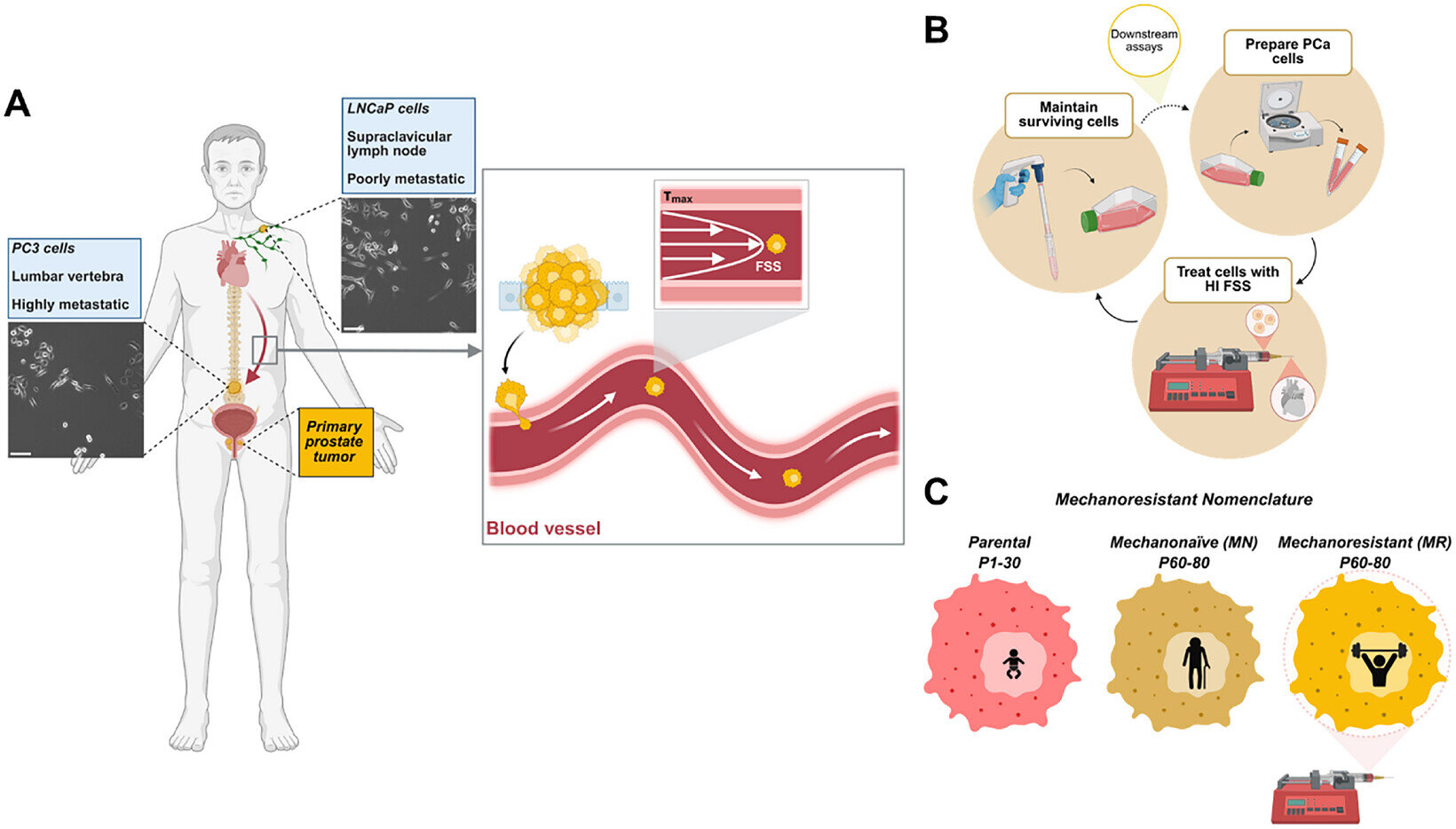
Rice University researchers have created mechanoresistant cancer cells in the lab, giving scientists a new way to study how prostate cancer cells survive the physical stress of spreading through the body. The work, published in Advanced Science, points to a gene called CALB2 as one factor that helps those cells endure high-force conditions.
When cancer cells break away from an original tumor and travel to distant sites, they must pass through blood vessels and the heart. According to Rice University, those cells can face repeated force spikes of up to 5,000 dynes per square centimeter while circulating.
Michael King, a Rice bioengineer and corresponding author on the paper, said the lab model could help identify predictors of metastasis and possible drug targets. The study focused on prostate cancer, where distant metastasis is difficult to treat and is associated with poor prognosis, according to King.
What are mechanoresistant cancer cells?
Mechanoresistant cancer cells are cancer cells able to survive mechanical forces that would kill many other cells. In this study, Rice researchers used repeated shear stress to select prostate cancer cells that could withstand force pulses similar to those encountered during circulation.
The team began with two prostate cancer cell lines. LNCaP represented early-stage prostate cancer and was sensitive to androgen deprivation, while PC3 represented advanced disease and resisted androgen therapy, according to Rice University.
Abigail Fabiano, lead author and a recent doctoral graduate in King’s lab, used a protocol developed at Rice to apply shear stress to the cells, collect the survivors and grow them before exposing them to more stress. After six months of repeated selection, most cells in both groups could survive regular high-shear pulses.
Rice University said the work produced the first mechanoresistant cell cultures. The result showed that both early- and late-stage prostate cancer cell types could acquire the ability to survive conditions similar to circulation through the body.
How did CALB2 change the cells’ survival?
After creating the stress-resistant populations, the researchers compared them with cells that remained sensitive to shear force. The cells did not show major visual differences, but genome sequencing found higher expression of CALB2 in both mechanoresistant populations, according to the study.
The researchers also found increased CALB2 expression in cancer cells donated by patients with metastatic prostate cancer. Fabiano said that finding suggested the change was not limited to the lab model.
To test whether CALB2 helped drive survival under force, the team used gene editing to reduce CALB2 expression in the mechanoresistant cells. When those edited cells were put back through the shear-stress test, they began dying again, while cells that kept high CALB2 expression survived, according to Rice University.
The researchers concluded that CALB2 had a direct role in helping prostate cancer cells withstand high-force environments. Fabiano said CALB2 had not been heavily studied in cancer progression before this model drew attention to it.
King’s lab said CALB2 does not explain all mechanoresistance. The study also found changes in other genes, and the group is continuing to investigate additional factors that may help cancer cells spread.
The paper, “CALB2 is a Mechanoresistance Gene in Metastatic Prostate Cancer,” was authored by Fabiano and colleagues and published in Advanced Science in 2026.
This story draws on original reporting from Medical Xpress.