
KR-NIR-P surgical imaging dye lasts longer under near-infrared light
KRICT researchers report a polymerized ICG dye that resists fading, a step toward longer fluorescence imaging during surgery.
By Priya Raghavan · Science Reporter
3 min read
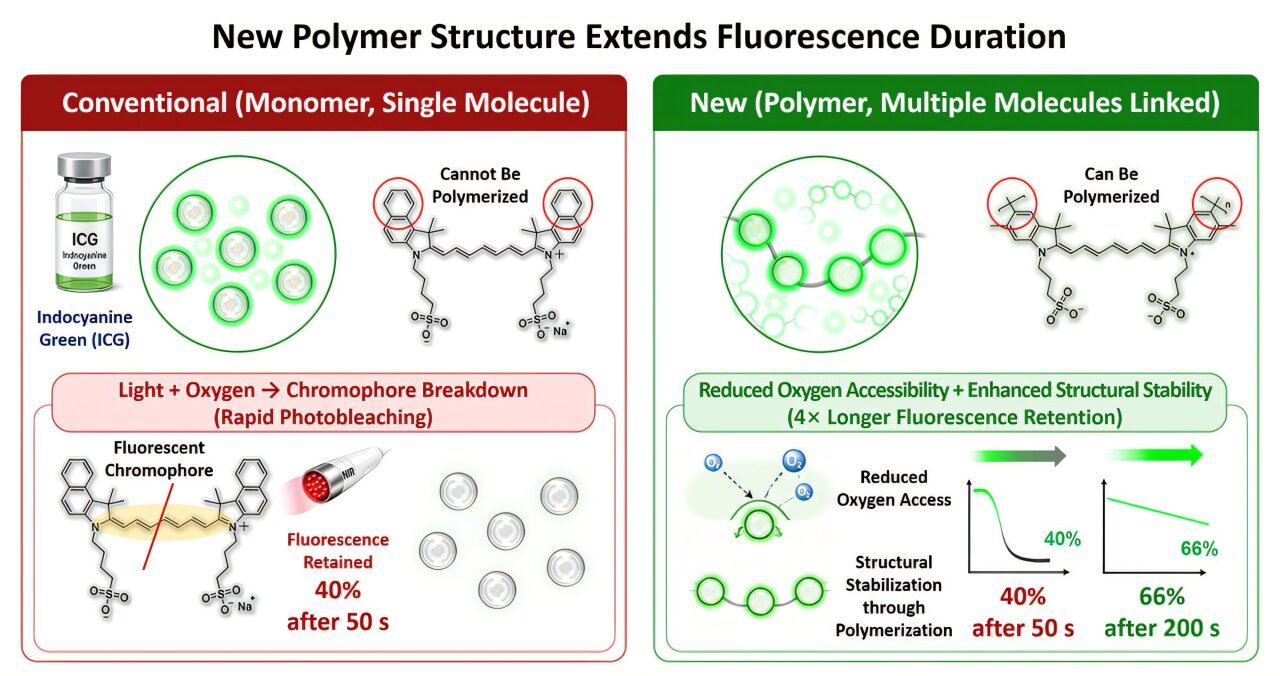
A Korean research team says its KR-NIR-P surgical imaging dye kept glowing longer than a standard near-infrared dye under laser light, a potential aid for operations that depend on real-time fluorescence images. The work, led by researchers at the Korea Research Institute of Chemical Technology, was published in the journal Small.
The team, led by Dr. Young Il Park and Dr. Sang Hwan Nam of KRICT with Georgia Institute of Technology professor Sung-Jin Park, developed a polymerized form inspired by indocyanine green, or ICG. The National Research Council of Science and Technology said the approach is meant to address photobleaching, the loss of fluorescent signal during continued illumination.
What is KR-NIR-P?
KR-NIR-P is a near-infrared fluorescent polymer made by chemically linking ICG-like dye units into a polymer backbone, according to KRICT. Near-infrared imaging uses light at roughly 650 to 900 nanometers, which can pass through tissue better than visible light because water and hemoglobin absorb less of it.
Fluorescent dyes paired with near-infrared light can help doctors see structures several centimeters below the surface, according to the research summary. The method is used in diagnosis and image-guided procedures, including cancer surgery and lymph node mapping.
ICG has a long clinical history. The National Research Council of Science and Technology said it has been the only FDA-approved near-infrared fluorescent dye and has been used since its 1959 approval in applications such as sentinel lymph node mapping, liver tumor resection and biliary tract visualization. The council also noted that more than 750,000 laparoscopic cholecystectomies are performed each year in the United States, a procedure in which fluorescent visualization can be useful.
Why does ICG fade during surgery?
ICG can lose its signal when exposed to continuous light, reducing image quality during longer procedures, according to the researchers. They reported that the dye’s heptamethine chromophore can react with oxygen produced during laser irradiation, causing irreversible structural damage.
Earlier attempts to protect ICG placed the dye inside polymer capsules or nanostructures, the research team said. Those methods can require more complex manufacturing and may allow dye leakage, limiting clinical use.
KRICT’s team instead built stability into the dye structure. In KR-NIR-P, the polymer framework partly shields the fluorescent chromophore from molecular oxygen, while hydrophobic interactions help stabilize the molecular structure and reduce uncontrolled aggregation, according to the published work.
How did the new dye perform in tests?
Under continuous exposure to a 785-nanometer near-infrared laser, conventional ICG dropped to about 40% of its starting fluorescence within 50 seconds, the researchers reported. KR-NIR-P retained about 66% of its initial signal after 200 seconds, which the team described as more than a fourfold improvement in photostability.
The polymer also showed favorable early biocompatibility results in lab testing, according to the study. Cell viability stayed above 90% at concentrations up to 20 micromolar in tested cancer cells, including cervical cancer and oral squamous carcinoma cells, as well as normal cells.
Protein analyses found no meaningful difference from conventional ICG in apoptosis-related biomarkers, suggesting no added cellular toxicity in those tests, the researchers said. In three-dimensional tumor spheroids, KR-NIR-P spread uniformly into deeper tissue-like regions.
In mouse studies, the team reported that fluorescence appeared in the sentinel lymph node two hours after subcutaneous injection into the footpad and built up strongly after 24 hours. The researchers said they plan broader preclinical studies, including toxicity and pharmacokinetic testing, before any clinical use.
This story draws on original reporting from Medical Xpress.