
Catalyst Performance healthspan audit reports 37% did no strength training
A self-selected audit of more than 1,000 Singapore adults found 37% reported no strength training, with limits on what the data can show.
By Tom Brennan · Health & Medicine Correspondent
3 min read
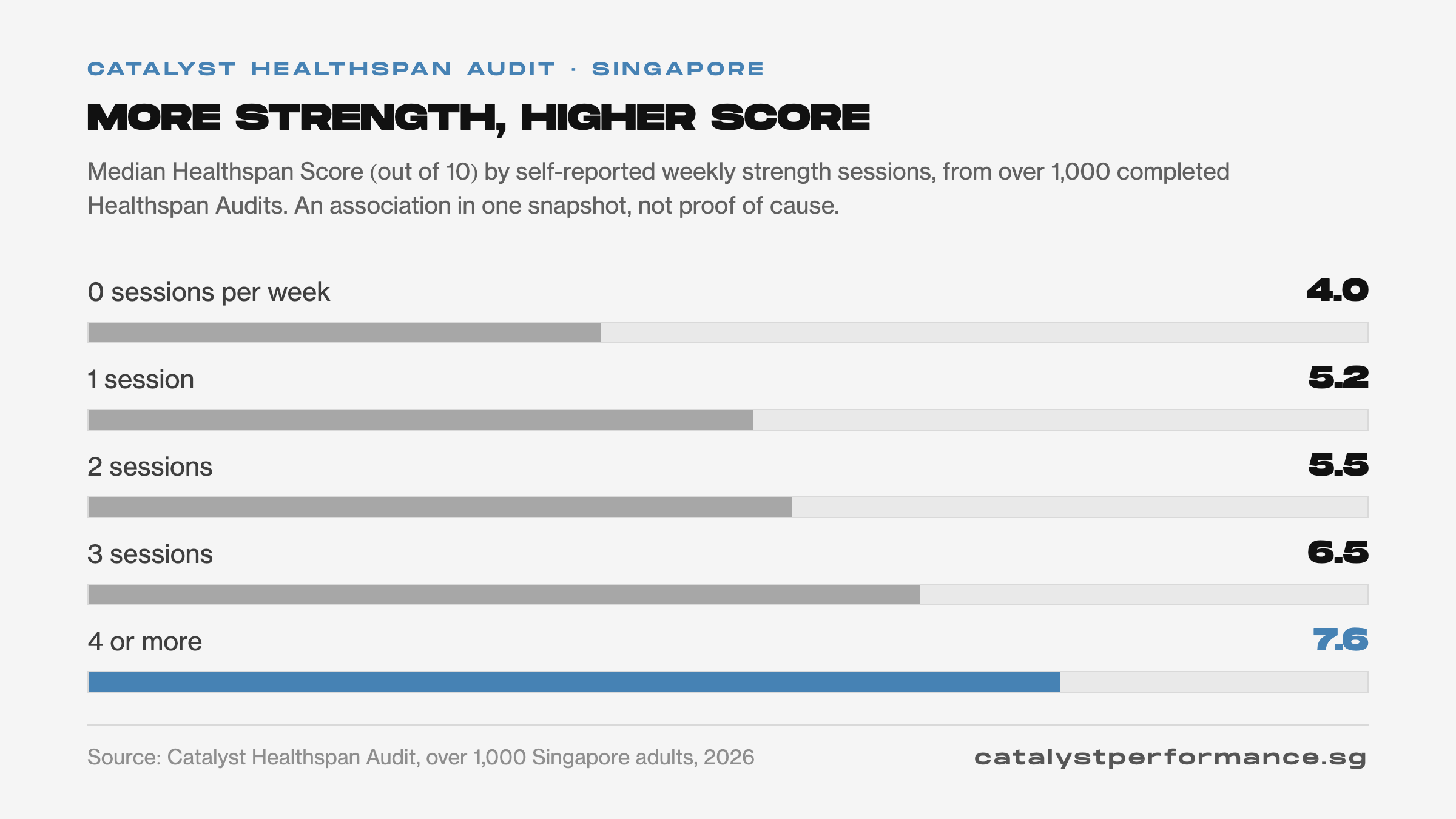
Catalyst Performance has released results from its Healthspan Audit, a free online self-assessment completed by more than 1,000 people in Singapore. The Catalyst Performance healthspan audit found that 37% of respondents reported doing no strength training, a result that describes this self-selected group rather than the wider population.
The Singapore personal-training studio published the findings on Aug. 12. Its assessment scores four areas: body composition, cardiorespiratory fitness, stability and strength.
What did Catalyst Performance’s healthspan audit find?
Catalyst reported a median Healthspan Score of 5.2 out of 10 across participants, with about 55% placed in its two lowest readiness bands. Cardiorespiratory fitness was the strongest area on average, while strength and body composition were the weakest, according to the company.
The reported scores also rose with self-reported weekly strength sessions: from a median 4.0 among people reporting none to 7.6 among those reporting four or more. That is an association observed at one point in time, not evidence that strength training caused the higher scores.
About 18% of respondents had strong cardiorespiratory fitness alongside weak body composition, Catalyst said. The studio also reported a median score of 5.0 for women and 5.4 for men, but said its composite measure did not establish that men were fitter.
How does this compare with Singapore activity data?
The audit is not a population health survey. Participants chose to take a health-focused assessment and were therefore likely to be more engaged with health than Singapore residents generally; most answers were self-reported.
For broader context, Singapore’s 2024 National Population Health Survey found that 84.7% of residents met total physical-activity guidelines and that adult obesity was 12.7%, figures cited by Catalyst. Activity-guideline compliance does not measure strength-training participation, so it cannot be used to estimate a national strength-training rate from the audit result.
Catalyst also said roughly two-thirds of its respondents were above a healthy weight under Asian-specific body-mass-index thresholds. That figure should not be compared directly with the national obesity estimate because the definitions differ.
What are the audit’s limits?
The Healthspan Score is Catalyst’s own composite rather than a clinical measure, and the company says it is intended for comparisons within the audit. It also reported that around one in four respondents had a screening flag for elevated sarcopenia risk, or age-related muscle loss, but stressed that the flag is not a diagnosis.
Singapore’s healthspan—the years lived in good health—has been estimated at about 74.1 years, with roughly 11.2 later years affected by ill health, according to a 2026 report on research using 2023 data. That population-wide estimate offers context for the studio’s findings, but does not validate or generalize its audit results. More detail on the assessment is available on Catalyst Performance’s website.