
U.S. and Iran trade control claims over Strait of Hormuz
Strikes around the Strait of Hormuz are straining ceasefire talks and raising concern over oil flows through a key maritime route.
By Hana Yoshida · Markets Reporter
3 min read
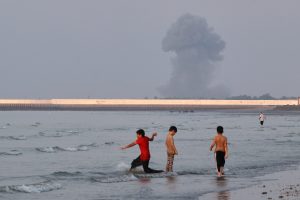
The United States and Iran both claimed control Monday over the Strait of Hormuz after a weekend of attacks across the wider Middle East. The dispute threatens ceasefire talks and the movement of oil and gas through one of the world’s most important waterways, according to the Associated Press.
The latest confrontation followed what the AP described as an Iranian attack Sunday on a container ship in the strait. Iran has asserted authority over traffic there since the war began Feb. 28 with U.S. and Israeli strikes, the AP reported.
Tehran says an interim peace deal reached last month gives it the right to manage traffic and possibly collect fees from vessels using the strait. Washington rejects that position and cites international law protecting freedom of navigation, according to the AP.
U.S. says it hit Iranian military sites
U.S. Central Command said Monday that American forces struck dozens of targets in Iran, including air defense systems, radar sites, missile and drone equipment, and small boats. The command called the strait a vital route for trade and said Iran does not control it.
The European Union’s top diplomat, Kaja Kallas, also urged that the waterway remain open. “Freedom of navigation has to be respected,” she said, according to the AP.
Iran’s Revolutionary Guard rejected the U.S. position and said the Strait of Hormuz is Iranian territory. The Guard accused the United States of illegal interference, according to the AP.
The two sides are nearly halfway through a 60-day window meant for talks on a permanent end to the war and an agreement over Iran’s disputed nuclear program. United Nations Secretary-General António Guterres warned in a statement that a return to full-scale fighting would bring “catastrophic consequences.”
Regional allies report incoming fire
Missile sirens sounded three times Monday in Bahrain, where the U.S. Navy’s 5th Fleet is based, and Kuwait said it was intercepting hostile fire, according to the AP. Officials did not immediately report damage in either country.
Jordan’s military said it shot down four Iranian missiles and reported no deaths, injuries or property damage. Jordan also hosts U.S. military forces and aircraft.
Inside Iran, authorities reported attacks in Hormozgan, Khuzestan and Markazi provinces, and the state-run IRNA news agency said at least two people were killed. Semiofficial Iranian media also reported strikes in Sistan and Baluchestan province, on the Gulf of Oman coast.
In Iraq’s semiautonomous Kurdistan region, a base used by the armed wing of an Iranian Kurdish opposition group came under drone attack Monday. Rebaz Sharifi, a local commander, said the base was targeted but gave no details on casualties or damage, according to the AP.
Oil markets react as traffic slows
Oil prices rose nearly 5% Monday before giving back some gains, the AP reported. U.S. benchmark crude, which had reached nearly $120 a barrel during the war, traded around $72.92.
Traffic on a southern route near Oman fell to minimal levels over the weekend, according to MarineTraffic.com, which said ship operators appeared to be placing security concerns above more direct transit options. Oman shares the strait with Iran and has long served as an intermediary between Tehran and the West.
Iranian Foreign Ministry spokesperson Esmail Baghaei blamed Washington for the turmoil and said the United States had damaged parts of the interim understanding. He also said Iran would not accept visits by the International Atomic Energy Agency to nuclear sites bombed by the U.S. in 2025, where Tehran’s highly enriched uranium is believed to remain, according to the AP.
President Donald Trump suggested last week that the interim deal was “over,” according to the AP. Mediators including Pakistan, Qatar and Egypt have continued trying to support the ceasefire, and Pakistan said its foreign minister urged both sides to de-escalate in a call with Iran’s top diplomat.
This story draws on original reporting from Fortune.