
Nvidia targets $500 billion in AI infrastructure financing
Nvidia signed MOUs with six finance firms to seek more than $500 billion for customer AI buildouts, though final deals remain pending.
By Sofia Marchetti · World Affairs Correspondent
3 min read
Nvidia $500 billion financing plans took shape Aug. 10 as the chipmaker announced memorandums of understanding with six major financial firms to create platforms for funding AI infrastructure. The stated goal is to mobilize more than $500 billion in third-party capital over time for Nvidia customers, rather than a $500 billion investment in or cash commitment to Nvidia itself.
Apollo, BlackRock, Blackstone, Brookfield, Goldman Sachs and KKR signed the MOUs with Nvidia. The companies intend to establish independent compute-financing platforms, Nvidia said, but the arrangements remain subject to final agreements.
What does Nvidia’s $500 billion financing plan mean?
The proposed platforms are meant to create dedicated capital pools for frontier AI labs, enterprises and AI clouds that want to build data centers and obtain Nvidia hardware. CNBC reported that the effort also targets hyperscalers.
In practice, the initiative is intended to bring institutional credit, insurance money and private capital into financing compute equipment and data centers. That could give customers another funding route rather than requiring them to rely entirely on their own balance sheets, according to CNBC. The evidence provided does not set out which customers would qualify, when platforms could begin operating or the terms of any financing.
Nvidia’s case for financeable compute
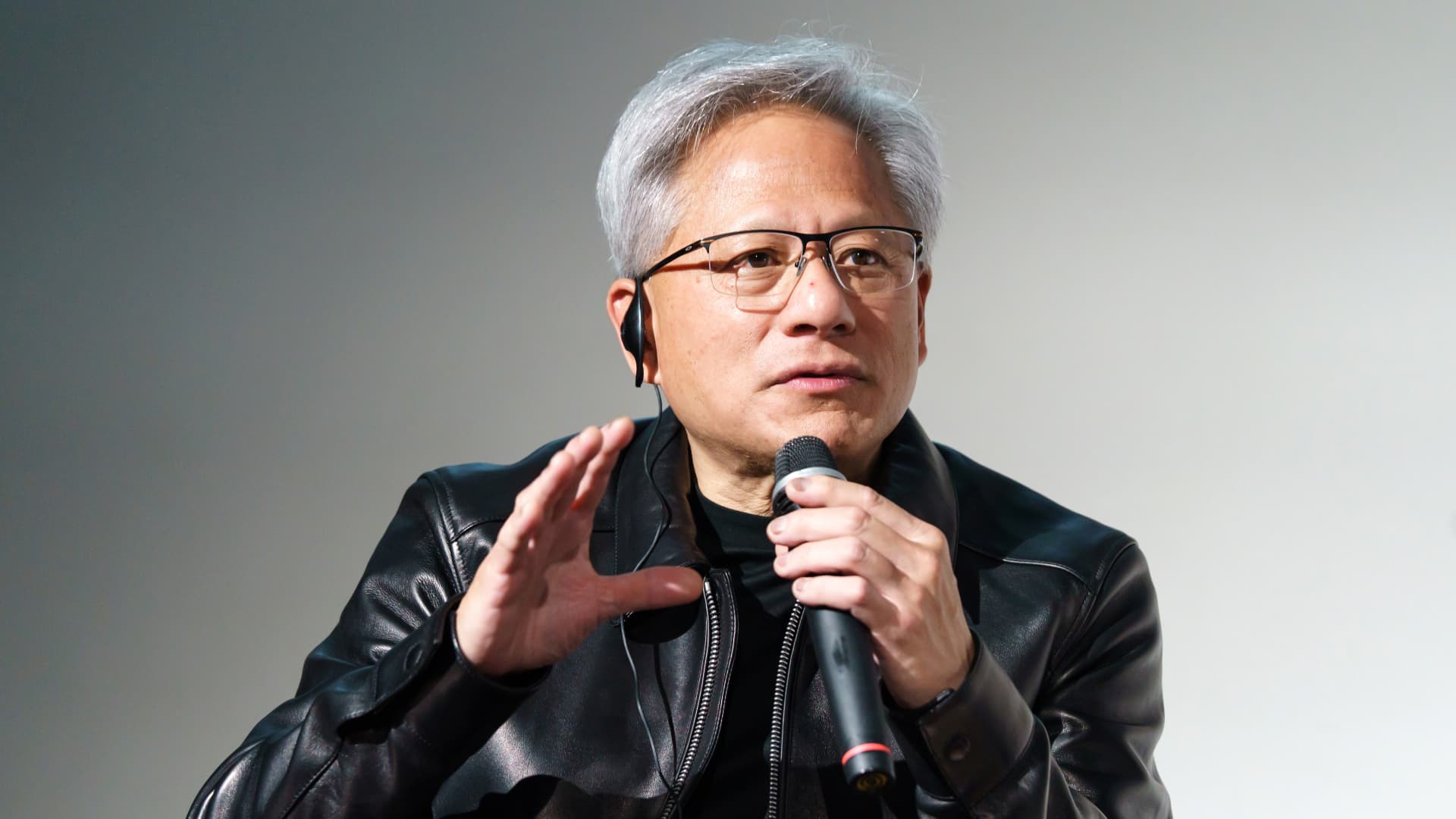
Chief Executive Jensen Huang said in a CNBC interview that technology chips had become an “investable asset class.” He described Nvidia compute as revenue-generating and argued that it can be transferred among customers and used across workloads.
Nvidia made a similar case in its announcement, saying its compute is broadly adopted, flexible and supported by its CUDA software ecosystem. Those are Nvidia’s reasons for treating compute as infrastructure that could attract long-term outside capital, rather than independently established measures of investment performance.
Goldman Sachs Chief Executive David Solomon said in Nvidia’s release that the group saw an opportunity to create credit backed by Nvidia compute. CNBC reported that Huang brought the financing concept to the Wall Street firms.
A financing ambition, with an open valuation question
The announcement comes as companies building AI capacity seek large amounts of money for data centers and hardware. CNBC reported that Moody’s warned in July that elevated AI capital spending was reducing free cash flow and leading some large technology companies toward heavier debt loads.
The proposed asset-class model also rests on a premise that remains unproven. CNBC noted that graphics processors have historically been regarded as hardware that loses value quickly, and that newer chip generations may call into question how much value earlier equipment retains. Nvidia’s MOUs outline an intended financing approach; they do not yet establish final funding structures or prove the long-term value of the equipment.
Readers can review Nvidia’s announcement for the companies’ stated terms and conditions.
This story draws on original reporting from CNBC.