
Monumental raises $32 million to bring bricklaying robots to U.S. sites
The Amsterdam startup plans to launch in the U.S. this year as contractors face labor gaps and housing shortages.
By Hana Yoshida · Markets Reporter
3 min read
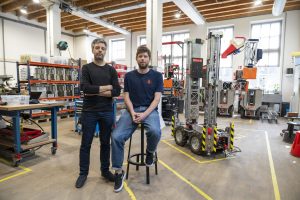
Monumental has raised $32 million to expand its construction robotics business and enter the U.S. market this year, Fortune reported. The Amsterdam-based company is trying to sell automation to builders as a subcontracting service, rather than asking contractors to buy costly machines upfront.
The Series B round was led by Khosla Ventures, according to Fortune. It follows a $25 million financing in February 2024 that was co-led by Plural and Hummingbird.
Founder Salar al Khafaji previously sold Silk to Palantir in 2016. He told Fortune that after leaving that company, he soon decided to build again and chose construction despite warnings from people who considered the sector a poor fit for venture-backed technology.
A service model for robot bricklaying
Monumental makes compact electric robots that drive themselves around job sites and build brick walls. The company presents itself to general contractors like a specialist subcontractor, quoting work in units builders already use, including per brick or per square meter.
Al Khafaji told Fortune the company is selling contractors “a wall.” Monumental provides the robotic crew and manages the work, while contractors use the bricks and mortar already planned for the project.
That choice is part of the company’s strategy for dealing with building rules. Al Khafaji told Fortune that by using approved materials rather than introducing new wall systems, Monumental avoids much of the code-by-code approval problem that has slowed other construction technology companies.
The company has more than 150 robots working on active job sites in Europe, Fortune reported. The new funding will support a larger European fleet, additional robot capabilities and the U.S. launch.
A difficult market for construction tech
Construction technology has been a hard sector for investors. Cemex Ventures reported that investment activity in the category fell 33% year over year, according to Fortune.
Several earlier attempts show the risk. Katerra, backed by SoftBank, raised more than $1 billion and sought to rebuild much of the construction supply chain inside one company before going bankrupt in 2021, Fortune reported. Australia’s FBR built a truck-mounted bricklaying robot arm that can place up to 360 blocks an hour, but Fortune reported that the machine costs nearly $6 million, requiring a large commitment from contractors.
Monumental is entering the market as builders face labor pressure. Fortune cited data showing construction accounts for 13% of global GDP while productivity has barely improved in 50 years. In the U.S., Associated Builders and Contractors has said the industry needs 349,000 net new workers in 2026, and Goldman Sachs has estimated the housing shortage at 3 million to 4 million units.
Al Khafaji told Fortune that even 10,000 robots a day would address only a small share of the shortfall. He framed the company’s role as filling unmet demand, a message that may matter in union-heavy U.S. markets and in an industry affected by tighter immigration enforcement, Fortune reported.
U.S. expansion plans
Monumental is targeting Texas, Florida, Virginia and Arizona for its initial U.S. push, Fortune reported, citing building activity and labor shortages in those states. Al Khafaji’s 18-month goal is to have a standing fleet in the high double digits to low triple digits across at least two states.
The company also plans to move beyond bricklaying into full facade work over time. It will enter a field that includes Gravis Robotics, which raised $23 million last November to add cameras and artificial intelligence to existing heavy equipment, as well as equipment makers including Caterpillar, Komatsu and Volvo, Fortune reported.
Global Market Insights has valued the autonomous construction equipment market at $10 billion in 2025, with annual growth of 7.9%, according to Fortune. Monumental’s bet is that builders will adopt robots faster when they can hire the output, instead of owning the machines.
This story draws on original reporting from Fortune.