
Mint starts producing Trump $1 coin for U.S. 250th anniversary
Treasury says the gold-finished coin will be released this fall as legal and political fights continue over Trump’s image and signature on U.S. money.
By Sofia Marchetti · World Affairs Correspondent
3 min read
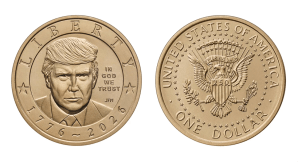
The U.S. Mint has begun making a $1 coin bearing President Donald Trump’s face for the country’s 250th anniversary celebrations, the Treasury Department said Wednesday. The coin adds to a broader fight over how far the administration can go in putting Trump’s image and signature on U.S. money.
Treasury Secretary Scott Bessent announced the coin on X, saying the Mint would strike the new $1 gold coin as the country marks 250 years of independence. Bessent said the coin would honor liberty and serve as a symbol of patriotism, and that it features Trump to celebrate American values and freedom.
The coin is scheduled for release this fall, according to Treasury. The department said the version shown Wednesday has a gold finish, rather than being made of solid gold.
Design approved with changes
The U.S. Commission of Fine Arts approved a final design earlier this year, according to Treasury. The version unveiled Wednesday differs somewhat from the design that received clearance.
The front of the coin shows Trump wearing a suit and tie. The words “LIBERTY” appear along the top, “1776–2026” runs along the bottom, and “IN GOD WE TRUST” appears in the center.
An earlier design for the commemorative coin showed Trump standing over the Resolute Desk with his fists down, according to materials from the U.S. Commission of Fine Arts.
Currency fight continues
The coin arrives as Treasury is also changing paper money to include Trump’s signature. Treasury said in March that new bills would carry Trump’s signature alongside Bessent’s, replacing the treasurer’s signature that has appeared on U.S. currency for about 165 years.
The first $100 bills with Trump’s signature began circulating around the Fourth of July, according to Treasury. That change has drawn scrutiny from lawmakers and a lawsuit challenging the administration’s authority.
Federal law bars the portrait of a living person from appearing on U.S. currency. Treasury has argued that the Circulating Collectible Coin Redesign Act of 2020, signed during Trump’s first term, gives the administration authority to make exceptions tied to the semiquincentennial.
James Rickher, an Oregon resident representing himself, sued in U.S. District Court in Oregon in late March. His lawsuit seeks to stop Trump, Bessent and other officials from allowing the Bureau of Engraving and Printing to issue currency carrying the image of a sitting president.
The case also points to Title 31 of the U.S. Code, which governs Treasury’s authority over coin designs. That law gives the Treasury secretary some discretion over imagery, while requiring “In God We Trust” and “Liberty” on the front and “United States of America,” “E Pluribus Unum” and the denomination on the back.
Lawmakers and voters weigh in
Congress has also taken up the issue. Rep. Jimmy Gomez introduced a bill that would prevent a sitting president’s signature from appearing on currency or securities, though it would have to pass both chambers and be signed into law to take effect.
Sens. Elizabeth Warren and Jeff Merkley questioned Bessent in an April letter about the reason for replacing the treasurer’s signature with Trump’s. An Economist/YouGov poll conducted in April found 59% of adults disapproved of the change, while 24% approved and 18% were undecided.
This story draws on original reporting from Fortune.