
McConnell absence clouds Senate push for Pentagon spending
Senate Republicans face tighter margins on defense funding as Mitch McConnell remains away and Lindsey Graham’s seat changes hands.
By Maya Lindqvist · Senior Technology Correspondent
3 min read
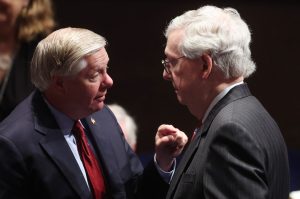
Sen. Mitch McConnell’s absence from the Senate is complicating Republican efforts to advance the Trump administration’s defense spending plans as the Iran war intensifies, Fortune reported. The delay matters because Congress faces a Sept. 30 funding deadline and Republicans are trying to move a large Pentagon package before the midterm elections.
McConnell said Sunday that he had been hospitalized after a fall and treated for pneumonia, ending weeks without a public update on his condition, according to Fortune. He has not said when he will return to the Senate floor.
McConnell chairs the Senate Appropriations defense subcommittee, the panel responsible for writing Pentagon funding legislation. His absence follows the unexpected death of Sen. Lindsey Graham, who served as a senior member of the Senate Appropriations Committee and chaired the Budget Committee, after an aorta rupture, Fortune reported.
Graham’s sister, Darline Graham Nordone, is expected to take his Senate seat Wednesday and serve the rest of his term, according to Fortune. That move reduces some uncertainty over Graham’s vacancy, but it does not resolve the immediate problem created by McConnell’s absence.
Defense bills face a narrow path
The Senate Appropriations Committee has not approved a spending bill for fiscal 2027, which includes a $1.15 trillion base for defense spending, Fortune reported. The Trump administration is also seeking a $350 billion package through reconciliation as part of a push toward a $1.5 trillion defense budget.
Reconciliation can allow legislation to pass the Senate with a simple majority of 51 votes rather than the 60 votes usually needed to overcome a filibuster. That makes Republican unity central to the administration’s plan.
Peter McLaughlin, a political science professor at the University of Rhode Island, told Fortune that Republicans face a difficult mix of midterm politics, internal disagreement over the Iran war and a funding package that needs party discipline. “It’s a very tricky situation right now,” McLaughlin said.
The war has added pressure to the spending fight. Fortune cited estimates that the conflict has already cost the United States $113 billion, while some public policy experts have projected total costs above $1 trillion. Fortune also reported that renewed U.S. and Iranian strikes have increased the administration’s urgency to replenish munitions, which have been reduced by more than half since the conflict began.
Panel math adds to the problem
Without McConnell on the defense appropriations subcommittee, Republicans and Democrats are split 14-14, according to Katherine Thompson, a defense and foreign policy scholar at the Cato Institute and former Trump administration Pentagon official. Thompson told Fortune that a defense appropriations bill is unlikely to clear the panel and reach the Senate floor under that split.
Thompson said the administration’s decision to rely on reconciliation has left Republicans exposed as the calendar tightens. She also pointed to Congress’ limited working schedule as a factor slowing the process.
Fewer than 30 scheduled Senate sessions remain before the midterms, and the August recess would remove a full month of time in Washington, Fortune reported. Senate Majority Leader John Thune could cancel that recess, a step Thompson said would show Republican commitment to passing the bills.
Thompson told Fortune she does not expect the Senate to pass the defense bill before the summer break. She also predicted Republicans and the Trump administration will fail to secure supplemental Iran war funding.
If Congress does not finish appropriations by Sept. 30, lawmakers could use a continuing resolution to avoid a funding lapse, Fortune reported. That would risk pushing the fight beyond the midterms, when control of the Senate could change.
This story draws on original reporting from Fortune.